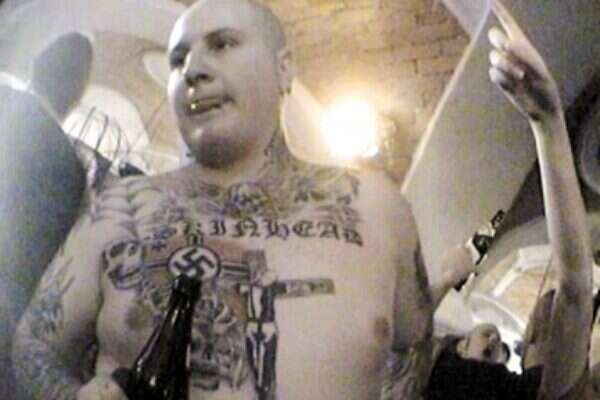
The skinheads-only party near his house would forever change the life of Thomas Kuban. On that summer day in 1997, Kuban was shocked to discover that neo-Nazis from the entire region had gathered for a concert near the village in which he lived. After recovering from his initial astonishment, the young journalist began to investigate. A few weeks later, he tracked down an expert on neo-Nazis who amassed an extensive collection of neo-Nazi music, or what is referred to in local parlance as right-wing rock. The man provided him with basic information, photocopied advertisements geared toward skinheads, and sent him information on their concerts. Kuban began to buy up more and more disks, read copious amounts of racist material, and attend concerts staged by neo-Nazi rock bands. Some of the concerts were legally authorized and organized by the far-right National Democratic Party of Germany (Nationaldemokratische Partei Deutschlands) the NPD. Other shows were held underground, or in back rooms of pubs or tiny concert halls or farms. Kuban, whose name is an alias, understood that what he was witnessing was a dangerous phenomenon that was being completely ignored by the press, the police, and the politicians. He decided to take upon himself the task of writing the message on the wall in hopes of cracking this underground scene. He believed that aside from the occupational challenge, he could slip into a journalistic niche that would enable him to reap financial benefits. After 15 years of risking his life while boldly covering dangerous assignments, including those that earned him prizes and awards but also adversely impacted his familys economic and emotional wellbeing, he decided to undertake what would be his journalistic swan songs a movie which was released early this year and a book titled Blood Must Flow: Undercover Among Nazis. The latter, which summarizes the assignment of his life, was released this week in bookstores. The title of the book was inspired by an anthem that was often song by Nazi storm troopers. A day after the premier showing of his film in February, I met with Kuban in Berlin. We talked for hours that day, and since then we have been in constant contact. Kuban, a round-faced 35-year-old with an orange-red goatee, made sure to send me neo-Nazi material, including CDs and songs. He also answered every question that was posed to him, though he was careful not to reveal any aspect of his identity. His real name, his address, and even his age remain a secret to me to this day. In a country where neo-Nazis have killed 180 people in the last 22 years, anonymity is his insurance policy. Dozens of aliases Shortly after that first concert near his house in 1997, Kuban began to lead a double life. During the day, he worked as a journalist writing stories about the racist music scene under numerous fictitious bylines. At nights and during weekends, he dug up information about skinheads. Music is the center of the neo-Nazi movement since it attracts the most youths, he said. Going to underground concerts while evading arrest by the police is one, huge adventure for them. During the concerts themselves, there is the adrenaline generated by the rock show in addition to acts that are against the law, like giving the Nazi salute, yelling Sieg Heil, singing outlawed songs doing all of these things without any police intervention. Unfortunately, this is the reality. Q: How does a regular citizen go about finding information about a neo-Nazi concert- When I started work on this project, there were some 20 nationalist telephones in Germany, recorded messages that would refer you to phone numbers of concert organizers. These messages were intended solely for activists. On the day of the concert, or the day before, I would call these numbers to confirm a meeting point, which could be at the parking lot of some supermarket. That is where an usher would be, and his job was to distribute notes with the driving directions to the actual concert location. Sometimes he would organize car pools or convoys of cars that would lead straight to the show. Sometimes they would send us to a second meeting point just to make sure that there were no policemen, or anti-Nazi activists, or journalists who were following us. Kuban aroused nary a suspicion. The telephone system has since been replaced by Internet forums, where he could operate freely under his various aliases. Over the course of his years-long investigative work, Kuban invented 40 different names which he listed meticulously and memorized so that he would remember which character he was playing at the relevant moment. He began to frequent legally staged concerts put on by the NPD. These shows were held in open, public venues, which was convenient for him since it would enable him to flee the scene easily if necessary. He stood out from the other skinheads because he had a full head of curly hair. Initially, he would introduce himself as a novice skinhead so that he could ask questions. The NPD provided him with an open door. Party activists were eager to maintain contact with me because they wanted to recruit new members, he said. The smaller organizations were much more suspicious. In March 2003, the German high court rejected an appeal to outlaw the party which was posing a threat to the countrys democracy. The NPD celebrated their victory by launching a new drive to recruit followers. It was then that they discovered the tremendous pull that music wielded among the youth of Germany. Kuban, who was already well-versed in the content of the songs, the various bands, and the neo-Nazi singers, blended in quite seamlessly. In time, he would amass a collection of 300 CDs. He formed relationships with many activists in the scene. He would learn by rote the racist lyrics and he would use an alias to write reviews of albums and concerts on neo-Nazi websites. In the fall of 2003, he decided to set a historical precedent. He would sneak into a neo-Nazi concert and secretly record what was happening. An acquaintance of his who occupied a senior position in this music scene in southern Germany revealed to him that he would be organizing another show in a French town just near the German border. The German skinheads would feel much safer there. This acquaintance also told him that a prominent rock group, Noie Werte (new values in German), would be performing there, along with another band whose name was kept secret. Kuban assumed that the band was Race War, which is very secretive about its appearances due to police investigations against it over alleged incitement to racism. Spiegel TV, a popular television newsmagazine, expressed interest in the story not just because of the ongoing investigation but also because the German news media diverted its gaze from Islamist extremists public enemy number one since the attacks on the World Trade Center to homegrown terrorists. In September of that year, the police arrested a neo-Nazi who planned to bomb a groundbreaking ceremony at a Jewish community center that was to be built in Munich. The producers of Spiegel TV refused to send a photographer or cameraman to the concert to which Kuban was invited. Two months prior, one of their camerapersons was beaten and hospitalized after showing up at a similar concert. Kuban, for his part, decided to jump into the swampy water. Q: Where does one buy a neo-Nazi uniform- At any army surplus store. These shops are also meeting points for young people, and that is where they are first introduced to other neo-Nazis. I chose a greenish pilot bomber jacket, because the black one just looked too scary to me. I bought black army pants, high-top boots, and a black shirt with a black and white collar, the colors that comprise the flag of the Third Reich black, red, and white (these colors are popular among neo-Nazis, because unlike the swastika, they are not banned by law). I passed on wearing a Wermacht uniform and white shoestrings for my boots, because those are worn by the really militant neo-Nazis. When I wore those clothes, I felt like a different person. I looked like a more solid, stronger person with that jacket, and I also walked differently and stood with a much wider stance. Q: Where did you find the recording equipment- Five days before the concert, I bought a tiny camera from the military affairs correspondent of ARD television. Two days later, I received a tiny, electronic recording device that I had ordered through the mail. On the day of the concert, I ran out to look for a cable. I ripped out the top button of my Polo shirt and cut a tiny hole in my jacket so that I could slip my camera in there without anyone noticing it. I attached the recording device to my belt. Underneath the jacket, I hid the cables, the adapter, and the batteries. I thought that they would pat me down to make sure I wasnt carrying a knife or brass knuckles, because neo-Nazis tend to gang up on each other and fight each other, especially the German and Austrian neo-Nazis against the Poles, who are Slavs and, thus, inferior in their eyes. It was obvious to me that if there were security checks at the entrance, I would have to turn around and go back. Undercover skinhead A few hours before the concert, Thomas parted ways with his previous identity at the barber shop. Of course, I went to a barber who didnt know me from before so that I wouldnt arouse any suspicions, he said. He was astounded, asking me numerous times if I really wanted to shave my head. This was a very difficult moment for me, when I realized that my curly hair would be gone for good. It was a humiliating moment, like when prisoners have their heads shaved. Kuban got into his car and drove off to the concert. In order to get into the spirit, he heard Nazi music along the way. One of the bands whose discs he listened to was Landser (the German word for mercenaries during the Middle Ages), a Berlin-based group that was one of the more popular among neo-Nazi youth who found their hate-filled, inciting lyrics particularly appealing. One of their songs is titled, Ambush the Enemy, which is based on old Nazi songs that called for the bombardment of Poland and England. They also sing Bomb Israel, whose lyrics end with a mocking Shalom. The groups members were arrested in 2001, and in 2003 they were convicted and sent to prison. This was the first time ever that a German rock group was deemed a criminal organization by the authorities. Thomas arrived at the hotel that served as the venue of the concert, aimed his camera, and hooked up the necessary cables. He was alarmed to discover that the equipment was not working. After a number of futile attempts to get the camera working, he drove to the parking lot meeting point. Behind in schedule, he received a note instructing him where to go. As he approached the concert hall, he met a television news crew that was capturing shots outside the venue. They fixed the bad connection that was plaguing the cables and hooked up the equipment to his body, using a flashlight amidst the darkness that shrouded the parking lot behind the local pub. At 10:30 p.m., Thomas arrived at the concert, which had long since started. It was clear to him that if his real identity was discovered, nobody could help him. Q: What was going through your mind at the entrance- I was scared every time I took a picture. It was clear to me that if they found me out, many of them would gang up on me and beat me and injure me badly, perhaps even try to kill me. I had no chance to flee the hall, and I had no contingency plan. I had to prepare as professionally as possible by making sure that all the equipment was in place and also by making sure my appearance was in order. I needed for people to see me as a neo-Nazi and for them to believe my cover story. I also had to be absolutely certain that everything would work. If I had a shred of doubt that I would succeed, I wouldnt be able to undertake this mission. Fortunately for Kuban, he arrived at the entrance with a group of neo-Nazis who knew the security guards. They were all allowed to enter without so much as a check. Thomas remained at the groups side, and what seemed like a split second later he found himself in the midst of a crowd of 800 screaming, sweaty neo-Nazis. I felt a huge relief, and still, each time someone looked in my eyes, I asked myself, Maybe this guy senses that theres something fake about me- I felt like I didnt belong, like Im a mole. When Noie Werte took to the stage, Thomas sang along. He memorized their lyrics, which seemed as if they were written with him in mind. I know your name, I know your face / youre not worth the fist, that will break your nose / what you always write is very logical, but you have to distort reality. This sophisticated language could easily be interpreted as a song against violence. When skinheads did their extended hand salute toward the stage, the charismatic lead singer-songwriter, Steffen Hammer, was careful to refrain from doing so in order to avoid breaking the law with which he had become intimately familiar. Hammer is a divorce lawyer by trade. The groups guitarist, Oliver Hilburger, spent many years as an auxiliary judge (In Germany, auxiliary judges serve on the bench alongside professional judges) before he was banned from the court when authorities determined that his bands work was tinged with Nazi overtones. One of their songs speaks of the old man from Spandau, the loneliest man in the word, an obvious reference to none other than Hitlers former deputy, Rudolf Hess, who served a life sentence in Spandau Prison. Kuban made sure not to spend too much time in one place so that nobody could later recall his appearance by gauging the angle from which the footage was shot. He sang loudly, but he was careful not to become too chummy with anyone. His conversations with people were brief, and they included racist comments, as was acceptable. When everyone danced wildly, he joined in, but he did not cross the line legally. He refrained from giving the Nazi salute and he did not join in during a rendition of the Nazi storm trooper anthem, Blood Must Flow. This was how he managed to shoot footage. Whoever sang also had to move around, he said. While Kuban filmed, everybody else sang. Sharpen your long knives on the sidewalk / Sink your knives deep into the flesh of the Jews / Blood must flow, thick and plentiful / We defecate on the freedom of this Jewish republic. Suddenly, a young, drunk, female skinhead jumped toward him, demanding that they dance together. Thomas refused, putting more distance between himself and the girl. He feared that she had a boyfriend, which would complicate matters for him. He was also worried that the equipment attached to him would fall if he were to engage in an aggressive dance. There were times he would retreat to the bathroom just to make sure the electronic equipment was working. In the middle of the concert, he received a text message from his friends who were taking photographs outside the concert hall. They needed to leave in time to get to the airport in Stuttgart, and the next morning they needed to reach a television studio in Hamburg. As he was getting ready to check in at the airport, Kuban remembered that he didnt have enough time to change into his normal clothing. Security personnel at the airport thoroughly searched the neo-Nazi before them. Only a portion of the footage was of sufficient quality, yet this was enough. They were aired on television the next day, and caused a stir. The neo-Nazis, who in public tried to lead normal lives, were fearful that their employers would see the broadcast and fire them. Internet forums were rife with speculation that the Israeli Mossad was behind the footage. 5,000 neo-Nazis in a park Security checks were tightened at the entrances to all neo-Nazi events. Metal detectors were used, cellular phones were confiscated, and those in attendance were filmed by closed-circuit television. Gradually, Kuban came into possession of tinier, more sophisticated equipment. He figured out how to evade the cameras and he continued recording with his own hidden camera. He grabbed footage of 25 concerts in eight countries across Europe without arousing suspicion. Since neo-Nazis travel to shows in groups, he was forced to join others. Once, when I traveled in the same car with other skinheads, we stopped at a huge gas station, he said. In the convenience store nearby, I saw a black guy doing some shopping, and I got scared. What will I do if they attack him- Q: What do neo-Nazis talk about with each other- They dont talk politics, but they do talk about famous concerts, albums, favorite songs. They listen to Nazi rock. I was thought of as one of the older fellows, so I would tell the younger ones about historic concerts of the past. After all, I knew more about the music scene than most neo-Nazis themselves. Kuban noticed many instances of anti-Semitism expressed by neo-Nazi bands. In one concert that was moved at the last minute from Bavaria to across the border with Austria, skinheads sang: In Majdanek, we made bacon out of the Jews, in Auschwitz every child knows, that the Jews exist only for heating. In the wake of the television exposes, more Nazi singers were put on trial. The police were asked to explain why officers were content to stand outside of the concerts at times they even wandered inside while ignoring the anti-Semitic contents of the songs. A controversy brewed in Austria after Kubans footage showed policemen there engaging in friendly chitchat with neo-Nazi performers. One female officer took photographs with them as a souvenir just before a concert. In the western German town of Kirtorf, a group of residents banded together in a bid to put a stop to the concerts. The authorities in Austria and Switzerland also banned a few shows. My job, though, wasnt to substitute the security services but to call the publics attention to this phenomenon, Kuban said. After all, these concerts were staged in small towns and villages where everyone in the neighborhoods were able to hear the music, but they didnt do anything. According to Kuban, neo-Nazis are gaining strength in the eastern part of Germany, where youth clubs are being shut down. The NPD offers cultural activities of a different nature, he said. They offer weekend nursery camps or far-right rock concerts, which at times are held in buildings bought by the party. They have perfected the method of recruiting youngsters through music. The party leaders disseminate their hate and preach xenophobia during these concerts. In 2009, I went to a Rock for Germany festival which took place in the city of Gera, he said. It was shocking. Some 5,000 neo-Nazis congregated in the municipal park for a concert that was totally legal. Most of them came to hear the star of the show, Michael Ragner. It is much more difficult to outlaw a concert organized by the party than a concert organized by a small, militant group. If the NPD is declared an illegal party, it will be impossible to organize such large-scale concerts. A multimillion euro industry Every year, 100 neo-Nazi albums are released in Germany. Concertgoers attend shows performed by 160 bands and 30 nationalist singers on a regular basis. In 2011, German intelligence agencies estimated that 91 neo-Nazi companies were active in the country, a 50-percent increase from five years ago. It is an industry that generates millions of euros. The record labels that release the albums hire experienced, savvy attorneys who vet the lyrics to make sure they do not violate legal statutes. Last year, the authorities banned the distribution of 103 albums whose content was deemed hazardous for the youth. In the time it takes to actually ban a specific disc, however, most of the copies are already sold, Kuban wrote in his book. Some of the record companies use the threat of a legal ban to encourage fans to buy quickly. The distributors of neo-Nazi music albums and films earn up to 40,000 euros per month. Their workforce is comprised solely of skinheads, and they contribute much to the scene. The owner of one of the largest content distributors, companies that are responsible for the delivery of CDs, films, and propaganda material, makes a ton of money, Kuban said. He drives a Porsche, and he even founded a customers club in which anyone that signed up would receive a free album every month. At that point, though, the neo-Nazis began to claim that he got rich off their backs and they accused him of helping the police, and they eventually organized a boycott of him. This phenomenon repeated itself often. People like him were assailed on the Internet and they were given nicknames like The Jews of the Scene, since the neo-Nazis claimed that they were getting wealthy off of them. In his book, Kuban describes the neo-Nazi industry, which includes an extensive network of tiny, hidden shops and large supermarkets geared exclusively toward skinheads. The small shops sell CDs and T-shirts. Patrons can quietly inquire as to the date, time, and location of the next concert. In one particular shop in the town of Wismar, he bought an album that was officially banned by German authorities due to its racist lyrics. One group that has run into legal trouble due to its lyrics is a rock band known as Kommando Freizler, which is named after a senior Nazi judge. Its repulsive songs are replete with Holocaust denial. The store clerk apparently trusted Kuban enough to show him the banned CDs, which he kept in a suitcase underneath the counter. He had just one copy of each CD. That way, if the police raided his store, he could innocently claim that this was part of his private collection, thus the authorities could not punish him for possession of the album. Kuban used his hidden camera to videotape himself buying the CD. The police were subsequently forced to act when the footage was released. Kuban even found neo-Nazi material in regular shops. In Dresden, he found shirts and hats with official insignia of neo-Nazi bands and the Ku Klux Klan in an army surplus store. The clerk offered to show him items with the colors of the SS. A local shop that sold arms also carried books about the SS and Hitler. While he leafed through the books, two customers entered the shop, policewomen in uniform who were doing their shopping on their own free time. Unlike the neo-Nazis who were the subject of his work, men and women who conducted themselves with relative personal freedom and made money doing it, Kuban spent years as a lone wolf who was fearful for his safety and on the verge of bankruptcy. In eight years, he spent 150,000 euros on hotels, rented cars, fuel, audio and video recording equipment, and a number of cellular phones. The articles that he sold covered just a small portion of his expenditures. Had his parents decided against allowing him to return home to live with them and lending him 20,000 euros, he would have quit long ago. In his book, he writes critically of the public television networks that ignored his work. In 2007, he risked his life by traveling to Hungary to secretly film a concert put on by the Holocaust-denying German singer Manfred Edelman. During the show, Edelman declared that this was the final battle against the Jewish pigs, but nobody wanted to air the footage shot by Kuban. Eventually, he despaired and gave up. At that moment, I was immediately relieved of all the nightmares that were coming to me on a nightly basis for years, he said. I dreamt of skinheads armed with batons who were chasing me. While they were coming after me, I wanted to run away but I couldnt move. At that moment, Id wake up. Last November, following the suicide of two neo-Nazis, police uncovered the Zwickau terror cell (or what was officially known as the Nazi Underground), a group of youngsters who were responsible for killing nine foreigners (eight of them Turks) and a German policewoman. A year before the breakthrough in the case, the neo-Nazi band Gigi and the Brown City Musicians released an album that included a song titled The Kabab Murderers, with lyrics exalting the deaths of the Turks. When the song was released, nobody in the German security services had an inkling that the murderers were perpetrated by those same people. The link between terrorism and neo-Nazi music momentarily roused the German news media from their slumber. Three heads of German intelligence agencies were sacked when mishaps in the investigation came to light. In his book, Kuban calls for the dismissal of the heads of German public television stations for committing what he views as journalistic malpractice: ignoring the investigation into the neo-Nazi scene. With a wig and sunglasses In every public appearance, Kuban wears a blonde wig, sunglasses, and a mustard-colored jacket. I hate wigs, he said. When we shot footage outdoors, it was terrible. Everybody was looking at me. Its very unpleasant to be the center of attention. Im used to being the one that sees other people instead of the one being seen. The films production was originally scheduled to take a year, but Kuban and his producer, Peter Ohlendorf (not an alias), could not find any television network or public foundation that was willing to financially support their project. Ultimately, it took five years to finish the film, which ended up forcing the two men into a 200,000 euro debt. In Germany, they had yet to find a distributor for the film, but after it premiered at the Berlin Film Festival, dozens of civic organizations and foreign festivals invited them to screen the movie. This year, the Israeli Docaviv Festival turned them down, but the filmmakers say it is important that an Israeli audience see it. Every year, we are inundated with hundreds upon hundreds of documentary films that are subject to approval by the Docaviv selection board, Sinai Abet, the artistic director of the Docaviv Festival, told Israel Hayom in response. The selection board chooses the appropriate films according to their professional judgment, and just a small number of films that are submitted actually get screened during the festival. I dont want to continue as a freelance investigative journalist, Kuban said. My dream is to get a fulltime job in this field for one of the newsmagazine shows on television, but I failed in this regard because there is no interest in lengthy, costly exposes of this sort. The big money goes to talk shows and sporting events. This coming year, I will finally have a great deal of free time. Q: If you quit, who will dig into what is going on in the neo-Nazi scene- I am afraid nobody will. It is work that takes up a lot of time and money, and it is also very dangerous.
Alone, among neo-Nazis
The amazing story of a German journalist who, for 15 years, infiltrated neo-Nazi concerts • But German television showed no interest in his shocking revelations • In an exclusive interview, he talks about the fear, the nightmares, and the disappointment.
Load more...