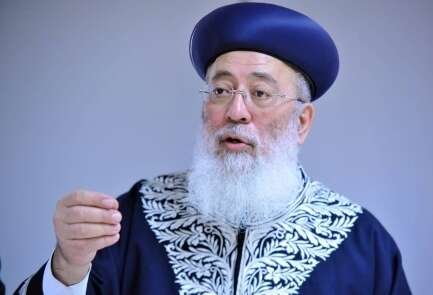
Sephardi Chief Rabbi Shlomo Amar will convene a conference next Tuesday for chief rabbis from around the country to unite in their opposition against state funding of non-Orthodox community rabbis. Amar intends to organize rabbinic activism against the government payment of salaries for non-Orthodox rabbis, a decision recently reiterated by the High Court after years of deliberation and negotiation. On May 29, Attorney-General Yehuda Weinstein announced that the state would implement a High Court decision allowing local municipalities to employ non-Orthodox rabbis if the specific community chooses to do so and the state would be required to fund the position. Along with the announcement, the state reiterated that the decision relates only to rabbinic salaries based on community needs, and that non-Orthodox rabbis would still have no bearing on matters of religion and Jewish law nationwide. Weinstein's announcement was actually the culmination of a process spanning nearly seven years, starting from the High Court's initial decision, in favor of Kibbutz Gezer Rabbi Miri Gold's petition - submitted by the Israel Religious Action Center (IRAC), the legal arm of the Israel Movement for Progressive Judaism (IMPJ) - to receive her salary as a community rabbi from the state, regardless of her non-Orthodox ordination. Gold is ordained by the Reform movement. In 2006, the High Court found in favor of the petition and ordered the IMPJ and IRAC to hold out-of-court negotiations with a government committee on religious affairs to reach an agreeable set of criteria for determining state allocations for non-Orthodox rabbis. The state submitted its reply only in March 2012, after years of delays, including a number of problematic aspects such as the obvious elimination of the term "non-Orthodox rabbis" from the criteria and in its place using the term "community leaders." The IMPJ and IRAC viewed the government's proposal as a failure of out-of-court deliberations and turned to the High Court again, which heard arguments in May 2012 and reiterated its 2006 decision regarding state funding for local rabbinic roles, even if they are non-Orthodox. Weinstein's announcement that the state would implement the policy was issued soon thereafter. Immediately following Weinstein's recommendation, on May 30, Religious Services Minister Yakov Margi (Shas) publicly expressed his opposition to the state employing non-Orthodox rabbis. He stated clearly that if he is forced to pay the salaries of non-Orthodox rabbis, he will ask Rabbi Ovadia Yosef, the Shas spiritual leader, to permit him to resign as religious services minister. Margi also attacked non-Orthodox religious streams, saying that, "the Reform movement is guilty of hundreds of years of assimilation. The Reform movement thinks it is bringing in a new spirit to Judaism, but in practice it is an evil wind." Amar on Monday commented on his upcoming conference telling the ultra-Orthodox radio station Kol Berama, "We are gathering all the chief rabbis in Israel. We will come out with one massive and clear voice against this shameful phenomenon of [non-Orthodox rabbis] referring to themselves by the title of rabbi, while they actually uproot the foundations of Torah."
X
שיתוף כתבה
Wars of the Jews: Orthodox fight Reform, Conservative recognition
Sephardi Chief Rabbi Shlomo Amar organizes conference next Tuesday against state decision to pay salaries of non-Orthodox rabbis • Conference comes after attorney-general announced last month he would implement High Court decision to pay salaries.