Efrat rabbi brings gender equality to synagogue
Zemer Hazayit is an Orthodox congregation with a partition, but with equally sized sections giving both genders direct access to Holy Ark • Women also read the haftarah • Rabbi says this is a sign of the times -- and in line with Jewish law.
, עודכן
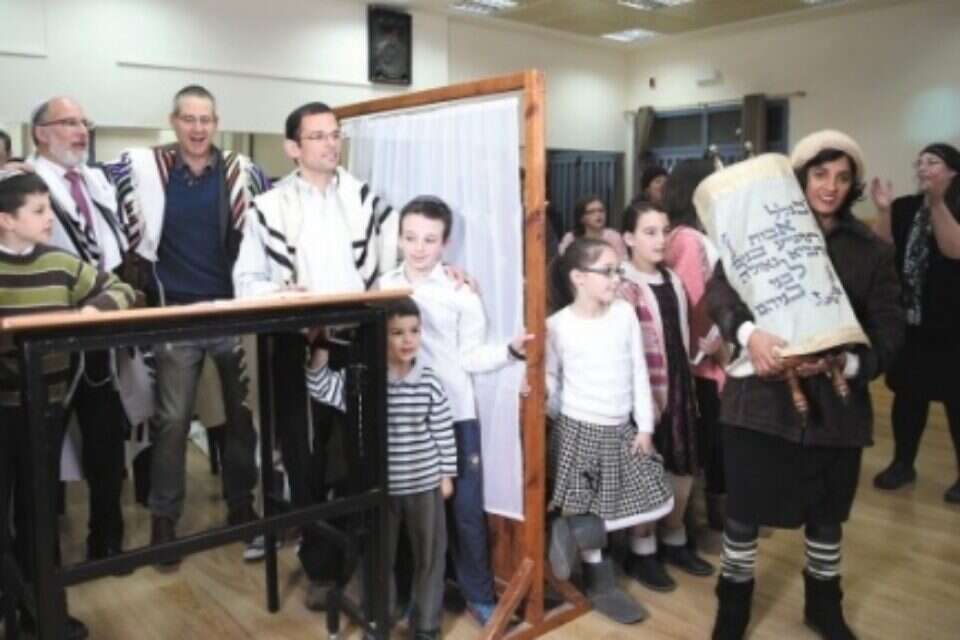
In this congregation, women hold the Torah scroll and place it in the Holy Ark, read the weekly haftarah (a selection from the Prophets read in synagogue on Shabbat, holidays and fast days) and give a sermon, and girls sing Anim Zemirot, the hymn at the end of the service. You could be forgiven for thinking this is the Women of the Wall or a Reform congregation in the U.S., but the truth is that this congregation is Orthodox and is in the national-religious community of Efrat, in Gush Etzion.
Over the past several years, egalitarian congregations have become more common in Israel. In these congregations, women assume more prominent roles during prayers and hold official duties. The Zemer Hazayit Congregation has gone a step further, some would say a step too far.
Although the synagogue has a traditional partition between the men's and women's sections, the two sections are next to each other, rather than the women's section being behind the men's or on the second floor, as is common in Orthodox synagogues. The partition runs across the sanctuary space, creating equally sized sections all the way to the Holy Ark, allowing the women to place the Torah scroll back in its place at the end of the service.
"It all started 10 years ago," says the leader of the congregation, Rabbi Dr. David Bollag. "A group of women wanted to let women say a Dvar Torah [sermon] but the community's main synagogue refused, so they created a new congregation."
Bollag is convinced there is no contradiction between the modern practices and Halachah (Jewish law): "There is a partition; the Holy Ark is in the center; a man always takes the Torah scroll out; when it is time to place it back inside the Ark, a man goes to the end of the mechitzah [partition] and hands it to a woman, who then takes it through the women's section all the way back to the Holy Ark."
Bollag says that Halacha does not prohibit women from holding the Torah scroll, even while they have their periods. For the haftarah reading, a man recites the blessings and a woman reads the portion with the traditional cantillation. According to the congregation's website, a "womens Torah reading, by women, for women, is held every few months."
Bollag insists this supposedly unorthodox approach is very much in line with Jewish tradition, and cites the late Shas spiritual leader Rabbi Ovadia Yosef to prove this point.
"He [Yosef] ruled, in response to a question, that the Talmudic prohibition on women singing does not apply to prayer services," Bollag says. "Girls under age 11 also sing Anim Zemirot, and this is permissible. As the synagogue's rabbi, I believe it is extremely important to be on solid halachic footing."
According to Bollag, Efrat Chief Rabbi Shlomo Riskin approves of the way Zemer Hazayit conducts its services.
"This is a balancing act between innovation and our obvious affiliation with Orthodox Judaism," Bollag says.
Dina Mann, a member of the synagogue's board of directors, says there is a way to combine the modern world with halachic tradition.
"I am a project manager in a software company and have a dominant presence there," she says. "So the contradiction between women's day-to-day lives and their synagogue experience was not lost on me. I felt that I was left out of the synagogue rituals, with women sitting in the back or in the upper floor rather than participating in the services. The separation from the spiritual world was painful to watch for myself and for many other women."
The congregation has come under fire for its departure from tradition.
"We have been called 'Women of the Wall' and 'Reform' and other names," Mann says. "They say it behind our backs but people tell us, 'We heard people calling you this and that." According to Mann, she and other women decided to establish the congregation "not because we wanted a women-only group, but because we wanted create a more familial atmosphere."
Bollag says the establishment of the congregation was a natural development because women take active roles in every other realm of modern life.
"Women are integrated politically, socially and economically, but when it comes to their synagogue, out of all places, they are denied that status," Bollag says. "We want to change that. This revolution doesn't mean every synagogue should do what we did, only that we can continue to offer this option and that those who disagree with us accept us."
טעינו? נתקן! אם מצאתם טעות בכתבה, נשמח שתשתפו אותנו