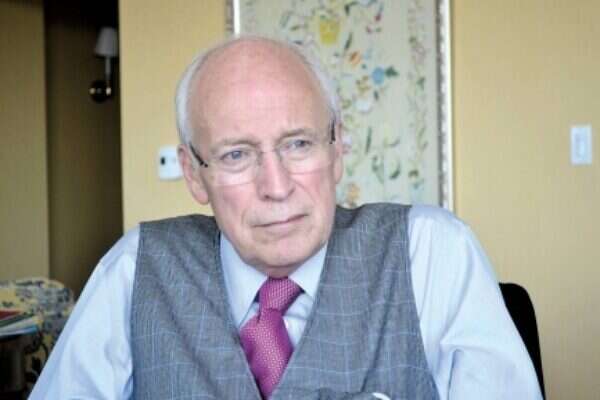
For eight consecutive years, Dick Cheney served as vice president to U.S. President George W. Bush and was a partner in decisions that stirred the world. In a special Rosh Hashanah interview with Israel Hayom, he discusses everything: his support for Israel, his disappointment with Palestinian Authority President Mahmoud Abbas, the attack on the Syrian nuclear reactor, the missiles that Saddam Hussein fired at us -- and President Barack Obama, whom he says has displayed inexperience, weakness and a lack of leadership. When I heard that Israel had attacked the Syrian reactor and totally destroyed it, I was happy and excited
I don't recall any of my colleagues in the American administration displaying any lack of satisfaction from the fact that this reactor was destroyed, Cheney said. A few weeks ago, Cheney's autobiography, In My Time: A Personal and Political Memoir, was published, and rocketed to the top of U.S. best-seller lists to become the talk of the town. The former vice president suddenly returned to the media spotlight, and his book provided plenty of headlines. He was a guest on all the major talk shows. The book revealed what really went on behind the scenes in the administration's decision-making process, beginning with the 9/11 attacks and ending with the anti-terror wars on two fronts: Iraq and Afghanistan. The book also strengthened Cheney's standing as one of the most important figures in current U.S. politics, who has been swept into the whirlwind ahead of the 2012 elections. When Cheney talks, Americans, not just Republicans, listen. We met Cheney and his daughter Liz, who helped him write the book, at a hotel in California's San Fernando Valley. From the windows of the seventh-story suite we could see an incredible view of the hills and vineyards. Cheney, relaxed and restrained, elegantly dressed, looks and speaks like the perfect gentleman. He's already seen it all, having spent 40 years at the heart of American politics, eight of them in the White House. A few days before the interview he was praised by one of the leading Republican presidential candidates, Mitt Romney, who said, He could have been president. In my eyes, he was the perfect vice president. if I am elected president, I want a Cheney-type person for vice president. And what's important to us is that Cheney is a real friend of Israel. So is his daughter Liz, who filled a number of State Department posts and afterwards established Keep America Safe, a group of conservative pundits who support Israel. We followed North Korea's nuclear activity, Cheney says, and we feared it would supply nuclear weapons to countries that support terror and that these weapons would reach the terrorist organizations and be used against the U.S. In April 2007, I participated in a meeting at the office of National Security Advisor Stephen Hadley. Two Israelis were sitting on the sofa: One was Mossad chief Meir Dagan. He pulled out pictures and documents from his briefcase and spread them across the coffee table. For an hour he showed us pictures of a building erected in a desert section of Syria in a place called Al-Kibar. It was a nuclear reactor. In his book he supplies additional information. More came from satellite photos and other intelligence agencies. We had a picture of the North Korean man who was responsible for producing nuclear fuel, standing alongside the chairman of the International Committee for Nuclear Weapons Inspection. And in yet another photo, the North Korean man was seen visiting the mysterious Syrian building. There was no doubt that the building in Syria had been built exactly like the one in North Korea, which was used to produce plutonium for nuclear bombs Pyongyang built for itself. The Syrians tried to conceal what they were doing: They hid the reactor in the wadi. But there were all the signs there that this was a reactor to be used for military means. There were no connections to electric power lines, so they couldn't say it was meant for peaceful use or to create electric power. Meir Dagan did outstanding work, and with the aid of our Israeli friends, the picture was absolutely clear. The Israelis clarified that this was a copy of the North Korean reactors, that it was a graphite-moderated gas-cooled reactor. We already knew from our intelligence that there was cooperation between North Korea and Syria dating back to 1977, but we didn't have any clear evidence that the Syrians were developing nuclear weapons. Now we knew. The more the evidence piled up, he tell us, a serious debate developed in the White House and among the heads of the administration: What do we do? The Israelis wanted us to destroy the reactor in an air attack. I recommended that we indeed do that. I thought that it was a proper and moral thing for us to do, because it would teach the Syrians a lesson that it wasn't worth their while to get into this business of developing nuclear weapons. It would also teach the North Koreans a lesson that when we warned them not to cross the line and distribute nuclear weapons around the world, we meant it. And it could also echo among the Iranians that we don't want them to develop nuclear weapons, otherwise -- they already knew what otherwise' meant. That's why I recommended that we destroy the reactor, but there was some vacillation because we had invaded Iraq based on intelligence that Saddam Hussein had weapons of mass destruction, and in the end it turned out he didn't. Ultimately the president decided not to attack. He didn't feel comfortable with that option. I say in the book that he decided to find, as he called it, a diplomatic option' to be based on turning to the U.N. The question arose whether Israel would make do with a diplomatic solution. I was certain that if we didn't launch a military action, Israel would attack on its own. I'm glad that's what they did. When the reports came in that its planes had destroyed the reactor, I was very excited. So essentially the U.S. gave Israel the "green light" to attack- Vice presidents are not allowed to give a foreign country a green light to attack
I certainly supported the idea and had long talks with the Israelis. And after the attack I don't remember hearing any senior U.S. officials expressing their dissatisfaction with the fact that the reactor was destroyed. The Syrians themselves, by the way, did not complain; they were too busy covering up the crater that you left in the sand, to cover up whatever happened there. So what is your stand on the possibility of attacking Iran's nuclear program? You said in the U.S. that you estimated Israel would attack. Of course I can't know what Israel plans to do there. But I remember when it attacked the Iraqi reactor at Osirak in 1981. This was outstanding work by the Israeli Air Force, and you were heavily criticized for doing so. But in 1991, after Operation Desert Storm (the Gulf War), I thanked the Israelis for destroying the Iraqi reactor, an act which only made it easier for our forces to operate in a war a decade later. Without your attack, Saddam Hussein could have developed his nuclear plans even further. Your ambassador in Washington, David Ivry, kept the note of thanks that I gave him in the embassy." I think the Iranian nuclear program is no less worrisome than the Syrian one. But what the Israelis will do in the end, I have no idea. Attacking the Iranians is certainly an option. In his book, Cheney takes aim at various U.S. secretaries of state. Our State Department has a tendency, he writes, to carry out preventive concessions (as opposed to preventive attacks) against bad guys in the international arena, with the hope that they will be nice enough to change their behavior. If they had historical proof that these concessions work, great. But history proves the opposite: that concessions made under pressure or naivete only damage national security. During the first Gulf War, when you were serving as Defense Secretary, you advised Israel not to react to the missiles Saddam Hussein was firing at it. Didn't this hurt our image in the region, namely, our national security- Saddam Hussein believed that if he could drag you into the war, he could present the dispute as being a confrontation between Iraq and Israel, and not as it really was, a confrontation pitting him against a wide international coalition which came together after he invaded Kuwait. If you had entered the war, it might have caused some Arab countries to drop out of the coalition. We were certain Saddam Hussein would use chemical weapons against you, and he had such weapons and threatened to use them, and if that happened nothing could stop the Israeli reaction to it. But he didn't use them because he apparently feared the reaction. On U.S. relations with Israel, he says, Our administration had two opinions in terms of our relations with Israel: The first said that we should keep our distance from you, because of our Arab allies. The second opinion, which I supported, was that we should as open and honest as we could be with Israel. To coordinate everything with you, to worry about your security. I had many conversations with your then Defense Minister Moshe Arens. In my book I write that he asked that we give the Israeli Air Force our code to identify friends or foes, so that if it became necessary you could attack Iraq. We didn't agree to do so, but from the moment Saddam started firing Scuds at you, we gave you satellite warnings of the firing of missiles. We told General Norman Schwarzkopf, who was in command of the operation, to attack the launchers in western Iraq, and we flew in Patriot missile batteries to you. There was a problem with Schwarzkopf, who served as the commander of the Central Command fighting in Iraq, while Israel, from our standpoint, was in an area closer to the European Command. It took us a little while to understand the importance of attacking the launch sites and assign this the required air power. In the end, I personally called Schwarzkopf, and after I complimented him for the outstanding job he was doing in Iraq, told him that he must understand that the president believed attacking the missile launchers in western Iraq was a task of supreme strategic importance. Schwarzkopf reinforced the air power that operated there. It didn't completely eliminate the launchers problem, but I called Arens every day and updated him: At such-and-such a time we sent 48 F-15s to hunt for launchers, or that at another time, there were 12 planes involved. There was a problem with Patriot missiles, which weren't meant for intercepting missiles, and sometimes hit the Scuds but didn't destroy them. They were able to divert the Scuds' direction from Tel Aviv to other populated areas [Ramat Gan in particular]. We also used special forces in western Iraq, whom we sent to go after the mobile Scud launchers. The firing didn't totally stop, but the number of missiles launched was reduced. Israel stayed on the sidelines, and that was important to all of us. Only after the war ended did I understand how close we came to Israel joining the attack. A senior Israeli told me that at one stage, Israeli commandos had already gotten into their helicopters and were about to be sent to western Iraq. The operation was canceled, he said, only after one of my phone calls with Arens, who was convinced about the level of efforts we were making to hunt down the Scuds. Cheney was defense secretary for four years (1989 to 1993) under President George H.W. Bush before spending eight years as vice president under his son, President George W. Bush (2001 to 2009). He is considered by many to have been the strongest and most influential vice president who ever served in that position. He has incredible experience, and when it comes to the Middle East, he is very knowledgeable, personally knows most of the players and is aware of developments. While we speak here, the Palestinians are on their way to the U.N. to seek recognition as a state. What do you think of that move- I must say that I am disappointed with what Mahmoud Abbas is doing. I met him, and he's definitely better than his predecessor, Yasser Arafat. [In his book, Cheny writes about Arafat: To be honest I always doubted if Arafat could ever be a partner for peace.] I am very impressed by Prime Minister Salam Fayyad, who is investing a lot in establishing economic and trade frameworks with Israel. I think the path taken by Abbas now, the effort to establish an independent state via the U.N., is not productive. It's a bad idea which will not advance the goal of achieving peace. I assume that ultimately if it comes down to a vote in the U.N. Security Council, the U.S. will use its veto. The Israeli-Palestinian dispute is a very important issue to the U.S., and we played a central role, in all the administrations in which I served, under four different presidents. I can't remember a single administration which did not devote a lot of time and energy to this problem, and did not try to promote an agreement. But I do not share the opinion that if that problem is resolved then all the rest will fall into place. I simply do not buy the rationale that the Israeli-Palestinian dispute is at the heart of the motivation of global terrorism, of organizations like Al-Qaida and Islamic Jihad. From our standpoint the main problem is the battle against global terrorism, and to defend the U.S. we must act everywhere, in every location. In my book I describe a meeting I had with former British Prime Minister Tony Blair, in which I made clear to him that the Bush administration would, without a doubt, be involved in efforts to achieve an agreement between the Israelis and the Palestinians. But this would in no way come at the expense of our continued battle against terror. Like Blair, I was not convinced that the moment this problem is solved, the wind will be taken out of the sails of world terror. I believed then, as I do now, that even if the Israeli-Palestinian dispute is resolved tomorrow morning, the terrorists will find another justification for continuing their jihad. The Bush administration, and yours, advanced the idea of democratization of the Arab world. How do you see the developments that were first called the Arab Spring, and are now perhaps turning into the Arab Winter- I'm worried because I don't know how it will turn out, and what direction it will take. Without a doubt, this is a historic moment. There are amazing developments. But there are different players, and we have to stay away from generalizations. It's hard to judge until we see who replaces the governments in the different countries, in which the protest movements toppled the previous leadership. Who will lead the new governments, and what kind of governments will they be? What kind of relations will they develop with the U.S., with Israel? When you see the footage of the Egyptian mobs breaking into the Israeli embassy in Cairo it's worrisome. I don't know, and my friends in the region don't either, and they live there. What did you feel about the pictures of President Hosni Mubarak, your former close ally, being taken to court in Cairo in a cage- I see him as a friend. The ties to the U.S. were important to him, as was the peace with Israel. In my book I single him out for praise, noting how after Saddam Hussein invaded Kuwait, I went to Cairo at the president's request to start to build the coalition, and Mubarak asked me immediately: 'How can I help-' And help he did. Egypt joined the coalition and opened its skies to American planes. I had two critical stops then, Egypt and Saudi Arabia. In Egypt, Mubarak was a friend. In Saudi Arabia, the defense minister was Prince Sultan, also a friend. When I think about it, perhaps not that much has changed in the region. Twenty years have passed. As defense secretary I worked with Field Marshal Tantawi, and now he's back again. In Saudi Arabia there was Crown Prince Sultan, and now he's defense minister is again. I'm the only one not serving, and instead I am writing books. Even so, the impression is that the current administration is abandoning its friends, that President Obama turned his back on Mubarak. You write in your book that Obama's policy is dangerous because he is withdrawing U.S. troops from combat zones like Afghanistan, and is abandoning those forces that helped the U.S. in its war on terror. I'll put it more carefully: I think the present administration is acting in a way that is raising doubts in the minds of some of our friends regarding the strength of our commitment to them. We, the Bush administration, left Obama the idea of reinforcing our troops in Iraq and Afghanistan, and he followed it at first. It worked well in Iraq. It also started to work well in Afghanistan. And then here comes the president, I think it was last spring, and announces that he will withdraw the troops from Afghanistan by the middle of next year, which is several weeks before the presidential elections, and contradicts the professional assessments of the army's commanders. The only conclusion I can reach is that he's doing it for political reasons. It's all tied to minor political matters ahead of the presidential campaign. Obama, as president, is the commander in chief of the army -- and he's working against their interests- To put it simply, what it all means is that the administration is making decisions based on economic considerations, ahead of the elections. And if they have to find a way around a plan that the military leadership committed itself to they simply sacrifice them, for their own narrow interests. I saw President George Bush make some tough decisions, frequently unpopular ones, like sending forces to Iraq and Afghanistan. I don't think this man (Obama) can, and is not ready to, make such decisions. Cheney has no inhibitions when it comes to criticizing Obama, especially when it comes to foreign policy and national security. Like many in the Bush administration, Cheney found himself under attack, especially at the beginning of the Obama administration, about several subjects, including the go-ahead the Bush administration gave for using torture methods like water-boarding when interrogating ticking bomb terrorists to get vital information. There was also the Guantanamo Bay Detention Center, a facility Obama promised to empty, in the name of human rights, but which is still being used. When President Obama got to Cairo, he declared that our response -- the response of the U.S.! -- to the Sept. 11 attacks was exaggerated, Cheney says. That's how a U.S. president talks, and in a foreign country to boot? Our friends in the Middle East, and around the world, see his policy and understand it reflects weakness and inexperience. Obama has not proven that he has the ability to provide genuine leadership. About two weeks ago you and the American people marked a decade since the Sept. 11 attacks. You were in office when that attack happened, and you made decisions in what you refer to in your book as the fog of battle. How does a leader make decisions in such a situation- First of all, according to intelligence. We know that at the beginning of a battle there's a great deal of information, only part of which is correct. In general, intelligence information is vital. Look, we were accused -- President Bush and I -- of a conspiracy theory, of simply sitting at the White House and plotting the invasion of Iraq for no good reason, except that it was based on incorrect intelligence. What can you do when the intelligence simply was wrong? Look at Clinton's speeches during his term as president, and he based them on the same incorrect intelligence. And there were congressional decisions, then with a Democratic majority, and there too they based them on incorrect intelligence. So the problem is indeed the intelligence, and true, sometimes it's wrong, but sometimes it's right. And the fact that the intelligence was wrong regarding weapons of mass destruction in Iraq doesn't mean it's also wrong when it comes to, let's say, the Syrian reactor. Take Admiral Nimitz, as an example. In June 1942, Admiral Nimitz commanded the U.S. forces assigned to block a Japanese invasion of Midway. He got information on movement of the Japanese fleet to Midway, deployed his forces accordingly and won the battle -- even though shortly beforehand the intelligence failed miserably regarding the Japanese attack on Pearl Harbor. On Sept. 11 there were many correct and incorrect reports. You have to stay cool. We fortunately had practiced scenarios of an all-out attack on the U.S., and we formulated procedures for emergency situations, in which the president and vice president would go. That experience served us well on Sept. 11. Cheney is also criticized, mainly by the Democrats and the U.S. liberal media. His critics sometimes compare him to the evil Darth Vader of Star Wars, who is eventually revealed to be the father of hero Luke Skywalker. Cheney, using his characteristic sense of humor, said the comparison makes him look good. You have to have a thick skin to wake up every morning and serve as vice president and make difficult decisions, he said. The Darth Vader thing doesn't bother me. At home we'd laugh about it. But even his critics admit that he's a sharp, witty guy, with impressive capabilities. Some two weeks ago he shocked the media and the American political system when he suggested that Secretary of State Hillary Clinton should already start running against Barak Obama for the presidential nomination now, ahead of the 2012 elections. She's a very powerful woman, Cheney said, and I think she's the most talented member of the Obama administration. So if the administration's achievements are so thin -- and right now it doesn't look very good, considering the economic situation -- maybe the seed will be planted there for primaries on their side, too. I think that will only be good for the U.S. Former president Bill Clinton quickly responded. I'm very proud of my wife, he said. I'm always very thankful when someone praises her. But I also am very impressed with the political talents of Vice President Cheney, who can still hit any target. He simply wanted to sow some division in the Democratic camp. Hillary Clinton did not announce she was running against Obama, but the episode only emphasized Cheney's status as a political oracle: When he talks, everyone listens, mainly the Republican presidential candidates seeking his support. Cheney's backing of any of them could be decisive. So far he has remained neutral. I support a Republican candidate against Obama, he has said in his American media appearances, but he has refused to name which candidate. Cheney fulfilled his job for eight years, while suffering from a heart condition. He doesn't try to hide the problem and in his book he describes in detail his first heart attack, at age 37. Today he is in excellent health. What do you want to tell the Israeli people on the eve of the Jewish New Year- I have visited Israel many times, and I was very satisfied with my work with the Israeli decision-makers. Israel has a very important role in the Middle East, and the Americans feel very friendly toward Israel -- we see Israel as a democratic sister-state. Israel is a very important ally; we have common interests and values. I want to tell the Israelis: Don't be led astray by the policy of the current administration. It doesn't reflect the opinion of most Americans, who support you." And, with a thin smile, he adds, And they [the current administration] won't be there forever.
Cheney: I was happy when Israel destroyed Syrian nuclear reactor
Former Vice President Dick Cheney details the attack on the reactor in Al-Kibar, saying: Meir Dagan did outstanding work • "I have no idea what the Israelis will do in the end, but attacking the Iranians is certainly an option.
Load more...