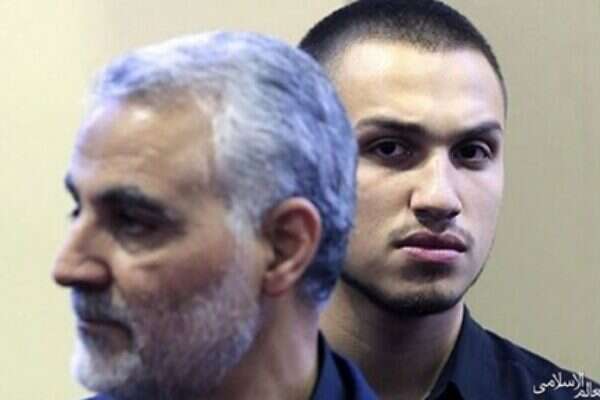
Hezbollah vowed revenge on Sunday after a convoy carrying Jihad Mughniyeh and a number of other Hezbollah members was, according foreign reports, targeted by an IAF helicopter missile strike in the Quneitra region of Syria, near the border with Israel in the Golan Heights. Hezbollah leader Hassan Nasrallah was quoted as saying that Hezbollah's response to the reported Israeli strike would be "harsh." There were conflicting reports about the number of fatalities in the incident, which took place around 2:30 p.m. on Sunday afternoon. Some reports said a number of Iranian Revolutionary Guards members were among the dead. Rebel websites in Syria reported at least 20 people were killed in the strike. According to Hezbollah, six of its members were killed, including Mughniyeh (the son of the late Hezbollah military commander Imad Mughniyeh, who was reportedly assassinated by Israel in Damascus in February 2008) and Mohammed Issa, known Abu Issa. Some reports named Iranian field commander Abu Ali Tabtabai as a fatality in the strike. A Hezbollah official was quoted as saying, "Hezbollah's leadership cannot accept the blow it received from the Israeli strike and the killing of [Hezbollah] officials. Hezbollah's leadership will choose how and when to respond to this criminal Israeli attack." The Hezbollah-run al-Manar news channel said the reported Israeli strike suggested "the enemy has gone crazy because of Hezbollah's growing capabilities and it could lead to a costly adventure [by Israel]." As usual in such circumstances, Israel did not issue an official response to the reports on Sunday's incident. However, speaking to Japanese Prime Minister Shinzo Abe on Monday, Prime Minister Benjamin Netanyahu remarked that like Japan, Israel has known the pain of war. "Israel strives for peace with all its neighbors, but we know that in a region like ours, peace and security are intertwined. If we don't defend ourselves from those who threaten us, threaten to attack us, and actually do it, then there will not be peace. Israel insists on having the right defend itself from those who commit acts of terrorism against its citizens and attack them."
Jihad Mughniyeh was born in 1989, making him either 25 or 26 at the time of his death. Hezbollah officials said Mughniyeh was one of the Hezbollah fighters tasked with overseeing operations in the Golan Heights.
He was a Hezbollah student activist at the Lebanese American University, and took on a more prominent role after the death of his father. His photograph has been taken with Nasrallah and with the powerful Iranian Gen. Ghasem Soleimani, highlighting his prominence within Hezbollah.
Jihad Mughniyeh appeared in public for the first time a week after his father's death to pledge loyalty to Nasrallah. "We are with you and we will go wherever you go," he said at the time, while wearing a Hezbollah military uniform in front of thousands of mouners. "We will never leave the battlefield and we will never drop our guns, we answer for you Nasrallah."
According to Western intelligence officials, Jihad Mughniyeh was a ruthless terrorist who was in charge of infrastructure in the Golan Heights region that had already been used for attacks against Israel in the past. The officials said Mughniyeh had planned a string of attacks against Israel in the Golan Heights region, including rocket fire, terrorist infiltrations, roadside bombings and anti-tank strikes. His goal was to kill both Israeli soldiers and civilians, the officials noted.
Following Sunday's incident, Hezbollah reportedly raised its alert level on the Israel-Lebanon border and began concentrating its forces there.
UNIFIL peacekeepers intensified their patrols on the Israel-Lebanon border on Sunday night, local sources said.
Shortly before the reported Israeli strike in Syria on Sunday, the Lebanese military said IDF soldiers fired smoke bombs at Lebanese soldiers in the border village of Ayta ash-Shab. According to reports, seven Lebanese soldiers were hurt by smoke inhalation. The Lebanese military filed a complaint with UNIFIL about the incident, calling it a "flagrant violation" of both Lebanese sovereignty and U.N. Resolution 1701, which brought the Second Lebanon War to an end in August 2006.
Lebanese media outlets speculated that this incident was meant to distract Hezbollah ahead of the later strike in Syria.