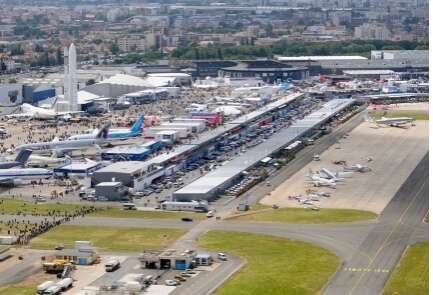
Despite the much-discussed recent cuts in the defense budget, it appears that Israel's defense industries have already learned the lessons of past cuts. Israeli defense companies are investing a lot of resources in marketing, and currently maintain an average 20:80 sale ratio, with exports far outweighing domestic sales. With an impressive scope of contracts and orders, at least for the big names (Israel Aerospace Industries has about $10 billion in orders and Rafael Advanced Defense Systems has about $5 billion, for example), the big defense companies are shining their wings, so to speak, ahead of the biggest marketing event in the aerospace industry -- the Paris Air Show -- scheduled to begin on Monday. The Paris Airshow, held every two years at the Le Bourget Airport, was founded in 1909 and it remains the most important aircraft exposition in the world. This year, the event will be marking its 50th anniversary. Some 2,200 companies are expected to present their wares in the upcoming exhibition, bringing thousands if not tens of thousands of aviation systems from around the world, as well as 150 commercial airliners, military aircraft and drones that will crowd the exhibition grounds. The engines of 40 aircraft will thunder above the French airport in a breathtaking flight display. (From experience, I can say that the display can literally take your breath away.) The expected 325,000 visitors will be able to put their hands on the cutting edge in technology and engineering. The highlight of the show will undoubtedly be the Russian entry -- this year the Russians are bringing back the Sukhoi Su-35, their advanced and wonderfully maneuverable fighter jet. This aircraft will be joined in the sky by veteran European aircraft like the Dassault Rafale and the Eurofighter Typhoon. The Americans usually put up a good fight with their F-15 and F-16, but this year they decided to travel light, with almost no air display (except the Boeing 787 Dreamliner, which has been suffering from serious battery problems lately). Several thousand visitors will also enjoy unusually delicious meals from Paris' finest restaurants, which will be served at the various booths at the exposition. Exquisite French wine will complete the experience and possibly nudge certain private individuals and government bodies to unburden themselves of several millions of dollars in the process. Even though everyone knows that the actual sales contracts aren't physically signed at the air show, it is a well-known tactic to keep signed deals secret and unveil them at the air show, because that is where these deals are guaranteed to receive the most attention. The bitter rivalry between Boeing and Airbus feeds off these types of unveilings, as each of these aviation giants tries to one-up the other and prove that it has the biggest order backlog. The main reason to visit the Paris Air Show -- other than the trip to Paris, of course -- is the networking, mingling and meeting of people who could someday turn into contracts and profits. The fact that the "whole world" will be there, makes the big investment of participating in the show worth every penny. "Participation in the Paris Air Show is equivalent to 100 business trips per year," say industry experts. Even if the focus has now shifted toward Asia, due to the global economic crisis, there is still only one Paris. Combat proven Traditionally, Israel attracts a lot of attention at the Paris Air Show. We are a superpower at this exposition. Beyond our technological prowess, innovation and creativity, Israel does have one major drawback that actually turns into a huge advantage in Paris: Most Israeli aviation systems have actually been tested in battle. They are what is known in the industry as "combat proven." Israel doesn't sell theories, usually, but rather weapons systems borne out of real operational necessity that have actually been used in the battlefield. This advantage yields results: Israel's total defense exports in 2012 were estimated at $7 billion (according to data provided by the Israel Export & International Cooperation Institute). Of this figure, the exports intended for commercial use (commercial unmanned aerial vehicles, for example) have increased significantly (by about 30 percent in comparison to 2011) and reached $1.3 billion. "For us, 2012 was a banner year in terms of the scope of new contracts that we signed," boasts Yossi Weiss, the CEO of Israel Aerospace Industries, in a special interview with Israel Hayom. "We reached almost $5 billion in new contracts during an especially difficult time. That is an all-time record. One of the biggest deals was with the Brazilian government, to supply them with Boeing 767-300 tankers." Under the deal, IAI will convert commercial Boeing aircraft into military, multi-mission tanker and transport aircraft that will serve the Brazilian air force. "In winning this contract we beat out both Boeing and Airbus, and we will supply [Brazil] with an entirely new aircraft, built on an old platform," he explains. Another important contract that Weiss describes as "a done deal" is the manufacturing of wings for the F-35 stealth fighter jet, which will be joining the Israel Air Force as well in about three years. "Israel Aerospace Industries received an order from Lockheed Martin to manufacture 811 pairs of wings for the F-35, and we have already begun working on infrastructure and production. We will begin manufacturing in less than a year," Weiss says. "This is a deal that could reach $2.5 to 3 billion, and this is just the first phase. For us, it is a real technological challenge. There are not a lot of companies in the world that are capable of doing this. We didn't win this contract because of our good looks," says Weiss. Another Israeli company -- Elbit System--Cyclone -- announced at the beginning of last week that it has delivered its first advanced composite component for the F-35, to be used in the aircraft's fuselage. Israel Aerospace Industries, which entered the bonds market in 2007, managed to raise 1.2 billion shekels in debt in January of this year, after its 1 billion shekel bond offer was over-subscribed three-fold. "Our business is going strong," Weiss says, content. "We paid out our first dividend last week, and we won't be requiring a haircut anytime soon." In order to retain full manpower of 15,500 employees, the Israel Aerospace Industries maintains constant dialogue with the Defense Ministry. "We will try to make sure than none of our central projects are affected," the CEO says of the recent budget cut. "We are trying to enter new markets. We are stepping up marketing efforts in new markets such as Africa as well as southeast Asia. We are making enormous efforts to avoid layoffs, and we don't have any plans to lay anyone off at this stage. We will have to take difficult operational steps in order to make ourselves more efficient, and we will postpone some planned activities, but our financial strength will allow us to keep going." Elbit Systems is also currently dealing with the defense cuts. "The Israel Defense Forces are a major and central client for Elbit Systems," says CEO Bezalel Machlis. "Elbit's strategic partnership with Israel's defense establishment is the source of the company's strength. We have developed an intimate relationship with the IDF, founded on a lot of openness, understanding the client's needs and extensive cooperation." "Over the years, we have made sure that we stay relevant to the changing needs of our clients, both in Israel and abroad, and it is this ability that allows us to customize a variety of solutions for the specific needs of our clients, with the IDF being our chief client, even today, when the budget is shrinking," says Machlis. "For example: the demand for simulations goes up especially when the need arises to cut back on training hours and fuel; maintenance is being outsourced; the issue of refurbishing becomes more relevant when belts are tightened, and more. Traditionally, our sales to the IDF make up about a quarter of our total sales, with a similar portion of sales going to the U.S., Asia, Pacific countries and South America." Iron Dome and UAVs Fourteen Israeli companies are taking part in the Paris Air Show this year. The group includes nine companies that are all presenting innovations in Israel's official booth. Among them are giants like Israel Aerospace Industries, Rafael Advanced Defense Systems and Elbit Systems that are planning to operate private booths at the show. The so-called "Israeli booth" is actually a virtual booth this year. Budget cuts have had an effect here as well. Unlike previous years, there will not be an actual physical booth representing Israel at the exposition. To save about $1.5 million it was decided not to erect a joint booth this year, like the ones built in previous years by the Israel Export and International Cooperation Institute. Having a physical booth in previous air shows actually took a lot of the responsibility for security, hosting foreign delegations and handling the media off the companies' individual shoulders. One of the reasons for the decision not to build a booth this year was also the absence of the Israeli company Aeronautics Defense Systems from the 2013 show. The company had been one of the main participants in previous exhibits, and its absence in large part obviated the need for a booth. "Beyond the financial savings," says Ofer Sachs, CEO of the Israel Export and International Cooperation Institute, "there is also the issue of how the industry would like to be perceived by the beholder. During this period of cutbacks we are spending less money on extravagant displays, but we are still trying to ensure that the prominence of the Israeli industry at the Paris Air Show is not diminished." So there is no booth, but what will there be instead? There will be a large "yard" on the exhibition grounds where all the systems will be displayed -- aircraft, UAVs, missiles and more, with the big companies -- IAI, Elbit Systems and Rafael -- presenting their wares at private booths meant for entertaining potential clients and holding meetings. Israel Aerospace Industries also owns its own booth at the exposition -- a booth that the company purchased in the 1970s -- where it will display its products' capabilities. The rest of the companies will share one of the enormous permanent structures with hundreds of others companies from all around the world. To borrow some terms from today's internet lexicon, the exhibit in the shared structure will ensure exposure, but not clicks. Vying for attention among the sea of companies will not be easy. Sachs mentioned Israel's prominence at the show, and if there is one Israeli system that is bound to become a prominent exhibit at the air show, it is the Iron Dome missile defense system. The defense system will be presented by Rafael Advanced Defense Systems. Even though this will not be the system's first public appearance, its stellar performance during the recent Israeli clash with Gaza militants -- November's Operation Pillar of Defense -- is bound to ensure that Iron Dome will be the center of attention. "This kind of attention is more media-oriented, and less practical," says Oron Orion, Rafael's marketing vice president. "We are talking about a brand name, and I am convinced that today there is not a single person working in the defense industry anywhere in the world who is not familiar with the name Iron Dome. However, this defense system was built with a very specific threat in mind, and most of the world's countries do not face this specific kind of threat. That is why I am expecting plenty of curious interest, but not so many buyers." As for the debate surrounding the Iron Dome system's performance level, Orion is very decisive: "If someone wants to claim that the defense establishment lied regarding the results of the most recent use of the Iron Dome system, I won't even get into an argument with them. That is too low of a blow. I would like to focus people's attention on the system's contribution in two different areas that have been proven beyond any debate." "One area is that Iron Dome allowed the [Israeli] decision makers to make rational decisions. It removed the aspect of public pressure (that would have resulted from civilians having been hit by missiles had the system not provided near-complete civilian protection) and allowed the military to operate with its head, rather than its gut. Try to compare the decision making process of Operation Pillar of Defense and the decision making process in 2006 during the Second Lebanon War and you will find the proof of what I am saying," Orion explains. "The second area of Iron Dome's contribution is the enormous financial savings it provides. The system protected against far more than property damage, not to mention loss of lives. It was thanks to Iron Dome that at least two or three inevitable military incursions into Gaza were avoided. That, in itself, covers the development and manufacturing costs of the missile defense system." Rafael Advanced Defense Systems will also present its second-layer system of missile defense -- David's Sling -- designed to protect against midrange missiles. The first functional second layer systems are expected to be delivered to the IDF by the end of the year, Orion promises. The David's Sling system is designed to cover the gap between Iron Dome's range of defense -- short range missiles -- and the range covered by the long-rage Arrow systems. Alongside the missile defense systems, Elta Systems -- a subsidiary of Israel Aerospace Industries -- will be presenting its newest multimission radar, designed to detect and locate aerial targets. The radar, in various sizes (derivatives of the Arrow system's Green Pine radar) also serves the Iron Dome and David's Sling systems. Elta issued a statement saying that this particular radar has already been ordered by 50 different clients. At the air show, Rafael Advanced Defense Systems will also unveil for the first time the SPICE 250 -- a light (125 kilogram), precise electro-optics guided bomb that can reach a range of 100 kilometers (62 miles). This is one of the most sophisticated additions to the SPICE (Smart, Precise Impact, Cost-Effective) family alongside the SPICE 1000 and the SPICE 2000, which have been customized especially for the modern battlefield. "Today's battle is asymmetrical," Orion explains. "Today there are smaller, more spaced out targets. An F-16 fighter jet, for example, can carry four times the number of bombs when carrying the SPICE 250 -- up to 16 bombs -- and take care of more targets, be they stationery or moving. They are smaller and cheaper, and as I've mentioned, extremely precise." Another important product is the UAV. American consulting firm Frost and Sullivan has ranked Israel first in the world in UAV exports. According to the firm's findings, between the years 2005 and 2012, Israel exported UAV systems worth $4.6 billion, while the scope of American exports by large companies like General Atomics (maker of the Predator) and Northrope Grumman (maker of the RQ-4 Global Hawk and X-47B) stood at about $2-3 billion in the same time period. UAVs are used to serve a wide range of purposes, starting with observation, intelligence gathering and control and expanding into tasks like relay communications, satellite communications, offensive operations and attacks. Frost and Sullivan analysts expect the demand for UAVs around the world to dramatically increase in the near future, quadrupling itself in the coming decade. The demand is spurred by Israeli successes in operating UAVs in Gaza, Lebanon and other arenas as well as their successful performance in Afghanistan and in Iraq (where Israeli-made UAVs were operated, among others). It is against this backdrop that Elbit Systems will unveil its new flagship UAV -- the Hermes 900. Elbit is a veteran manufacturer of UAVs, with years of experience, and is situated along with IAI at the forefront of the industry. IAI is the pioneer in Israel in the manufacture of UAVs, with a wide range of products in various sizes and designed to complete different tasks. The IAI aircraft range from "personal" UAVs designed for surveillance all the way to large aircraft designed to carry out strategic operations, like the Heron, and the enormous Heron TP. IAI-made UAVs are sold all over the world, and the company is considered to be the leading company in the industry. Elbit System's Hermes 900 is unofficially designed to compete with IAI's Heron, which is used by the IDF. Frost and Sullivan report that a large portion of Elbit's exports in the UAV industry are made within the framework of a project with the British army, called Watchkeeper (in conjunction with the international French company Thales). The Hermes 900 was built on the basis of the operational lessons learned by the Hermes 450, which is used extensively by the IDF for intelligence missions, border security and routine security. The Hermes 900 has a wide range of advanced capabilities, including long flight capability, altitude of up to 30,000 feet and the ability to carry heavy payloads. The UAV's unique build allows it to carry a wide range of different payloads, and to exchange between them rapidly when needed. Elbit Systems announced this week, ahead of the Paris Air Show, that it has recently signed a $50 million to supply a country in the Americas with Hermes 900 UAVs. This is the third order of Hermes 900 drones after the IDF and Chile. The aircraft will be used for security operations, and it will be equipped with ground control stations, advanced electro-optic payloads and a satellite communications system. Speaking of UAVs, Elbit Systems EW and SIGINT-Elisra will unveil in Paris an electronic warfare system designed to operate on UAVs. The system which will be used for defense and will improve the UAVs' survivability, relies on the Elisra's experience in developing similar systems for a range of operational platforms (fighter jets, helicopters and cargo planes) for clients in the Israel Air Force and around the world. Incidentally, not every exhibit at the Paris Air Show will be military-oriented. The Music model of a defense system designed to protect passenger planes from shoulder-fired missiles will also be unveiled at the show. Elbit issued a statement saying that the Music system will be installed on passenger planes starting soon, and that it is the only platform of its kind in the world that has FAA approval (as a product of approval by Israel's Civil Aviation Authority). Comprehensive solutions Israel Aerospace Industries will also present for the first time a civilian system with the potential to become a runaway success. The system is called "Taxibot" and, as its name implies, it is a robotic vehicle designed to taxi planes to the runway. Currently, planes taxi themselves using their own engines using up expensive fuel and emitting unnecessary pollution. The Taxibot is designed to prevent all that waste and pollution. The big innovation of the Taxibot (as opposed to the existing towing vehicles) is that the pilot of the plane controls the Taxibot, as though he or she were operating the plane itself. This greatly diminishes the pressure on the front brake when the plane needs to stop. IAI served as the main contractor on the Taxibot development project, in cooperation with Airbus and Lufthansa. The system is manufactured in France by a company called TLD, and immediately after the Paris Air Show it will be transferred to the airport in Frankfurt for a series of field tests. According to early estimates, the taxi system could save an airport like Frankfurt's 20 million tons of CO2 emissions per year as well as $6 billion in fuel costs. The Taxibot system is compatible will all types of planes, and does not require any adjustments when being transferred from aircraft to aircraft. It takes up no space on the aircraft itself either. In addition, it reduces the risk of foreign objects from the runway being sucked into the engines. This year, IAI's Paris Air Show exhibit is themed "comprehensive solutions" -- not a dramatic title, but unique and very meaningful, says Weiss. "Until today, we have been marketing system components and even full systems, but we never put the emphasis on a comprehensive solution for the battlefield. We manufacture all the sensors, we know how to meld information into singular products and we have all the platforms: satellites, mission aircraft, balloons, fighter jet systems, UAVs and ground sensors." "All the different systems are linked, and together they provide a comprehensive, precise picture in real time. Using various weapons, we can come full circle rather rapidly, almost online. This platform in its entirety provides the military force continuous persistent intelligence and ultimately, the ability for total domination. The integration between the different systems is intimate, and response is operational. That, in broad terms, is also the IDF's approach. Rafael Advanced Defense Systems is also presenting a similar approach with its Shooter to Sensor project. Beyond the use of sensors, the approach relies on electro-optic systems like the Lightning and information processing systems like ImiLite -- a multisource, multitask imagery intelligence system that, using advanced algorithms, ultimately spits out a complete and accurate picture. The shooter part of the approach relies on the Spike family air-to-surface missiles "at the precision level of one pixel," as Orion describes it. The image battle At the end of the day, the demand for Israeli defense industry products is determined by Israel's image in the world, among other factors. "We don't sell to public opinion; we sell to countries," Orion says decisively, adding: "The state of Israel makes decisions based on other considerations -- mainly cost vs. benefit and political considerations. Obviously it is easier to sell to friendly countries. Everything depends on relationships, levels of defense cooperation and export licenses." "Israel Aerospace Industries has a very positive image in the world," says Weiss. "We are well respected in the technological and creative realms as well as our ability to supply the goods. Therefore, even at times when Israel's image in the world is not at its peak, like it is now, it almost doesn't affect us." Machlis argues that the defense industry serves as a kind of counterweight to balance out the erosion of Israel's image in the world. "We have been bestowed with the privilege of sometimes serving as ambassadors of this country through the business we conduct abroad. Elbit Systems maintains business relationships with many countries across the globe, and in this way serves as a kind of bridge between Israel and other governments, armies, leading manufacturers and other bodies." Sachs sums up: "Exports are not influenced by the anti-Israel sentiments in the world. The global market is suffering from the current economic situation, especially in the area of defense purchases, which are essentially government purchases. Because of the global financial crisis, governments are turning off the tap and that, of course, will affect the numbers."