Israel received its fifth Dolphin-class submarine, the INS Rahav, at a ceremony in the German port city of Kiel on Monday. The ceremony was attended by Israel Navy Commander Maj. Gen. Ram Rothberg, Defense Ministry Director-General Maj. Gen. (res.) Udi Shani and other Israeli officials. To celebrate the handover, Israeli and German officials broke a bottle of champagne on the submarine's bow. The submarine is expected to arrive in Israel in 2014, after undergoing a number of steps required to make it operational. The Rahav is considered one of the most advanced submarines in the world. The Defense Ministry said the new submarine was the most expensive item it had ever acquired for the Israel Defense Forces. According to foreign reports, the submarine has 10 torpedo tubes capable of launching missiles carrying nuclear warheads. Israel's fourth Dolphin-class submarine, the INS Tannin, is expected to arrive in Israel several months before the Rahav. The Tannin was supposed to reach Israel in 2013, but its arrival was delayed a few months and it is now expected to get to Israel at the start of 2014. A ceremony marking the handover of the Tannin was held in Germany last year. In February 2013, then-Defense Minister Ehud Barak signed a deal with Germany for the construction of a sixth Dolphin-class submarine. Each Dolphin-class submarine costs around half a billion dollars. One-third of the cost is paid for by the German government. Dolphin-class submarines are considered to be multipurpose vessels capable of carrying out a diverse range of missions. These submarines are the long arm of the Israel Navy, and, according to foreign reports, provide Israel with second-strike capability in the event of a nuclear conflict, making them an important element of Israeli deterrence. Israeli submarines conduct intensive covert missions from Israel's shores on a daily basis. Meanwhile, Prime Minister Benjamin Netanyahu said on Monday: "Iran is continuing its nuclear program. It has yet to cross the red line I presented at the United Nations, but it is approaching it systematically. We cannot let Iran cross it." Speaking at a Likud-Beytenu meeting at the Knesset, Netanyahu also referred to the situation in the Gaza Strip. "There is an effort to renew attacks against us and breach the quiet that was achieved following Operation Pillar of Defense," Netanyahu said. "We are monitoring [the situation] and prepared for all scenarios. We are bolstering the IDF's strength and we won't allow our citizens to be harmed, not in the north and not in the south. It needs to be clear to all forces in Gaza: We won't permit a drizzle of rockets into Israel's cities. We will respond with much greater strength."
X
שיתוף כתבה
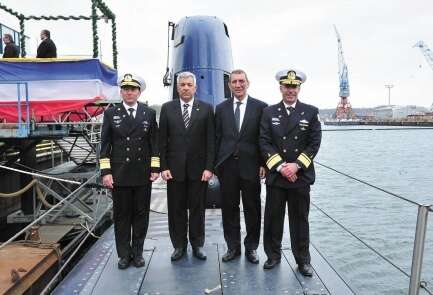
Israel receives fifth Dolphin-class submarine from Germany
The INS Rahav is expected to arrive in Israel in 2014 • According to foreign reports, Dolphin-class submarines provide Israel with second-strike capability in event of a nuclear conflict • Prime Minister Benjamin Netanyahu: Iran has yet to cross red line, but it is approaching it systematically.