As elections in the U.S. take center stage worldwide, domestic party primary elections for leading the New National Religious Party end with Naftali Bennett, 41, defeating veteran MK Zevulun Orlev, 67. A late night tally Wednesday revealed Bennett earning 70 percent of the votes and Orlev conceding defeat. The official results gave Bennett 23,645 of the votes; Orlev 11,501 and 79 for Yehudah Cohen. Upon losing the election, Orlev congratulated Bennett and told him that he would be available to help the party in the upcoming Knesset elections. Orlev promptly announced his departure from politics. After the results were announced, Bennett said "Anyone who thought religious Zionism had ended its historical role was proved wrong this evening something new has begun in Israel." From 3:00-10:00 p.m. on Tuesday, 168 ballot boxes were made available for the 54,000 members of the New National Religious Party. Bennett was perceived as representing a new approach and platform, while Orlev represented the old guard. Bennett served as the director-general of the Yesha Council, the umbrella body of Jewish communities in Judea and Samaria, and was a high-tech entrepreneur. He also founded the right-wing advocacy group Yisrael Sheli (My Israel). Orlev was elected to the Knesset in 1999 on the National Religious Party (NRP) list. After his re-election in 2003, Orlev was minister of Welfare and Social Services and became chairman of the NRP after MKs Effie Eitam and Yitzhak Levy left to form the Renewed Religious National Zionist Party, which later merged with the National Union Party. The NRP was dissolved before the 2009 elections and was reformed as the Bayit Hayehudi ("The Jewish Home"), with Orlev taking second place on the party's list. Bayit Hayehudi was founded by a merger of NRP and other small religious Zionist parties and led to the current New National Religious Party. Orlev is also currently co-president of the international Mizrachi (Jews from Arabic countries) movement. Both candidates cast their votes in their residential cities, Bennett in Ra'anana and Orlev in Jerusalem. As he cast his vote, Orlev said "My spirits are high. I feel as if religious Zionism and its organizations, youth movements, adults and women have embraced me. And I hope this is expressed in the vote." The New National Religious Party drama is not over yet. Party members will return to the polling stations next week to choose their list of Knesset candidates. The list of potential MKs is expected to reflect the battle of the old and new guard within the party, with a chance for new secular candidates to make it into the list this time around.
X
שיתוף כתבה
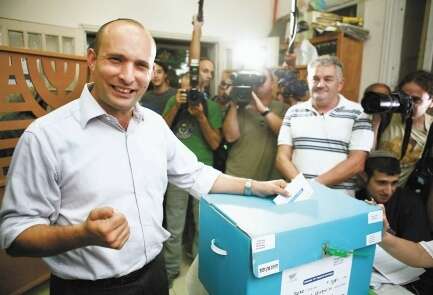
Changing of the guard at national religious party as Bennett wins
Naftali Bennett beats veteran MK Zvulun Orlev in the vote for chairmanship of the Bayit Hayehudi faction within the New National Religious Party • Orlev resigns • Party members will return to the polling stations next week to choose their Knesset list.