The decision to pardon two incarcerated criminals in exchange for information on a missing soldier was made by Prime Minister Benjamin Netanyahu, Justice Minister Yaakov Neeman and senior defense and justice officials, a source involved in the negotiations revealed on Monday. Majdi Halabi, a Druze soldier from northern Israel, disappeared in 2005, as he was on his way from his home to a Haifa army base. In the seven years since he went missing, Israel has carried out two large-scale prisoner swaps with Hezbollah and Hamas in exchange for captive Israeli soldiers, but neither organization claimed to have Halabi in its custody. A few years ago, an Israeli NGO even offered a $10 million bounty in exchange for information on Halabi. His family maintains he is still alive. The pardon deal was negotiated by David Meidan, the same mediator who worked on securing the release of Gilad Schalit from Hamas captivity last year. The source, a senior justice official, revealed the details of a deal struck last month between the Justice Ministry's pardons department and a prisoner serving a life sentence for murder. The prisoner, 60-year-old Amos Nahum, has already served 22 years of a sentence that had been reduced to 33 years. Under the deal, Nahum's cellmate, 62-year-old Alias Dali who is about to complete his 16-year sentence for drug dealing, will be forgiven a heavy fine that he is obligated to pay as part of his sentence. The source added that when the initial pardon deal was signed, it was not yet clear that a third party Mordechai Moshe, 44, who is serving a double life sentence for murder was involved. Moshe was supposed to supply the other two with information on Halabi in exchange for money and a promise to take care of his mother. The source said that there was no direct negotiation with Moshe, whose reliability is in question. "The prisoner with whom the deal was signed approached us, telling us he had information regarding a missing soldier. It was decided to give his claim a chance, as it appeared to have a basis of truth. The pardon was only to be granted in the event that the body was in fact located. The state minimized the risk," the source said. On the price that the state was willing to pay, he said: "The compensation is reasonable and as low as possible. We don't need to mention the high price we have paid in the past for prisoners or bodies of missing soldiers." It also emerged that the prisoners had referred to the missing soldier as a "product" in an infuriatingly worded written agreement between themselves. According to their agreement, Moshe vowed to supply Nahum with "the H.B. (human body) product" in exchange for financing for his legal defense. In addition, the agreement required Nahum to supply Moshe with "money for the prison commissary for the entire duration of his sentence and to provide Moshe's mother with a stipend." Attorney Boaz Kenig, who represents Moshe in his Supreme Court appeal, said, "Moshe changed his demands at every meeting. Among other things, he demanded a ballistics test for every weapon he allegedly used to kill the victims, and demanded that if the bullets pulled out of the victims did not match the weapons, the state would be compelled to release him and pay him $100,000. I believe that if he exercised good judgment, he would reveal the location of the body immediately." Meanwhile, Halabi's family was preparing for the wedding of the missing soldier's brother, scheduled for June. Should the body be recovered, they would have to postpone the wedding. The wedding has already been postponed once before, when another brother was killed in a car accident last year, just before the weddings previous date. "On Sunday, we were contacted by Defense Ministry officials," said the soldiers father, Nazmi Halabi. "They told us that there was information regarding Majdi's burial site, and they were telling us so that we wouldn't learn about it from the media and be surprised. I gathered that no search was underway, and that the information was still being verified." "The media reports shook us to the core," he said. "Majdi's mother nearly collapsed when she heard that her son could be dead, even though no body has been recovered. As far as we are concerned, our son is alive and we believe and expect him to come home safely with the other missing soldiers." The mother, Fahima Halabi, said that she did not believe that her son was dead. "I am convinced that Majdi is alive. Call it a mother's intuition. But I am very anxious that they tell me it is Majdi, and that is why the entire family and I are under immense stress. I believe this will all amount to nothing." The soldier's cousin, Jamal Halabi, voiced his outrage, telling Israel Hayom, "We are furious. Convicted felons cannot be allowed to dictate the lives of an entire family. This was an irresponsible deal that the state signed with criminals. We are convinced that the information will be revealed as false. The Halabi family believes the soldier was kidnapped by hostile agents. In 2008, a Palestinian prisoner called them and told them that Majdi Halabi had been captured by Palestinians and was being held, alive, in Nablus. It later emerged that there was no truth to the claim. Two years later, another convicted murderer claimed he had information on the missing soldier, and that he would provide the information in exchange for a pardon. That too turned out to be untrue.
X
שיתוף כתבה
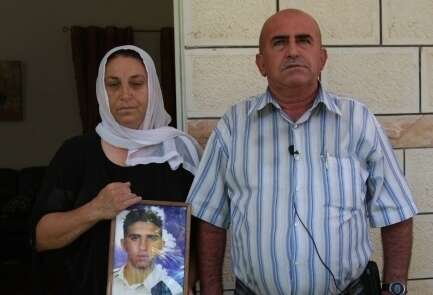
'PM approved deal with prisoners for missing soldier's body'
Prisoners sign pardon deal promising to reveal location of body of soldier Majdi Halabi, missing since 2005 • Halabi's parents insist he is still alive • In written agreement between prisoners, Halabi is referred to as a "product."