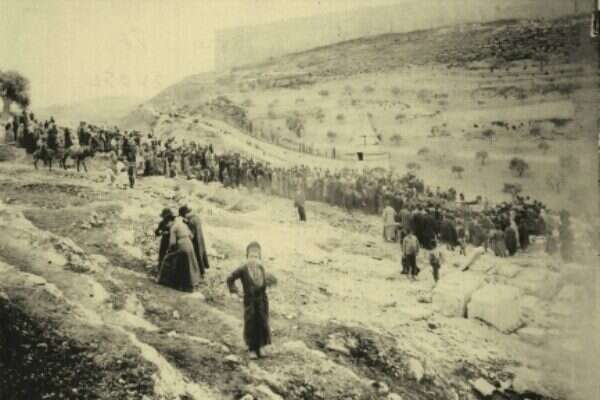
The Sambusky Cemetery, named for the sambusak, known as the pastry of the poor, is Jerusalems abandoned cemetery on the slopes of Mount Zion, a step-sibling of the best-known Jewish cemetery in the world on the Mount of Olives. The Sambusky Cemetery, which was established in a completely irregular fashion opposite the Ben Hinnom Valley, contains the graves of thousands of Jerusalems poor who were buried there over the past several centuries. Just as they knew no rest in life, so it is for them in death. This forgotten and desecrated cemetery, which was plowed over and neglected when the state of Israel had control of Mount Zion, as well as earlier during the British Mandate and the Ottoman eras, would have descended into oblivion if not for the grief of a single man, Doron Herzog, a teacher and tour guide from Jerusalem. For 30 years, Herzog researched the stories of the uprooted graves and shattered tombstones, picked through the yellowed, aging burial records and dusty archives, examined old photographs, spoke with elderly residents of Jerusalem and even cleaned and documented tombstone fragments with help from his students and friends, whom he persuaded with his enthusiasm. Now a book has been released about the cemetery. Sambusky: the Story of the Jewish Cemetery on Mount Zion, published by the City of David Institute for Jerusalem Studies and edited by Dr. Eyal Miron, is both fascinating and sad, not only because a story about the dead and their graves particularly ones that have been desecrated innumerable times can only be a sad one, but also because Doron Herzog died unexpectedly two years ago at the age of 53, turning his research project into a memorial for its author. The image that first drew Herzog to this story is a spectacular one. At summers end, thousands of squills color the southern slopes of Mount Zion. Herzog saw them for the first time at the end of the 1970s, but when he approached the flowers, he saw that they covered a desolate slope strewn with garbage, filth, junk and dozens of tombstones and tombstone fragments scattered about with no fencing or pathways. He learned that the Sephardic community of Jerusalem had used the squills, whose roots are particularly strong, as a cheap alternative to stone walls to mark sections and plots, as had been done in ancient times. This was the beginning of the investigation into the cemeterys history. Afterward, when he had studied the history of the cemetery on the Mount of Olives, Herzog understood the process that had led to the establishment of the Sambusky Cemetery on Mount Zion and its transformation into the cemetery for the citys paupers. The cemetery was a mirror that reflected Jerusalems troubles. During and after the 16th century, terrible plagues struck the city, claiming many casualties. Neighbors from the village of Silwan were a threat to burial plots on the Mount of Olives, whose number was decreasing in any case. They would demand protection money from the Jews in return for a quiet burial. The location on the Mount of Olives was so troublesome that at a certain stage, the Jews buried their dead in the courtyard of the Omari Mosque and in the cave in the courtyard, which is at the heart of the village of Silwan today. Blow after blow When the bubonic plague spread in Jerusalem, the Ottoman governor ordered all the citys infected dogs slaughtered and buried in the Jewish cemetery. When the Jews protested the humiliating order, the governor replied: They are all dogs, so I want all the dogs to be in one place. In 1562, the Arabs stole plots of land on the Mount of Olives from the Jews, and the Jews had to pay ransoms to reclaim them. Two generations later, in 1625, French priest Yves de Lille, who visited Jerusalem, reported the order of the kadi to exhume the corpses of Jews who had been buried on the slope of the Mount of Olives and cast them elsewhere, but in return for a thousand grush, he agreed to rescind the order. For half of the 17th century, no funds reached Jerusalem, and many people died of hunger. In addition to the shortage of burial plots, there was also the custom of bringing the dead to burial in Jerusalem. Every Passover, the Jews of Egypt would arrive in Jerusalem in a large caravan, bringing the bones of their loved ones to burial on the Mount of Olives. Pilgrims and visitors from European lands did the same, all so that the dead would be the first to be resurrected in the End of Days. In addition to this importing of the dead, the troubles from within worsened. Throughout the 17th, 18th and 19th centuries, plagues struck Jerusalem repeatedly, killing many. In 1864, the British physician, Dr. Thomas Chaplin, describing the diseases of Jerusalem in an essay, dwelt upon the open sewers, animal carcasses left in the streets and pieces of fruits and vegetables and remnants of food scattered everywhere. The worst plague was recorded in 1865, when cholera raged in Jerusalem, killing between 500 and 800 Jews. The rabbi of Jerusalem, Meir Auerbach, recalled the plague in a letter. From the week in which the biblical portion of Noah is read, the disease worsened due to our many sins and only lamentation was heard in the streets. In the courtyards of Jerusalem, there was only mourning and weeping of parents over their children and of children over their parents. The author S.Y. Agnon described the filth and disease in Jerusalem at the time: The days of wrath were at their height. Jerusalem was enveloped in hunger and thirst and dust and all sorts of disease .... Various flies and mosquitoes and fleas and gnats made sport of the blood of the Jews. Later on, locusts invaded the fields twice, devouring the crops. A terrible drought dried the water sources. Jerusalem lacked both food and drinking water. Many people died of hunger, including several well-known figures such as Rabbi Mordechai Salomon, Rabbi Yoel Yosef Rivlin and Dr. Rotsiegel, a physician who had devoted himself to saving many of the sick. Extortion and destruction The establishment of an additional cemetery on the slopes of Mount Zion was a natural outcome of the high mortality rate in the Jewish community of Jerusalem at the time. The shortage of burial plots on the Mount of Olives, the protection money that was extorted from the Jews in exchange for burial there and the fact that Jews from abroad also arrived to die in Jerusalem and be buried there led to a steep increase in the price of burial plots at the site. The Sambusky Cemetery, which was fairly close to the Jewish Quarter and its wall, was a convenient, cheap solution for the citys poor, who could not afford to bury their dead on the Mount of Olives. It was also convenient for Jerusalem community leaders, who did not want to waste valuable burial space on the Mount of Olives on the citys poor inhabitants, and spared themselves the necessity of having to pass through the hostile village of Silwan. Thus the Sambusky Cemetery was established, and from the 19th century on, reports about it became increasingly detailed. Christian pilgrims and tourists, together with writers and researchers of Jerusalems history, mention it explicitly. In a rare photograph from 1855 that Herzog found, the cemetery can be seen in its full glory, with hundreds of tombstones that no longer exist today. Fourteen years later, in a photograph taken by Frank Goode, many tombstones that do not appear in the 1855 photograph can be seen, evidently marking the graves of the victims of cholera. The Jewish cemetery on Mount Zion is also marked on maps from that period. But during the British Mandate, and particularly during the riots of 1929, tombstones were systematically destroyed and used by the areas inhabitants in fences and homes. The heads of the Sephardic community in Jerusalem, Moshe David Gaon (the father of singer and actor Yehoram Gaon) and Yosef Navon (the father of Israels fifth president, Yitzhak Navon), approached the British authorities, and in 1936, the British Mandates Survey Department mapped the area and sketched the borders of the cemetery. But the attacks did not stop. In 1936, the newspaper Haaretz reported: In the section known as Sambusky, the neighbors constructed a home right inside the cemetery after removing, without hesitation, hundreds of tombstones that covered the area. The leaders of the Sephardic community, led by Moshe David Gaon, visited the location repeatedly and documented damage, neglect and squatting by Arabs there. The minutes of a meeting of the local burial society that took place several days after Shavuot in 1945 recount: It is hard to judge the extent of the neglect and the ruin that can be seen in every direction. Dozens of tombstones have been shattered and strewn about everywhere one sets foot, some completely removed from over the graves and others thrown from side to side in order to widen the road or clear a known area to make a playground where the bones of the dead were once buried. That is how the village children made a playground inside the cemetery .... Cows and goats graze there. The area suffered even greater damage during the period of Jordanian rule (1948 to 1967), when some 50,000 of the 70,000 Jewish graves there were destroyed and thousands of tombstones vanished in the Sambusky Cemetery. In IDF maps from before the Six-Day War, the entire western area of the cemetery, on the patrol route, is called Hasmartutiya, a play on the Hebrew word for rag. A Jordanian army base constructed on the ridge of Mount Zion, north of the cemetery, was paved with tombstones taken from the Sambusky Cemetery. Acknowledging the shame When Israel united Jerusalem, only 300 tombstones remained. Herzog, who became almost the legal father of the cemetery, gathered almost all the internal correspondence among various authorities about the cemetery, but from day to day and from year to year, it descended farther and farther toward oblivion, even under Israeli rule. A 1973 memo from the cemetery coordinator of the Jerusalem municipality notes: The cemetery is in such a neglected, abandoned and deteriorated state that in some places no sign of graves can be found because the tombstones were stolen or removed. I found several stones in Arab homes being used as stairs leading up to the houses. There are signs that gravestones have disappeared, and the earth has been plowed or dispersed with hoes. Six years later, Amram Harush, then director-general of the Jerusalem Cemeteries Council, acknowledged the state of affairs, writing to Herzog: How can we lift our heads before the public and the world when we act in such a manner toward a Jewish cemetery, and what demand can we possibly make to the world when we complain about how they treat Jewish cemeteries? I feel terrible pain and guilt in light of the fact that this is a cemetery for the poor and lonely, and we owe a double measure of the loving-kindness so ingrained in us to these paupers, who did not have the means to purchase a cemetery plot. Although the Israeli authorities never stopped corresponding with each other about the Sambusky Cemetery, almost nothing was done at the site itself. Herzog quotes excerpts from this fruitless correspondence in his book. The letters deal with budgets and authority, but nobody takes responsibility for the reality on the ground. Perhaps because of that, the Arab neighbors feel free to build in the heart of the cemetery, of which almost nothing remains, an illegal chop-shop and car-repair garage, as well as a goat shed and a stable for horses. In one of the buildings there is even the minaret of a mosque, on the assumption that the Jews will not dare demolish a holy site. Only in 2004 did the Israel Nature and Parks Authority begin to integrate the Sambusky Cemetery into a national park surrounding Jerusalem, and authority was granted to change the situation. But in 2010, as Herzog himself documented several months before his death, the situation in the cemetery reached a low point. Almost no tombstone remained standing and in the area of the cemetery, only 10 tombstones or fragments of tombstones could be identified. The Arab inhabitants who live on the borders of the cemetery used the edges of the area as a parking lot, and thousands of tons of trash covered large parts of it. A belated redemption Several years before his death, Herzog obtained, after much effort, the lists of those buried in the Sambusky Cemetery from the members of the Parnas family, who were the grave-diggers in the Sephardic community. Most of the worn-out notebooks were written in an ancient, hard-to-read script, and in order to prepare a proper list of those buried there, the lists were cross-checked with other sources of information and also with the fragments that had been found in the area since 1979. An enormous amount of work yielded a list of 1,600 names that appear in the book. Only now, two years after Herzogs death, is the area finally getting attention. The Jerusalem Development Authority cleaned it and after a great deal of work in which Yisrael Caudres, Herzogs research assistant, took part, 280 graves were located. A sewer line that went through the area was relocated. A large memorial containing the names of all the people whose exact burial places are unknown is being planned. These are the names of more than 1,000 people whom time forgot, and who have now been rescued from oblivion.
Paying final respects at last
The story of the Sambusky Cemetery, the Jewish paupers cemetery, is a mark of shame for the city of Jerusalem • A new book, Sambusky: The Story of the Jewish Cemetery on Mount Zion, lays bare the historical injustice.
Load more...