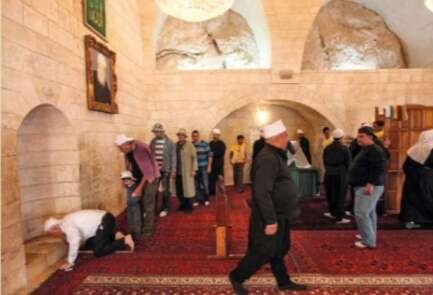
For a week I've been feeling that I want to scream: "My Druze brothers, your grief is our grief." The covenant between us -- one persecuted minority reaching out to assist another persecuted minority -- was sealed in blood last Friday, in a terrorist attack on our spiritual heart (Jerusalem), where Haiel Sitawe and Kamil Shnaan were stationed to defend its walls. It has been a long time since I saw all of Israel mourn this way. You are not "friends of the state," you are citizens. But you are friends of the Jewish people. Having chosen to join your fate with ours, you deserve even more admiration than all our security forces. You didn't have to choose this way. After all, the terrorists who murdered Haiel and Kamil were also Israeli citizens, and they chose differently. Two fighters were killed while defending the state, by three citizens seeking the state's destruction. * * * In a green village at the foot of the Carmel A loyal son was born to the State of Israel He went to school, all boys Two hours Muhammad; three hours Zionism. He rode ahead with the blowing wind At age 18 he joined the army He chose an elite unit, then officers' training His commanders were proud, he couldn't lose They said: With the coat and the Uzi Who could even tell he was Druze- In Kiryat Shmona, facing fire and murder He ran ahead of the pack, and drew his gun He fell first as he went up the stairs Badly hurt, his legs paralyzed. When they took him away, they told the news: With the blood on his coat and his Uzi, Who could even tell he was Druze- * * * Yonatan Geffen's "Ballad for a Druze" contains a third, more critical verse, but the first two verses are quite accurate: The State of Israel is often blind to the Druze population's contribution and slow to show its gratitude for their sacrifices. The subpar state of infrastructure in Druze villages is an obvious example of this type of injustice. The Druze joined the ranks of the Israel Defense Forces shortly after the establishment of the state, enlisting in mandatory duty, when they were recognized as a religious ethnicity (Israel was the only country that recognized them). But their military service was not just a show of gratitude -- even before they came under the mandatory draft, the Druze served in the IDF on a voluntary basis, under a fascinating alliance with the Jews that began as early as 1938, when they suffered persecution by the Arabs. Some 400 fallen Druze IDF soldiers are commemorated in the Yad Labanim memorial in Daliat al-Carmel, not including the civilians who were murdered in terrorist attacks. The percentage of fallen Druze soldiers is very high in comparison to their percentage in the general population. Many of them showed extreme courage and were abundantly decorated. In 1972, Nabih Meri, then a youth group counselor in the Druze town of Hurfeish, demanded to enlist in the paratroopers rather than the minorities unit that existed for Druze soldiers back then. He succeeded and advanced to the rank of colonel and served as a deputy commander in Gaza. It was thanks to him that the name of the minorities unit was changed to the Cherev Battalion. Meri reasonably argued that changing the name would boost motivation among minorities to enlist in the IDF. He was right. When riots erupted in the Western Wall tunnels in 1996, Meri met with Palestinian officers in Gaza and promised them a truce on behalf of Israel. He then rushed back to his soldiers, who came under Palestinian fire from the direction of the Rafah crossing. The bullets were faster than he was, and he was killed instantly. Madhat Yosef, an exceptional high school students who dreamed of attending medical school one day, followed his father's footsteps and joined the Border Police. His father had served as a border policeman for 28 years. In 2000, he fought to defend Joseph's Tomb, where a Jewish forefather who shares a name with Madhat's family is buried. The fighting was tough. A Palestinian sniper -- an Arabic speaker just like Madhat -- fired a bullet into his neck and wounded him critically. The Israeli military command did not send additional troops to the area to extract the wounded, opting instead to rely on the cooperation of the Palestinian security forces. Madhat's life slowly extinguished right before his friends, who did not have the tools to help him and were busy fighting. His life could have been saved, but for four hours he was left to bleed to death. Even now, 17 years later, no defense official has visited his grave to beg his forgiveness. When ax-wielding terrorists attacked a synagogue in Har Nof and viciously murdered five Jewish worshippers, two traffic police officers stormed the site and waged a heroic battle with the assailants. Druze officer Zidan Saif fought with the terrorists until he fell in an exchange of fire. His widow, Rinal, has kept in touch with the widows of the other victims in the attack -- ultra-Orthodox Jewish women. Blood touched blood. * * * During the Holocaust, 26,000 Righteous Among the Nations risked their lives to save Jews. Some 130 Arabic-speaking Righteous Among the Nations live among us today. Last Shabbat, in many synagogues -- Ashkenazi and Sephardi -- the policemen killed on the Temple Mount were included in the prayer. This was done in accordance with the instructions of the late Chief Rabbi Ovadia Yosef, who once ruled that when a Druze soldier is killed while defending Israel from its enemies a special prayer must be recited, as is customary for Righteous Among the Nations. Our shared fate ties us together -- two national minorities (the Druze rebelled against French colonialism, the Jews against the British). Our partnership is paved with military tombstones alongside cobblestones of life and success (the local school in the Druze village of Beit Jann has the country's highest matriculation scores, for example). The painful side of our partnership is the cost. The mourners' tents erected in Hurfeish and Maghar, the homes of the two slain police officers, may as well extend across all of Israel. Every Israeli killed in the line of duty is a "son to us all," but members of minorities who serve alongside us are even more so. It is incumbent upon us to glorify these righteous individuals, invest resources in their towns and their exceptional students and teach our own children to thank them, so that the whole world may know: Those who partner with us will be cherished and rewarded. The nations of the world granted us a state on the assumption that it would be a democratic one, and that we would behave morally toward minorities. Our duty is to them as much as it is to ourselves. Our conscience should guide us to be as generous toward them as they are toward us in ways that cannot even be measured. If we want a true partnership with the country's Bedouin, Circassian, Christian and Muslim minorities, if we want to tie our blood to theirs in a shared life on this land, we need to bestow the highest honors on our country's Druze population.