A chance meeting in an elevator has restored a 2,700-year-old jug to the state's collection of archaeological finds. Last week, Israel Korenfeld, an Israel Antiquities Authority archaeologist in the Ramla district, was going between floors when he met a young man who identified the IAA logo on Korenfeld's shirt and told the archaeologist that he had an ancient jug that had been pulled up from the sea and that he wanted to hand over to the IAA. The young man, who asked to be identified only by his first name, Alexei, told Korenfeld that about a year ago, he had been visiting the Ashdod beach with a relative. The two men met friends who were fishing and had hooked a stone anchor and jug, the latter of which the fishermen gave to Alexei's relative. The fate of the anchor is still a mystery. Korenfeld visited Alexei at his home and was given the jug, which has been identified as an amphora typical of the First Persian Empire, dating from the sixth century BCE. The IAA believes that the amphora was part of a ship's cargo, which is how it found its way to the bottom of the sea. IAA researchers plan to send samples of the remaining traces of the amphora's contents for laboratory testing to determine what the vessel used to contain. Kobi Shavit, director of the Marine Archaeology Unit at the Israel Antiquities Authority, said: "The archaeological finds from Ashdod coastal sites show evidence of trade ties and extensive seafaring activity [between Ashdod] and many port cities in the Mediterranean Sea, whereas there are relatively few archaeological finds from the sea itself. Therefore, finds from the seabed are very important to completing the archaeological and historical knowledge of ancient Ashdod in the Phoenician period and the Babylonian exile (597 BCE). "Alexei returning the amphora and the general information about the area in which it was found, along with information from other sources we have collected, will allow us to focus our searches on a fairly limited area in the hope that the single find will lead to a more significant archaeological discovery. Amphorae like this were in wide use along the Mediterranean coasts and were used to transport oil and wine," Shavit said. Under the Antiquities Law of 1978, antiquities -- a definition that includes all man-made objects produced before the year 1700 C.E. -- discovered in Israel are the property of the state. Alexei, who will receive a good citizenship commendation for his decision to return the amphora, said: "I didn't think that something could be preserved in the sea for so long. When I realized it was an ancient object, I decided to give it to the Antiquities Authority. Then I met the right man in the elevator." The IAA encourages all members of the public who might be in possession of ancient artifacts to hand them over to the IAA so they can be properly researched and preserved as part of the cultural legacy of everyone in Israel.
X
שיתוף כתבה
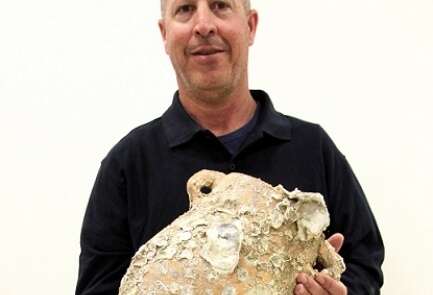
2,700-year-old jug found in south helps archaeologists focus digs
A man meets an Israel Antiquities Authority archaeologist in an elevator and tells him he has an ancient amphora • Vessel dates from the First Persian Empire • Director of IAA Marine Archaeology Unit Kobi Shavit: Finds from the seabed are relatively rare.