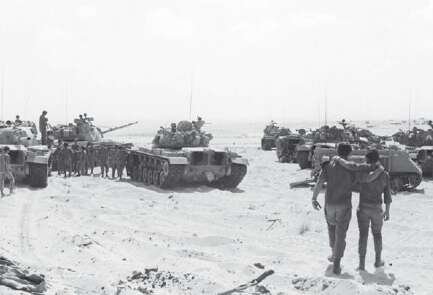
At this time 43 years ago, a bloody war was being waged in the Sinai and in the Golan Heights. It broke out on the afternoon of Yom Kippur and went on for 18 days. It began as a complete surprise and a stinging failure of the Israel Defense Forces, from both a tactical and strategic perspective, and ended in an Israeli victory, 100 kilometers (62 miles) from Cairo and 35 kilometers (20 miles) from Damascus. After the war, there was a sense in Israel of crisis, disappointment, humiliation and even a deep sense of mistrust in the military and political leaders and the soundness of their considerations. A commission of inquiry and the harsh conclusions it reached shook the country. The chief of staff, the director of military intelligence, the chief of the Southern Command, the director of the military intelligence research brigade and the head of the research brigade were all removed from their positions, and it seemed to many that the decision not to oust members of the political leadership was not due to a lack of culpability. This, of course, did not help garner support for those leaders who remained in their government positions. The process came to an in end in 1977, when the Likud party was first elected to lead the State of Israel and the Labor party was thrown out of the government it had run since the founding of the country. The war caused a severe shock and was deemed a failure, through an emphasis on its beginning and almost total disregard for its end, and it contributed to the first regime change in a generation. In retrospect, it is correct to determine that this was a war that created a historical turning point in the relationship between Israel and its neighbors. The first to grasp the new strategic situation was then-U.S. Secretary of State Henry Kissinger. He understood that the outcome of the war created an opportunity to exploit. On the one hand, success in the first part of the war enabled Egypt to overcome the sense of national humiliation it had suffered since the Six-Day War and bolstered the status of then-President Anwar Sadat. On the other hand, Egypt's Third Army was entirely cut off, meaning that a third of the Egyptian Army was in danger of being wiped out and there was nothing to prevent it from happening. Kissinger understood that the key was to end military actions against the Third Army and to hold negotiations with it while it was under siege, with a military success under Egypt's belt while at the same time a threat hovered over the heads of the multitude of surrounded soldiers with no way out. Negotiations were held 100 kilometers (62 miles) from Cairo, which became a sort of symbol of the IDF's success at the end of the war, because Israeli forces had gotten that far. It was the beginning of a long journey that eventually, after some years, led to the signing of the peace deal between Israel and Egypt, an agreement that only a victorious leader like Sadat could have signed. The agreement has stood the test of time and of events: It has survived the murder of Sadat and his replacement by President Hosni Mubarak, the revolution against Mubarak and his replacement by the Muslim Brotherhood, and the counterrevolution that brought about the regime of Col. Gen. Abdel-Fattah el-Sissi. It has survived the conquest of capital cities by Israel and the difficult operations against the Palestinians. But this war and its outcomes had even further repercussions. The removal of Egypt from the cycle of war with Israel made it clear to then-Syrian President Hafez Assad, father of current President Bashar Assad, that the chances of forging a coalition that could challenge Israel militarily had faded. In light of this understanding, Syria, despite not signing a peace agreement with Israel, was diligent in honoring the cease-fire it signed. Although it assisted various elements in Lebanon against Israel through the years, it did everything in its power to avoid embroilment in the Golan Heights. Moreover, from a historical standpoint, the Yom Kippur War was the last war to be waged by active armies against the State of Israel for an extensive period, and following the changes in the region following the "Arab Spring" (with only the Egyptian army maintaining its capabilities), this period could go on for many years to come. Israel has faced genuine militaries on four different occasions: In the 1948 Arab-Israeli War, it came under attack by the armies of all the neighboring countries and of Iraq, which intended to destroy it. In 1956, in the Suez Crisis, Israel initiated a war against Egypt's increasingly formidable military in the Sinai, which brought it several years of quiet. In 1967, the Arab countries, led by Egyptian President Gamal Abdel Nasser, tried to organize a coordinated attack on Israel's narrow borders, and in a successful pre-emptive attack, Israel paid (with blood) for control of the Sinai Peninsula, Judea and Samaria, and the Golan Heights. It took the Arab countries six years to recover from the shock they received and to attempt to retaliate. But that effort, the 1973 Yom Kippur War, also ended in failure on the battlefield. A failure that was not understood or appreciated by the surprised people of Israel, who could not bear the number of those killed and the humiliating images of the hostages -- in stark contrast with euphoria that had presided over Israel after the Six-Day War. In retrospect, one can say that the results of the 1973 war reinforced Arab conclusions from the 1967 war: that it was not possible to defeat Israel on the battlefield and alternative means were necessary. Some, like Sadat, chose diplomatic negotiations. Others, including Assad, believed Israel would only be defeated with the help of unconventional weapons, and he therefore built the largest array of chemical weapons and missiles in the region. PLO leader Yasser Arafat thought the future lay in terrorism. But it was clear to all that the Yom Kippur War had been their last opportunity to defeat Israel on a "classic" battlefield. That war started with the aggressors at an extraordinary advantage, able to completely surprise Israel and reap huge gains, and ended with the IDF embedded deep inside Syria and Egypt, threatening their capitals. This is not the only instance in which the results of a war or military operation can be understood only several years after the fact. Of course, proper precautions should not interfere with inquires into operations or wars, to allow us to learn from our mistakes. But a degree of skepticism in understanding long-term results should be reserved; this allows a more sober approach to events, even when they are difficult to digest. It is true that in 1973, there was an intelligence failure and the IDF found it difficult to function. It is true that Israel did not take into account the possibility of war at the time, and it is true that even technological means such as surface-to-air missiles and anti-tank missiles led to a surprise on the battlefield. But during the war the tables turned, and one cannot forget what led to this dramatic shift. It was the fighting spirit of the different units that did this -- the scattered reserve units, the battalions that blocked the enemy with their bodies in the initial stages, paying with their blood to give the reserve divisions the time needed to report for duty and get to the battlefield and transform the reality on the ground. That should be remembered. Because the necessary abilities -- the fighting spirit, the quality of commanders in the field, and the consummate professionalism of the military force -- must continue to be cultivated. One never knows when the next test will come and what it will look like. One must constantly prepare for it. That is the lesson of that war.