One year after striking a nuclear deal with Iran, U.S. President Barack Obama is facing criticism surrounding the unusual delivery of $400 million in cash to the ayatollah regime. The money transfer, in Swiss francs, euros and other currencies, was made last January soon after the release of five Americans detained in Iran. Obama insisted last Thursday that the money transfer was not a ransom payment for the American citizens, rather a return of frozen funds belonging to the Iranians. The five, including Washington Post reporter Jason Rezaian, were released on Jan. 16 in exchange for seven Iranians held in the United States for sanctions violations. The prisoner deal coincided with the lifting of international sanctions against Tehran. "We do not pay ransom. We didn't here, and we won't in the future," Obama said at a press conference at the Pentagon. "Those families know we have a policy that we don't pay ransom," he continued. "And the notion that we would somehow start now, in this high-profile way, and announce it to the world, even as we're looking in the faces of other hostage families whose loved ones are being held hostage, and saying to them we don't pay ransom, defies logic." Obama downplayed the story, saying he had been open about the payment at the time it was agreed. "We announced these payments in January. Many months ago. They were not a secret. It wasn't a secret. We were completely open with everybody about it," he said. At the time, the U.S. said it had settled a longstanding Iranian claim at the Iran-U.S. Claims Tribunal in The Hague, releasing $400 million in funds frozen since 1981, plus $1.3 billion in interest that was owed to Iran. The funds were part of a trust fund Iran used before its 1979 Islamic Revolution to buy U.S. military equipment that was tied up for decades in litigation at the tribunal. In response to a Wall Street Journal article that said Washington secretly organized the cash airlift, White House spokesman Josh Earnest also rejected suggestions the money transfer to Iran was ransom or a secret. "The United States, under President Obama, has not paid a ransom to secure the release of Americans unjustly detained in Iran and we're not going to pay a ransom," he said. In Iran, meanwhile, the matter has been presented in a completely different manner. An Iranian documentary film, which was broadcast last February and is available online, offers alleged video evidence of a large cash delivery being taken off a plane. "In the early morning hours of Jan. 17, at Mehrabad International Airport, cash in the sum of $400 million were transferred to Iran by plane," the film says. "The Islamic republic presented a simple equation: the release of seven Iranian prisoners held in the U.S., $1.7 billion, and the removal of sanctions against 16 Iranian individuals undergoing legal proceedings in the U.S.," the film claims, "all this in exchange for the release of just four Americans, which makes this deal beneficial to the Islamic republic and harmful to the United States." "People knew what it was going to look like" Senior officials at the Justice Department had objected to sending cash on a plane to Iran at the same time that Iran was releasing the four imprisoned Americans (the fifth American was released separately) but were overruled by the State Department, The Wall Street Journal reported in a separate story last Wednesday, citing people familiar with the discussions. "People knew what it was going to look like, and there was concern the Iranians probably did consider it a ransom payment," the newspaper quoted one of the people as saying. Justice Department prosecutors were also concerned that the U.S. would release too many Iranian convicts and drop too many pending criminal cases against people suspected of violating sanctions laws, the second Wall Street Journal report said. Reuters was unable to independently verify the report. In response to the report, a Department of Justice spokesman they "fully supported the ultimate outcome of the Administration's resolution of several issues with Iran, including Hague settlement efforts, as well as the return of U.S. citizens detained in Iran. We will not comment further on internal interagency deliberations." A senior State Department official also responded by saying that the payment had been fully an interagency decision and that any idea that the State Department had the power to overrule was false. Republican presidential nominee Donald Trump blamed his Democratic opponent, Hillary Clinton, who was secretary of state during Obama's first term, for launching the talks with Iran. "Our incompetent Secretary of State, Hillary Clinton, was the one who started talks to give 400 million dollars, in cash, to Iran. Scandal!" Trump wrote on his Twitter account. The chairman of the Republican National Committee, Reince Priebus, also weighed in. "The Obama-Clinton foreign policy not only means cutting a dangerous nuclear deal with the world's number one state sponsor of terrorism, it also means paying them a secret ransom with cargo planes full of cash," he said. House Speaker Paul Ryan was more measured, saying, "If true, this report confirms our longstanding suspicion that the administration paid a ransom in exchange for Americans unjustly detained in Iran."
X
שיתוף כתבה
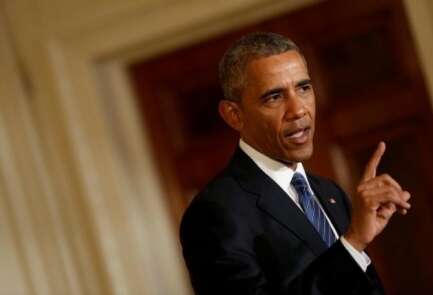
Obama: $400 million sent to Iran not 'ransom' for hostages
Although cash transfer was made soon after release of five Americans held in Iran, U.S. president says "payments were not a secret" • Iranian film allegedly documenting the cash delivery claims deal benefited the Islamic republic and hurt the U.S.