The tables have officially turned in Jerusalem, with the fertility rate for Jewish women (4.3 children) in the city higher than the fertility rate among the city's Arab women (3.3 children). The 2016 figures were provided by the Statistical Yearbook of Jerusalem, which is issued annually by the Jerusalem Institute for Israel Studies and the municipality. The overall fertility rate represents the number of children a woman is projected to give birth to in her life. Unsurprisingly, the high rate among Jewish women is heavily influenced by the city's ultra-Orthodox and religious population. Meanwhile, however, the city's overall Arab population has continued to grow while the Jewish majority has shrunk. In 2014, the last year for which official figures are available, Jerusalem's population of 849,000 residents comprised 533,900 Jews (63%) and 315,900 Arabs (37%). The Arab population growth rate that year stood at 2.7%, while the growth rate for the Jewish population was just 2.2%. Unofficial figures now show that the city's Jewish majority has dropped to 61% of the population. The reason the Jewish majority has decreased is the negative migration from the city: More Jews are leaving Jerusalem than are coming in. In 2014, 17,100 residents left the city, but only 10,400 new residents moved there. The disparity in the migration balance is less dramatic now than the average in recent years, but it is still significant. According to the Jerusalem Institute for Israel Studies, from 1991 to 2102, 368,300 residents migrated from Jerusalem, while 223,800 moved there. The main reason behind the negative migration trend, according to recurring research, is the lack of available or accessible housing in the city. Over the past decade, construction beyond the Green Line has fallen off due to political pressure. Construction in the western part of the city, over that same time period, has decreased due to pressure from environmental groups. As a result, construction has been condensed to the city's central neighborhoods and primarily consists of high-rises.
X
שיתוף כתבה
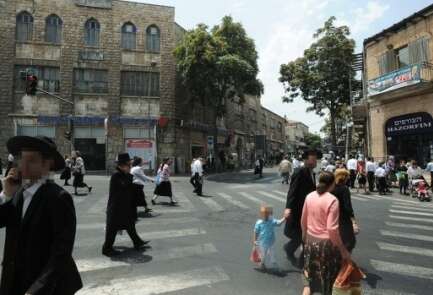
Jewish fertility surpasses Arab fertility in Jerusalem, data show
While Jewish fertility rate, 4.3 children per woman, is higher than Arab fertility rate -- 3.3 children -- city's overall Arab population is growing as Jewish majority shrinks due to negative migration sparked by severe housing shortage.