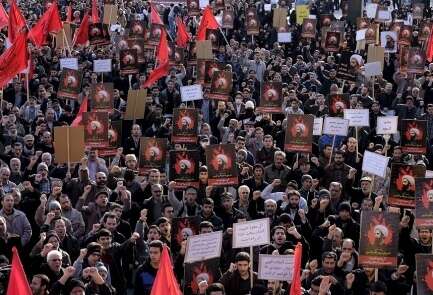
Saudi Arabia is under pressure. How else could you explain its decision to execute Sheikh Nimr al-Nimr last week, alongside 46 others on death row, after he was convicted of belonging to a terrorist network? Riyadh knew very well what the consequences would be for harming a Sheikh with ties to Iran. And yet, the Saudis decided to take a chance. The Shiite world, led by Iran, made a lot of noise this week. The Saudi Embassy in Iran's capital, Tehran, and the Saudi consulate in the city of Mashhad were attacked by enraged Shiite mobs, and the Iranian government did not lift a finger to stop them. The Sunni world did not stand by in silence: Saudi Arabia was the first to respond, announcing that it was severing ties with Iran. Its allies, among them Bahrain, Kuwait, and the United Arab Emirates, followed suit, at the very least recalling their ambassadors to Tehran. Since the execution of Nimr, a bitter rival of the House of Saud, the winds of war have been blowing through the Persian Gulf. The West, Russia, China and Turkey have all offered to mediate the crisis. The world understands just how serious a military conflict between these two giants would be. The Saudi Arabian Sunni absolute monarchy and the Iranian Shiite Islamic Republic have decided to take the gloves off. Obviously, references were made this week to the Battle of Karbala (680 C.E.) -- essentially the birth of the great Sunni-Shiite conflict. Everyone knows how deep tensions between the Sunni majority and the Shiite minority are within Islam. Everyone was concerned. Everyone, except the Islamic State group, whose members looked on in excitement. Islamic State stands to profit the most in the event of a conflict. And it is precisely because of this that the world enlisted to the cause of returning calm to the Gulf. You could say that the deterioration of this relationship was planned and calculated: Saudi Arabia knew that Iran would react to the execution, and Iran knew that the Saudis would not be indifferent to attacks on its diplomatic missions. Saudi Arabia wanted a crisis. And do not be mistaken -- the nuclear agreement with Tehran, which worries the Gulf States, certainly contributed to Saudi Arabia's decisions and to the deterioration of its relationship with Iran. The crisis this week allowed us to see, once again, Iran's ability to speak in two distinct voices. Iranian President Hassan Rouhani did condemn the attack on the Saudi diplomatic missions in his country, but it was clearly a feeble condemnation. In contrast, Iranian Supreme Leader Ayatollah Ali Khamenei did not address the attacks. In fact, he threatened that divine vengeance would strike the Saudis -- and everyone in Iran knows who has the final word. Rouhani chiefly deals with the country's economic issues; the real power and the authority on security policy are in Khamenei's hands. Obama forgot who the bad guys are Among the 47 Saudis on death row, only five were Shiites. The rest were Sunnis convicted of having ties to al-Qaida and Islamic State. Saudi Arabia sought to get across a few messages with the executions. The first message was directed at jihadi terrorist organizations. Riyadh actually funded these groups and supported them as long as they were in line with Saudi interests, among them overthrowing Syrian President Bashar Assad. Now, the Saudis are witnessing a boomerang effect, as these groups threaten the Saudi Arabian monarchy. The second message from the Saudis was directed at the Shiite minority, which makes up 10-15% of the population. This community lives in the center of the country, in an area that contains many oil wells and overlooks the border with Bahrain, a country ruled by a Sunni monarchy that is threatened by a Shiite majority. In 2009, Nimr demanded that the eastern part of Saudi Arabia be cut off from the rest of the country and joined with Bahrain, which would then be transferred to Shiite rule. The Saudis saw Iran's fingerprints all over this demand and claimed that Nimr was an Iranian agent. The third message was meant for the Iranians, who are threatening the Wahhabi Sunni hegemony in the region. Riyadh does not look fondly upon Iranian intervention in Yemen, Syria, Iraq and Lebanon. The Saudis also dislike the idea that Washington is turning its back on them and is instead courting their archrival, Tehran. In fact, U.S. President Barack Obama gambled on Iran, upgraded it, and made the Saudis the bad guys in the story. Add to this the fact that a relatively new ruler who suffers from health problems is now sitting on the Saudi throne (he was appointed about a year ago) -- and you can understand why the Saudis are under pressure. King Salman has to juggle two major threats: The threat of terrorism from al-Qaida and Islamic State, and the Iranian threat. Israel's choice is clear The relationship between Saudi Arabia and the United States deteriorated significantly during Obama's time in office. Riyadh was greatly disturbed when it saw Washington abandon its ally, former Egyptian President Hosni Mubarak, at the beginning of the Arab Spring. American indecisiveness regarding Assad, and the fact that the United States ignored the red lines it set for him, gave the Saudis another lesson in loyalty or lack thereof. Riyadh came to the conclusion that there was no one to rely on in Washington, so it grew closer to Russia and France. The Saudis also began to take on independent initiatives, including strikes on Yemen's Houthi rebels, who are supported by Iran. The big question is whether the tensions between Iran and Saudi Arabia are a harbinger of religious conflict between Sunnis and Shiites. There has never been a great love between the Saudis and the Iranians, but these two giants learned to live together so they could solve problems and divide regions of influence amongst them. What stands to suffer the most serious damage due to the tensions between the two states? The diplomatic efforts to find a solution for Syria. Without cooperation between Iran and Saudi Arabia, it will be very difficult to arrive at a decision at the negotiating table, as we saw in Vienna. This week, an acquaintance of mine, a European diplomat in a Middle Eastern country, called me. He told me that he was surprised that Israel was not getting involved in the Saudi-Iranian crisis. But Israel knows full well where it lives. In the new Middle East, there are no good guys, only bad guys and worse guys. Israel is interested in the growth of a moderate Sunni axis. Saudi Arabia fits into this equation, and when it comes to Saudi Arabia or Iran, it's clear which Israel will choose. But that does not mean that the Arab Peace Initiative will suddenly become sacred in Jerusalem's eyes. Let's not forget that it demands Israel withdraw to June 1967 lines. If it were to be put into action, the Golan Heights would now be in Syrian hands -- rather, in Islamic State hands. The Saudis, presumably, would not be thrilled.