A senior Russian military delegation will visit Israel on Tuesday for two days of talks on how the countries can avoid accidentally clashing while operating in Syria, an Israeli military officer said. Prime Minister Benjamin Netanyahu and Russian President Vladimir Putin agreed on Sept. 21 to set up teams as Russia steps up military support for Syrian President Bashar Assad, who has been losing ground to an Islamist-led insurgency. Israel is worried the Russian deployment, which includes advanced anti-aircraft units and warplanes, risks pitting Russian forces against its own over Syria. According to foreign reports, Israel has carried out a number of strikes in Syria in recent years to prevent the transfer of advanced weaponry from the Assad regime to the Lebanese terrorist group Hezbollah. Israel has said it holds the Syrian government responsible for any spillover of violence from the four-year civil war there. On Sept. 27, Israel struck Syrian military targets on the Syrian side of the Golan Heights in retaliation for cross-border rocket fire. The Russian delegation will be led by First Deputy Chief of General Staff Gen. Nikolai Bogdanovsky, who will meet his Israeli counterpart, Deputy Chief of Staff Maj. Gen. Yair Golan. "The two will meet at military command headquarters in Tel Aviv as part of the two-day visit of the Russian army delegation to Israel. Among other matters, they will discuss regional coordination issues," an Israeli military officer said on Monday. After Putin and Netanyahu met, an Israeli military officer, who spoke on condition of anonymity, told Reuters the countries would focus on aerial operations in Syria and "electromagnetic coordination." The latter appeared to refer to the sides agreeing not to scramble each other's radio communications or radar-tracking systems, and devising ways of identifying each other's forces to avoid any unintended confrontation in the heat of battle. Israel and Russia will also coordinate on sea operations off Syria's Mediterranean coast, where Russia has a major naval base, the Israeli officer said. In explaining Israel's objectives in coordination with the Russians, Netanyahu told CNN in an interview on Sunday, "I went to Moscow to make it clear that we should avoid a clash between Russian forces and Israeli forces. "In Syria, I've defined my goals. They're to protect the security of my people and my country. Russia has different goals. But they shouldn't clash." When asked by Reuters about the talks, an official at the Russian embassy in Israel declined to comment.
X
שיתוף כתבה
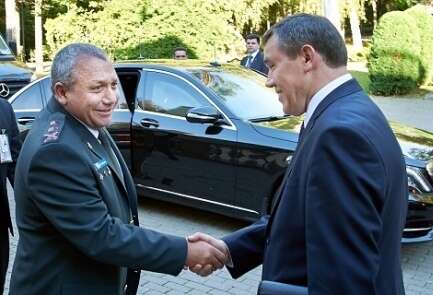
Russia-Israel military talks on Syria set to get underway
Senior Russian military delegation, led by First Deputy Chief of General Staff Gen. Nikolai Bogdanovsky, to arrive in Israel on Tuesday for two days of talks on how the countries can avoid accidentally clashing while operating in Syria.