The 14th day of Operation Protective Edge, July 21, 2014, is a day burned in the memory of many as one of the hardest of the 50-day war. Early that morning, two terrorist cells penetrated Israeli territory via a tunnel in the northern Gaza Strip, and the soldiers who went in pursuit, led by Geffen Battalion commander Lt. Col. Dolev Keidar, were hit by an anti-tank missile. Keidar, 38, of Modiin was killed in the attack, as were Chief Warrant Officer Baynesian Kasahun, 2nd Lt. Yuval Haiman, and Sgt. Nadav Goldmacher. Keidar's death left the Geffen Battalion without a commander in those crucial moments of fierce fighting. That same morning, shortly after the incident, Lt. Col. Eliad Maor's phone rang. On the other end of the line was the chief officer of the infantry and paratroopers, Lt. Col. Yehuda Fuchs. "He asked me if I could be the Geffen Battalion commander. I didn't understand. I asked him what happened to Dolev, and he told me that Dolev had been killed," Maor recalls in a conversation with Israel Hayom, nearly a year after the operation. Prior to Operation Protective Edge, Maor was a team leader at the IDF's College for Tactical Command. When the operation started, he was stationed in the southern Gaza Strip with the Givati Brigade, where he had previously served as a commander of the patrol battalion and helped prepare forces for the ground operation. When he took over command of the Geffen Battalion following Keidar's death, Maor knew almost none of his new soldiers. And for the most part his soldiers -- mostly cadets from the IDF officers' course -- did not know each other, since they had been called up for Protective Edge from time off. "I managed to get all the company commanders together; we talked for a few minutes. I explained that I wouldn't be able to know what each one's missions were, and that each of them was responsible for the mission he had been assigned until I could get up to speed," Maor says. "I made the decision that the most important thing for the battalion at the time was stability, calm, and support for the officers' decisions. It was important to me to visit the cadets and the commanders, to speak with them. See. Touch. There were some who weren't in such good shape. More sensitive and vulnerable after the traumatic incident." After the conversation with the company commanders, Maor set off for the place where Keidar and his soldiers had been killed. "There were a few soldiers there, and a smell of blood and burning," he said. "You could see there had been a battle. I looked back. Just from standing there, you could tell why you were there and what needed to be done. Because you see Nir Am, the train, Sderot. You see that you're standing between them and Gaza." At 4 a.m. the next day, Maor began working with his new troops on plans for a ground incursion near Nisanit and Beit Hanoun. "The 'cohesion' of the force was a weak point. But the quality of the people, the commanders, the cadets, was so high that it inspired a lot of confidence," Maor recalls. When they entered the Gaza Strip, Maor felt the significance of being a commander who had just entered the role. "When we were inside [Gaza], someone I didn't recognize came up to me. He said, 'I'm Benny, I'm your company commander.' He had just been under a different company, and until that moment I didn't know I had another company," Maor says. After the operation, despite his team leader position at the IDF school, Maor chose to remain in command of the Geffen Battalion for a year. "I realized that after the event I couldn't leave them, [couldn't] leave the system in such a precarious position and change commanders again," Maor says. "The evening before the course ended, we brought all the bereaved families together and had an emotional evening. The entire course took on a different atmosphere after the events. What bothered the cadets at the end of the course was that they were going to command soldiers who had experienced more intense battles than they themselves. They didn't know how to appreciate their experiences -- losing soldiers and officers, a change of command, which meant they arrived at their units with significant experience. They were a very special course."
X
שיתוף כתבה
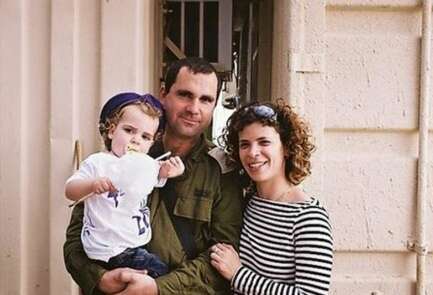
'They told me: Dolev is dead, you're the battalion commander'
A year after Operation Protective Edge, Lt. Col. Eliad Maor -- who was placed in command of the Geffen Battalion after Lt. Col. Dolev Keidar was killed in a Hamas ambush -- talks with Israel Hayom about some of the darkest days of the 50-day war.