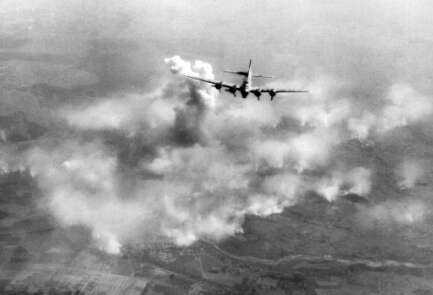
"If I were a prisoner at Auschwitz and I could have chosen between dying by exposure to poisonous gas or being burned alive in a firebombing, I know which one I would prefer," said Marshal Arthur "Bomber" Harris, the legendary head of the Royal Air Force's Bomber Command during World War II. "Bomber" Harris was notorious for his advocacy of a controversial strategy calling for indiscriminate bombardment of German cities and population centers. The "jewel" in Harris' crown was the bombing of Dresden, an act which left one of Europe's most beautiful cities a smoldering ruin and a civilian casualty count of some 25,000 Germans. The military and tactical utility in the bombing of Dresden is a matter of debate. Most historians and researchers are united in their belief that the heavy bombardment of population centers had a minimal impact, if any, on the outcome of the war. When it comes to the bombardment of concentration camps, on the other hand, there is no unanimity of opinion. Harris, who was adamantly opposed to bombing the camps and the railways tracks that led to them, made the above statement to David Irving, the Holocaust-denying British historian, in 1962. The statement was meant to serve as his explanation for why he was opposed to such an operation. The camp prisoners obviously thought differently. Many of them wrote in their memoirs that they would have gladly welcomed any bombing of this nature, even if it had cost them their lives. Why didn't the Allied forces bomb the Nazi concentration camps, chief among them Auschwitz, in order to stop -- or, at the very least delay -- the process of European Jewry's extermination? This remains a painful topic which to this day perplexes Holocaust survivors, particularly those from Hungary. It also continues to vex historians, 70 years after the fact. No wonder. Given the horrific events that characterized the five years during which World War II was waged, what stands out are unfathomable tragedies during those fateful months spanning the summer and autumn of 1944. By the end of that spring, a window of opportunity appeared to have been opened. While the Germans were characteristically determined to liquidate the remnants of Hungarian Jewry -- the last concentration of Jews that fell under their rule -- in Auschwitz, planners began toying with the idea of bombing the railways connecting Budapest with Poland. Specifically, the plan called for targeting the gas chambers and crematoria in Auschwitz. The sense was that it was possible to save the lives of hundreds of thousands of people. All that was needed were a few sorties by Allied bombers. Unfortunately, with high expectations comes great disappointment. Neither the Americans or the British responded positively to the exhortations of Jewish organizations. Both countries refused to make even one sortie for the fateful mission. Why? This question is twofold. From a political standpoint, did the Allies want to rescue the Jews? From a practical standpoint, if they did desire to do so, could they have effectively bombarded the camps, thereby sabotaging the Nazi extermination drive? An international conference recently held at the Menachem Begin Heritage Center in Jerusalem and staged in conjunction with the World Jewish Congress focused on the Allies and their conduct while the Jews of Europe were being systematically annihilated. Among the participants at the conference were Professor Kenneth Werrell, a military historian at Redford University who has published numerous books and research papers on the topic of air power, particularly strategic bombing. 'Beyond their ability' On April 10, 1944, two young Slovakian Jews, Rudolf Vrba (born Walter Rosenberg) and Alfred Wetzler, managed to escape Auschwitz. On April 25, they wrote a detailed 40-page report that included maps of the camps and a chilling description of the extermination process. "As of now, there are four crematoria operating in Birkenau. ... A large chimney juts out of the room filled with ovens, each of which have four openings. Each opening has room to jam three average-sized bodies inside at one time and after 90 minutes, the bodies would be completely burnt. This represents a capacity of 2,000 bodies per day. Next to the room, the large 'welcome room' is organized so that people get the impression it is a wait room for the bathing house. "Death by gassing is carried out thus: The poor victims are brought to the welcome room, where they are instructed to remove their clothing. In order to keep up the ruse that makes them think they are about to be given showers, everyone receives a towel and a tiny piece of soap.
Afterward, they are shoved into the gas chamber. ... When everyone is inside, the heavy doors are shut. ... The SS don gas masks and ascend to the roof, open the valves, and pour the powder from tin cans with the marking 'Zyklon B -- For Use Against Insects.' ... Three minutes later, everyone was dead." The daily death toll at Auschwitz reached 12,000. This report took a tortuous path until it finally reached the desks of the Allied governments. As David S. Wyman points out in his book, "The Abandonment of the Jews: America and the Holocaust, 1941-1945," these governments had detailed descriptions of the geographic locations and structures of these buildings. The number of times that Jewish organizations tried to persuade the British and the Americans to do something in the summer of 1944 are too plentiful to count. On July 6, Chaim Weizmann and Moshe Sharett (at the time still known as Moshe Shertok) met with the British foreign secretary, Anthony Eden. During the meeting, the Zionist leaders presented him with a document titled "Five Urgent Points." The aim of the meeting was to put a halt to the shuttles that were ferrying Hungarian Jews to Auschwitz. At the time, there were still 300,000 Jews in Budapest. As each day went by, more and more were in danger of finding themselves hauled onto a train that transported them to their deaths. The fifth point in the document read: "The railways connecting Budapest and Birkenau must be bombed, as are the death camps in Birkenau and other places." Historian Martin Gilbert wrote about this demand in his book, "Auschwitz and the Allies." Eden passed along these demands to then-Prime Minister Winston Churchill, a man known to be sympathetic to the fate of the Jews. Churchill was one of the few who truly understood the monstrous dimensions of the Holocaust. Churchill wrote to Eden that this appeared to be one of the gravest, most heinous crimes in its history. He instructed Eden to accede to Weizmann and Sharett's request. "Get everything you can out of the air force," Churchill wrote. "If need be, use my name." Eden indeed acted immediately. He appealed to Archibald Sinclair, who held the title of secretary of state for air, pleading with him to "bomb the railways leading to Birkenau
and to bomb the camps themselves." Sinclair replied that bombarding the railways and the camp "are beyond the capability of the Bombers Command." He proposed that the mission be instead passed along to the Americans. "The British had deployed an aircraft that was more suited to that kind of mission -- the Mosquito, which was a more accurate bomber from lower altitudes," Werrell said. "They just passed the buck onto the Americans, who were using bombers that flew at a higher altitude, the B-17 ('Flying Fortress') and the B-24 ('Liberator'). These were far less precise warplanes, which made them less suited." The Americans, however, had by that point perfected their knee-jerk response of refusing to come to the aid of refugees. Despite the fact that the War Refugee Board, which was formed by executive order on the instruction of President Franklin D. Roosevelt, did have power of attorney to operate among the various government departments, including the Department of War, that department repeatedly refused to devote any military resources to rescue missions. "We are not considering the possibility of deploying units for the purpose of rescuing victims of oppression by the enemy unless the rescue operations stem directly from military operations waged with the goal of defeating the enemy's armed forces," the board said. The rationale used by the Americans was that bombarding the railways and camps would divert resources away from the primary aim of the campaign, which was to defeat the Axis powers. Those pleading for assistance on humanitarian grounds received the same reply: "The most effective aid for the victims is to ensure the defeat of the Axis powers as quickly as possible." When examining the political and diplomatic decision-making process, the Western powers declined to intervene for reasons that are both obvious and less so. There was the fear that the Allied countries would be flooded with Jewish refugees. Another theory held that they did not want to anger Soviet leader Josef Stalin. While Churchill expressed a willingness to help, his instructions evaporated throughout the long chain of command. The Americans, meanwhile, held to their long-standing policy of non-intervention, against the instructions of Roosevelt. Swallowed up by the bureaucracy Perhaps the reason that the Allies declined to take on the mission cannot solely be explained by wicked intentions or apathy in the face of unspeakable horrors. Perhaps those in charge simply could not fathom the scope and the brutality of what was taking place right underneath their noses. Nowadays we can piece together the puzzle to form a logical picture. At the time, however, as the Allies were in the midst of a massive war effort to cut down the forces of evil, they were limited by poor assessment capabilities. There were quite a large number of planners who believed that from a purely operational standpoint, there were tremendous technical obstacles that needed to be overcome, particularly as it related to range and accuracy of bombs. Another factor to consider is the heavy casualty toll absorbed by the Bombers Command. These losses were incurred when British pilots undertook missions like the bombing of the Ploiesti oil fields in Romania or the sorties over Dorenberg. These traumatic incidents contributed to a keen sense of aversion toward any new "adventures." "Technically, the Allies could absolutely have bombed Auschwitz," Werrell said. The shocking bottom line is that "the idea of bombing the camps was never considered by any of the Allies' high-ranking military officials." In other words, all of the requests, plans and instructions from civilian leaders to consider bombardment had never reached the military planners who were supposed to execute these actions. They were swallowed up by the bureaucracy. Werrell said the evidence overwhelmingly shows that the Allies possessed the means to bombard Auschwitz. "In the summer-fall of 1944, Allied planes conducted 2,800 sorties in the area and bombed sites within a radius of 45 miles [72 kilometers] from Auschwitz. There were at least four confirmed sorties over the camp itself. The planes photographed the camp and dropped bombs on factories that were situated on the camp's periphery." The main targets of the bombing runs were synthetic fuel factories, a vital ingredient to the war effort. Nonetheless, Werrell adds: "These were heavy bombing runs that dropped ordinances from an altitude of 20,000 feet. Their accuracy was quite low. The bombs fell on targets within a radius of 300 meters. Judging by reasonable calculations, if these planes dropped bombs on the crematoria and gas chambers, at least one in four bombs would have hit the camp itself." Q: But even if there were prisoner casualties, the damage done to the extermination apparatus would have saved hundreds of thousands of lives. "The question is what the ratio would have been between casualties and survivors. What would happen if the result of these bombings was that thousands of camp inmates were hit? The Germans would then claim that those who are really killing the inmates are the Allies. They would then take retaliatory measures and accelerate the killings. That's before we even mention the beefed-up air defenses that they would have certainly deployed around Auschwitz." Q: In the summer of 1944, the Luftwaffe did not have air superiority over the Allies. So Allied pilots had nothing to fear, correct- "At the time, the Allies gained control of an airport after conquering the Italian town of Foggia. This placed Auschwitz within range of bombers [the distance between Auschwitz and Foggia is 995 kilometers, or 618 miles. During the war, it was claimed that the camps lay beyond the range of bombers, but this was incorrect]. In retrospect, German planes did not constitute a threat in 1944, and their air defense was also a non-factor." Q: What reasons were given for the Allies' unwillingness to bomb the camps- "Maj. Gen. Frederick Anderson, the deputy commander of the 15th Air Force, was stationed at Foggia. He said, 'We don't want to bomb prisoners.' The U.S. Air Force had issued an order to all of its pilots not to bomb prisoner-of-war camps or areas near them so as not to hit our men." From June to September of that year, American warplanes flew a number of bombing sorties from their bases in England and Italy. After concluding their bombing runs, they landed in Soviet-held bases in Ukraine in order to neutralize the problem of range. During these runs, the planes flew just a few kilometers from Auschwitz. The American planes landed in Poltava, which lay 1,100 kilometers (683 miles) from the camp. "In my view, this was the ideal base from which to hit Auschwitz," Werrell said. "It could have been done either by American planes or by the Soviet Petlyakov Pe-2 and Tupolev Tu-2 dive bombers. The Russians were the best positioned to carry out the attacks, and they had the best chance to carry them out successfully. But, to the best of my knowledge, nobody appealed to them officially. Also, there's no chance that they would have agreed to do it. They did whatever they wanted. If I had to rank the candidates from an operational standpoint, I'd pick the Russians first, followed by the British because of the Mosquito. Only then would I chose the American bombers." Alongside military and tactical considerations, there were also very deep political and moral trends that precluded the bombing of the camps. The failure to intervene was the result of a tragic confluence of factors ranging from a lack of understanding, bureaucratic opposition, problematic timing and tense political circumstances. There was also the fear of sacrificing "precious" lives (those of the pilots) in order to save Jewish victims, who were thought of as less important by war planners. Had Allied POWs been among those imprisoned in Auschwitz, "I think that they would have devoted much more thought to bombing the camps," Werrell said. The tremendous frustration felt by the camp inmates -- who watched helplessly as the bombers flew over them time and again without dropping any explosives on the factories of death -- remains unabated. That frustration was compounded by the knowledge that even after Allied commanders refused to allocate forces for rescue mission, pilots did fly sorties to provide supplies to the combatants of the Warsaw Uprising (even while taking casualties). There was also the bombing of a French prison, a direct hit that was ordered in the hope of preventing the execution of 13 partisan fighters. When it came to Auschwitz, there were no pilots available.