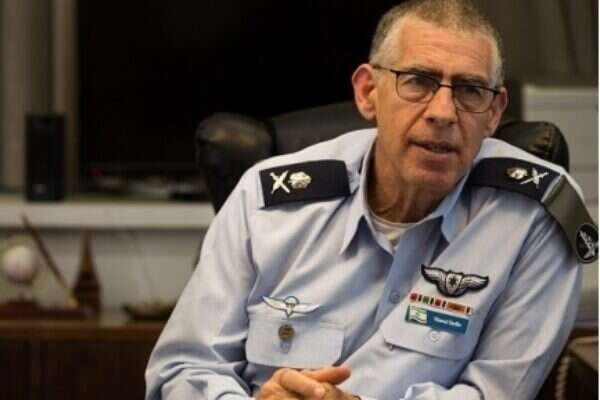
Maj. Gen. Nimrod Sheffer, the head of the Israel Defense Forces Planning Directorate, doesn't have any doubts: "I am honestly saying, with as much caution as I can muster here, that I think that the [nuclear] deal with Iran, as it is emerging right now, will not be a good deal for Israel. If such a deal is ultimately signed, we will have to ask ourselves 'okay, what are we going to do with this-'" Q: Are all the options on the table, as they say- "Yes. If someone builds a nuclear bomb and at the same time declares that the State of Israel has no right to exist, then we have to think about how to respond. It goes beyond a simple challenge." Q: Could we take dramatic steps in defiance of the American position- "When it comes to our national security, the answer is yes." Q: You started out in the Israel Air Force when Israel bombed the nuclear reactor in Iraq in 1981, and according to foreign reports, the same air force bombed a facility in Syria in 2007. Can you envision a situation in which Israeli jets bomb an Iranian nuclear facility in defiance of the U.S.- "Since it has already happened in the past, I don't see any reason why it shouldn't happen again. I think that where Israel feels its existence depends on action, it will take it. I think that any true partner would accept that, and I honestly think that the Americans are in fact true partners, despite all the tension. They are a true, authentic partner, not just a façade of partnership, and I do think that they would be understanding. As long as Israel instructs its army to do what it has to do because that is the right thing to do for Israel's security, I think it will be accepted. That is why I am certain that any decision on this issue will not be the thing that destroys the relationship between the U.S. and Israel." • • • There are only a handful of people in Israel who have access to (almost) all the country's secrets. The head of the IDF Planning Directorate is one of those people. This position entails overseeing not only the IDF's future plans but also, maybe most importantly, the IDF's strategy: anything from peace agreements to war plans; from covert operations to relations with friendly (and not-so-friendly) countries. Sheffer has a hand in everything. He takes part in every meeting, and is fully abreast of all the details. Anyone who knows him will attest that he will always say whatever is on his mind, even when his opinion doesn't exactly sit well with his audience. Here, too, in his first interview since he was a young colonel (a rarity in the glory-seeking Israeli military), Sheffer speaks with unusual directness that contrasts starkly with the many sensitive issues he must maneuver on a daily basis, not least of which is the Iranian-American problem. "Strategically speaking, the direction is very clear," he says. "Iran is trying to become a regional superpower in every respect. It wants to be an industrial, military, scientific and cultural superpower while generating a lot of terrorism as well. Its expansion, including what we are clearly seeing in Yemen now, precisely serves the same idea of spreading multiple tentacles throughout the Middle East." "When I look at the entire game, it is very obviously designed to cement Iran's status as a superpower in the region -- one whose influence far exceeds the country's physical borders. That is the Iranian game. Having nuclear capability would certainly serve this effort, because when you are a nuclear superpower there is very little anyone can do to threaten you in other places." Q: You used the word "game." Is that what the Iranians are doing? Playing- "Unequivocally, yes. They are constantly asking themselves how they can make sure to get nuclear weapons. I don't know if they will do it tomorrow or the next day, but when it comes to Iran, I have no doubt in my mind that the general idea guiding them is to possess nuclear capability that will allow them to realize their vision of regional domination." Q: Does that mean that the Iranians are lying when they say they are not seeking nuclear weapons- "I think that if you add one word it would complete the puzzle. Iran does not seek nuclear weapons now. But a country that doesn't want any nuclear capability can find other ways of producing nuclear energy for civilian purposes. It abides by the rules -- all the inspection rules and all the oversight rules. That is not the case with Iran." Q: When you speak with your colleagues around the world, do you find that they don't understand that- "Most of them do understand, but they don't live in the Middle East. And I say that without an iota of cynicism. The rest of Iran's influence, on which it seeks to build its nuclear umbrella, isn't palpable in other places. When you are in the Golan Heights and you watch Hezbollah already headed there, and when you realize what is happening in Lebanon, and when you look at what is going on in Yemen today with the Houthis and how they [Iran] are taking over more countries, you begin to understand what this influence is. But when you are in Europe, I am not sure you feel that aspect of things." As the head of the Planning Directorate, Sheffer is an active partner in Israel's strategic dialogue with the U.S. The way he describes it, despite the obvious diplomatic rift between the two countries, the military cooperation is both intimate and intense, with the two countries' armies maintaining very close ties. "When I say that relations are very good, I don't mean niceties over the phone," he clarifies. "I look at the scope of the cooperation as it spans a wide variety of things -- thoughts and ideas, plans, intelligence and information, munitions and resources -- and it has not suffered one bit. But we have already learned that the Americans are capable of adhering to policy in a very unambiguous way." Q: Like when they delayed a missile shipment during Operation Protective Edge last summer. "With their typical American politeness, they told us 'Wait a minute. We need to check.' It wasn't a trivial matter, but we need to put it into proportion. The relationship is stable. I don't want to say it is invincible, because that is taking things too far, but it is certainly stable and it rests on sufficiently deep foundations." Q: Are you familiar with the argument that their leader, President Barack Obama, doesn't miss an opportunity to miss an opportunity in the Middle East- "That goes beyond the military realm. Keep in mind that just because relations are good doesn't mean that we don't have disagreements -- sometimes very unpleasant, piercing disagreements. I think that we often forget that they serve America's interests first and foremost. There is an Israeli influence, but at the end of the day it just an Israeli influence." Israel is not the problem The fear of Iran on the one hand and of radical Islamist terrorism on the other (the "Shiite axis" versus the "Sunni axis") has created an unusual situation in the Middle East where many countries, among them Saudi Arabia, the Gulf states, Egypt and Jordan, share common interests with Israel. Sheffer believes that this presents a rare opportunity because the "world around us is now starting to understand that Israel is not the problem in the region." Q: So everything that Europe is getting all wrong, the Middle East is getting right- "Absolutely. Anyone who lives here understands that Israel, or the Israeli-Palestinian conflict, are not the reason that the Islamic State group exists, or that there are terror gangs that kill thousands of people. They know that the Iranian nuclear bomb or the presence of Iranian terrorism across the Middle East have nothing to do with struggle between Israel and the Palestinians. The Israeli-Palestinian conflict does bother a lot of Arab countries not because they view it as the root of all evil but because it is about the Palestinians, who are Arab, and they would like to see the conflict resolved." Q: What would that achieve- "None of them think that it would stop Islamic State or the Iranian nuclear bomb. There are people in Europe who say that it will, but they don't understand. But if you look at all the other interests -- energy, stability, quality of life -- I don't see any reason at all why there should not be a closer partnership between Israel and, I'll say this with caution, all its neighbors." Q: Overt partnership or a secretive one- "In the Middle East, sometimes it is better to have a mistress, but you would never say 'that's my wife.' There are all kinds of partnerships, and if going public would be detrimental then there is no point in doing it. It would be silly." Q: It is nice that in the region, we are expected to resolve the Palestinian issue. The question, which has long become a clich , remains: Do we have a partner- "First of all, I am not sure. But I think that Israel should aspire to do the right thing for Israel. On many issues we do not have a partner. We also do not have a partner in our efforts to stop Iran's nuclear program right now. But you asked me earlier what Israel would do if it had to do something about it, and my answer was that Israel would do whatever is right for Israel. The same is true with this: The question whether we have a partner is good and important -- and the other side's strategy right now is taking us to bad places and showing us that actually there isn't anyone who wants to talk to us that much -- but I don't want to be dependent on others. Most importantly, I want to make sure that I did everything in my power to protect my interests." Q: So what are the alternatives, in your opinion- "The prime minister said two states, and he also said that now is not the time because of the instability and threats all around us. Without going into too much detail, I think that if Israel says that this is the solution, it has to make every effort to achieve it, even if the partner on the other side is very problematic." The solution that ensures stability Q: How concerned are you about the international initiatives currently being pursued by the Palestinians- "I am concerned." Q: Are you preparing for the possibility that Israel will face sanctions- "We are not preparing. But we are concerned. I think that there are measures here that could spiral out of control, for example the membership in the International Criminal Court in the Hague. This could lead someone to sue the State of Israel and throw the entire system out of balance." Q: What is the likelihood that the U.N. will recognize a Palestinian state anytime soon- "I have already learned that trying to make long-term predictions in the Middle East is never a good idea. I will cautiously say that the U.S. would likely prevent it, so in my assessment it won't happen in the near future. But other things could happen in many different realms, like the financial one example. We are already seeing hints of it, like the labeling of products manufactured in all sorts of places. It could get worse." Q: Would you agree that the best place for Arabs to live in the Middle East is Israel? And that the second best place is the West Bank- "True. But they don't see it that way. Obviously none of them want to live in Syria or in Yemen, or even in Egypt, but they do want to live like the people living 20 kilometers (12.5 miles) from them in Tel Aviv or Haifa. If they also begin to see things the right way, how things could be, then the joint potential here would be enormous." Q: Let's talks about Gaza. Six months after Operation Protective Edge, are you able to say what we have achieved- "Let's begin with the basics: We dealt a significant blow to Hamas' military capability, but I think that we achieved another thing, and that is the potential for long term stability. It depends very much on what we do and what the world will do." Q: You mean that it is in Israel's best interest that their condition improves- "Yes, and I don't mean it in the cynical way, that if we build them a house we will have something to tear down later. I really do think that we need to invest in supplying them energy and water, or to provide the conditions for them to supply it to themselves so that they can drastically rehabilitate, and that the rehabilitation will be more tangible, and the people will feel actual change. That way the likelihood for stability will be higher." Q: Some would say that this is a Hamas victory: They fired rockets at us and we are rehabilitating Gaza. "I think that our goal should be to look forward, not backward. To ask ourselves what we can do to really prevent another Operation Protective Edge in a few months' time. As far as I understand, it is mainly the financial aspect and everything having to do with rehabilitation and rebuilding the Strip." Q: Was it a mistake not to deepen the operation and take the opportunity to defeat Hamas entirely- "I read and heard all the cynical remarks on the issue. I can tell you that the cabinet truly considered all the alternatives and discussed them in depth. Only history will tell whether we were wrong. If another operation begins soon then maybe yes, but if there are years of calm and stability then maybe not. But as I said, it depends on us as well." Q: Is Hamas renewing its strategic capability- "They are doing that, yes, with high trajectory rockets and tunnels, but we need to be honest and put everything on the table: This comes as no surprise. Every country, every organization, would do exactly the same thing after a war -- they rehabilitate themselves. We do it too, incidentally." The mechanism of terrorism The arena that Israel, including the IDF Planning Directorate, finds most alarming is the northern border. Sheffer describes a single front -- a combination of the borders with Lebanon and Syria -- that is currently posing an ever-escalating challenge. There is the quantity and quality of Hezbollah weapons and there is the Syrian border, which has become far more tumultuous than it was in the last 40 years. Sheffer is worried that local incidents will spiral out of control and lead to unwanted escalation. But he is also encouraged by the evident Israeli power of deterrence. Q: Please explain. "[Hezbollah chief Hassan] Nasrallah is not thinking about any incident on the border, he is thinking about 2006 [the Second Lebanon War], when buildings collapsed in Beirut and the Shiite infrastructure suffered a terrible blow in southern Lebanon. He understands very well the game he is playing, firing from populated villages. He is the one who caused it, and he will be the one to force us to take action against them in the future. Q: And the people that you meet in the world don't understand that- "We really are making every effort to make it clear that this Iranian fighting style, which is spreading throughout the Middle East, will be the lot of anyone who combats terrorism: ours, in Lebanon and Gaza, but also the Americans' in Syria and Arab countries' in Iraq and Syria, and now in Yemen as well. Like us they will have to deal with terrorism that comes out of cities and carried out by civilians." Q: But we are still being criticized for it. "There are two alternatives for the missile in Lebanon: Either I attack and destroy it, or it is fired at civilians in Tel Aviv or Haifa. It doesn't strike the Iraqi desert in Mosul, and no one is firing at Boston. The missiles are pointed at us, and that is why you can only judge us from here. When you fly a helicopter from Tel Aviv to the Golan Heights you understand perfectly what is at stake. In order to get from Boston to the closest place that poses a threat you have to fly 1,000 kilometers [620 miles]. That is the difference, and I think that anyone who comes here understands that." Q: Can you estimate approximately when Islamic State will reach our northern border- "No. But it could happen. That is why we are so busy boosting our defenses along the border." Q: Can anyone say how or when the war in Syria will end- "Things are only getting more and more complicated. I read somewhere that the average life expectancy in Syria has decreased by 20 years over the last four years from 77 to 57. One percent of the population has been murdered and another quarter of a percent has fled. These are crazy numbers. Why am I telling you this? Because I think that there is no going back from that. That is why something new will emerge there, which could be the direct continuation of the chaos that is raging there now, but it could also be a certain division into cantons, or it could be a dangerous deepening of the Iranian influence, like what we are currently seeing in Yemen. But my job at the Planning Directorate is not just to look at the threats but also to discern the opportunities." Q: Are there opportunities in the north- "We have to look for opportunities for cooperation, even if not formally. Peace with Lebanon is tricky, but it is enough for us to keep in mind that there is a lot of natural gas in the sea, and that a maritime border was never drawn to realize that there is a lot of potential, and that we should be thinking in other directions." Security is expensive business Sheffer is due to complete his term as head of the Planning Directorate at the end of summer. As a fighter pilot who served most of his military career in the Air Force, he had hoped to be appointed commander of the Air Force, but that dream will go unfulfilled. Instead, he may find himself in Washington as the IDF attache. Until then, he has one important mission: To complete a long-term work plan for the IDF. Q: In the IDF, people are saying the current situation is a catastrophe, in the absence of an organized work plan. "It is not that we are not doing anything. We are simply not doing the best we can. Because when you think only in the short term, and your planning only goes 12 months into the future at most, then you are necessarily not doing your best thinking." Q: What are you going to do differently when you work out a five-year rather than a one-year plan? "A lot will be different. Mainly I will be able to think about what will make the IDF better in the future rather than tomorrow, and go backward from there, taking measured steps, and think about how I can get there. If I see the end of the process, I am more willing to take risks and launch big measures that cost a lot of money or involve a lot of people, because big measures can only be undertaken after having looked far ahead. You never establish new divisions or squadrons when you don't know what is going to happen, and the opposite is true as well. We will know much better how to budget when we plan for the long term, because only that way will we be able to achieve our objectives while ensuring that we are the best we can be at all points leading there." Q: In your opinion, is the state investing too little in defense? "The way I see it, yes, but that doesn't matter." Q: Why- "Because the state invests what it thinks is right in defense, and our job is to turn that into maximum security. So it is true that I am fighting for a bigger budget, but at some point the fight has to end and we need to understand that this is the extent of our resources and we have to generate as much security as possible from it." Q: What you are saying would not have gone over well in the IDF, where it is customary to complain about shortage. "One of the IDF's biggest assets, in my opinion, is the public's faith in it, in us. And that cannot be purchased with money. I earn that faith with my conduct. I have a feeling that whenever we are perceived as a body that lacks credibility, or as one who is never satisfied, we lose points in the public's eyes. So it is true that there are those who blame the media, the political cartoons and the satire programs for our image problems, but I ask myself what we have done to earn it, and how we can turn it around." Q: And how do you answer yourself- "That we need to be honest with ourselves, first and foremost. The people of the IDF have a high enough level of morality that if I feel that I'm doing the right thing, you will likely feel that what I'm doing is the right thing too." Q: What makes you so optimistic that you will be able to formulate a long-term plan for the IDF? "I think that after so long without a plan, there is now a profound of understanding of all the problems that absence creates. But there will certainly be dilemmas, because this plan will be challenging for the IDF. We will have to let go of hundreds of people, or more. We will have to ask ourselves hard questions about the big empowerment plans. Mainly, we will have to strike a balance between what we are building or creating for the long term and making sure that the IDF is prepared for battle in April or May." Q: Do these things necessarily come at each other's expense? "Yes, one is necessarily at the other's expense. The last few years have demonstrated that very clearly. I don't know how to build satellites more efficiently. Even today, no one in the world understands how we do it with the amount of money that we invest, and that is true for drones and other things. But ultimately, we won't be able to do it at half cost, and there is also no way to train a tank operator or a pilot with less money. There just isn't. Security is expensive business."
The missiles are pointed at us
IDF Planning Directorate chief Maj. Gen. Nimrod Sheffer is worried • He says the world can't judge us until it's been in our shoes • He does not rule out dramatic steps to combat Iran's nuclear program • Iran deal "will not be good for Israel," he warns.
Load more...