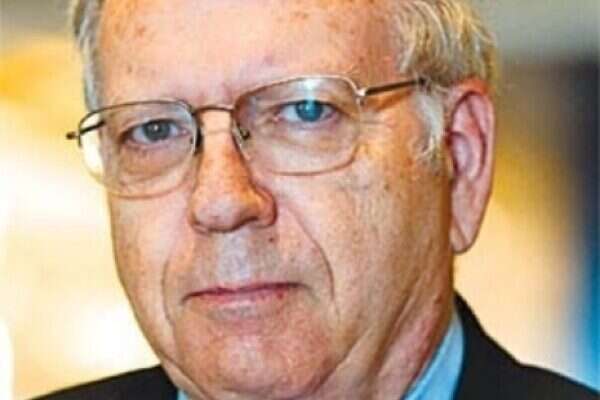
The ultra-Orthodox are furious with former Mossad chief Efraim Halevy, who told a gathering of graduates of army boarding schools last week that religious extremism is a growing peril to Israels existence and is a greater threat than Irans nuclear program. "Israels true existential danger comes from within," he said. As Halevy explained: "When I was in [the religious Zionist movement] Bnei Akiva, there were boys and girls. Were we not religious? Were the rabbis then not religious? What happened to us-" he asked. "I was educated there and I learned about religion and was warmly received. But ultra-Orthodox radicalization is darkening our lives," he said. "In Bnei Akiva, girls danced with boys. Were the rabbis of that time not religious? Former Israel Defense Forces Rabbi Shlomo Goren knew that there were mixed performance groups in the army. Did he say anything about it-" This incident with Halevy, however, is more important than others, because while it is typical of such arguments, this time the ultra-Orthodox took Halevy's words as a personal affront. Immediately after Halevy's remarks, there were cries of "anti-Semitism" and "incitement." There were Knesset debates and threats in the ultra-Orthodox press, during the week that the nation marked the 16th anniversary of Yitzhak Rabin's assassination amid declarations, statements and demands that certain people be brought to trial. Let us pause here for a moment and not just because when it comes to the crux of the matter, Halevy is right, but because when ultra-Orthodox politicos join the voices shouting "incitement" and "anti-Semites" it is an interesting development. So I took a gamble and purchased two of the ultra-Orthodox newspapers that is all this correspondent was able to find from the day before the storm erupted, a moment before Halevy spoke. No one can say that the tongue-lashing against Zionists in the ultra-Orthodox press was simply in response to what he said. It turns out that ultra-Orthodox hatred for anything outside their own camp makes Halevy's remarks seem like a class in proper etiquette by comparison. Here are some characteristics of the Zionist regime presented in those papers: "Hard-hearted," "filth,' "a choir of jackals," "murky thinking," references to "the idiocy of the state's constitution," "perverted minds" and "empty pits." "That which emanates from the defiled is defiled," one article said, and accused the Zionists of being "bereft of knowledge," and "thin-brained." There are more of these insults, but that is the overall spirit. And there is lots of it, all from just two newspapers, from the day before Halevy made his comments. Also note that the two papers from which this invective was taken represents a public with representatives in the coalition. On the other hand, the show of hypocrisy from the representatives of those experts in obscene curses who complained about incitement, fits the principle established by the HaGashash HaHiver [The Pale Tracker] comedy troupe: "He who speaks in curses may his father's father's father's father be cursed." The ultra-Orthodox reform, which transforms sins like insolence, impertinence and exploiting the Torah for financial gain, among others, adheres to the principle set years ago by one of the Hungarian community's rabbis. The rabbi and the priest there were on good terms, and one day the rabbi asked the priest what exactly happens in the confessional. The priest offered the rabbi to join him in such a session. In the morning, the rabbi sat next to the priest. After a few minutes, a woman entered the confessional and said: "Forgive me father, for I have sinned." "What was the sin-" asked the priest. "I cheated on my husband," she said. The priest asked, "How many times-" "Five," she responded. "So please put a five pengo bill in the collection tray at the church entrance and Jesus will immediately forgive you." After her, a woman came in who cheated on her husband three times, and was told by the priest to put three pengo in the collection box. At this point the priest said to the rabbi: "Do you want to do the next confession on your own-" The rabbi said: "Why not-" They waited a while and another woman entered who had cheated with her neighbor. The rabbi asked: " How many times-" The woman answered: "Twice." The rabbi said: Put two pengo in the charity box." The woman thought a moment and said: "But I only have a 10 pengo bill." The rabbi mulled it over and said: "So put in that bill and you've got eight more trysts with your neighbor." One of the many discussions about Halevy's remarks took place on the afternoon news report of Army Radio. Halevy and some ultra-Orthodox journalist were talking. The latter made claims proving that every rule has an exception, even the accepted one that studying Gemara sharpens the brain. He then gracefully offered Halevy to "return to Judaism." It was a good example of the most repulsive kind of arrogance. Not just because Halevy and his family are traditional Jews, and he is extremely restrained as exemplified by his lack of response to these attacks. But because Halevy, unlike the real reformers who are the ultra-Orthodox politicos, did not back down. We can also say: What Halevy accomplished in one year at the Mossad, not one of the ultra-Orthodox journalists accomplished in their whole lives, even if we double or triple their number. There are quite a few mitzvot the ultra-Orthodox reformers canceled in the last few years: Not only the obligation to serve in wars considered a mitzvah according to Judaism, but also what the Yom Kippur confessional prayer calls the "sin we have committed against you with brazenness." Which reminds me of the guy who goes into a restaurant and does not see a kashrut certificate. The man turns to the waiter and says: "Tell me, do they have pig here-" The waiter looked at him and said: "Now we do." A bronze medal Over the past two weeks the media has been interviewing both the current and past heads of the defense establishment regarding Iran. They talk about the Israel Defense Forces, the Israel Security Agency (Shin Bet) and the Mossad. Missing from this list is Uzi Arad, who served as national security adviser and Israel National Advisory Council head, and Yaakov Amidror who took over from Arad as national security adviser. The Council head holds an extremely important position because he is privy not only to the raw intelligence data all the others can see, but is also always the prime minister's right hand man. He is responsible for preparing the model used by the president in determining the administration's stand on the issues. Despite all that, not a word was heard from either of them on this issue. We should keep in mind: Arad quit his post as national security adviser and head of the National Security Council (after an impressive career in the Mossad and academia) leaving behind him a trail of journalists' accusations that he leaked material. Since then it has been proven Arad never leaked anything. The facts are known to at least two reporters who floated the accusations against Arad. Neither of them has asked his forgiveness. Arad deserves to hear that from them. If we are already talking On the eve of the disengagement from Gaza, Kadima MK Meir Sheetrit stood at the Knesset podium and listened to claims that after the move, Qassam rockets would be fired from the Gaza Strip. Sheetrit excitedly declared: "There is a claim that communities in the Negev will be in danger. I have never heard such a ridiculous argument." This week he declared that if he is given a chance to be prime minister there would be peace within a year. Yeah, right. "I am always ready to be prime minister," Sheetrit said. Or as my righteous late grandmother used to say: "When Eisenberg the green grocer tells me in the afternoon that his fruit is ripe, I know it means that by evening, at the latest, they will be totally rotten.'"
The rift grows wider
Ultra-Orthodox politicos are furious at former Mossad chief Efraim Halevy, after remarks he made touched a nerve • Their hatred for anything outside their own camp makes Halevy's remarks seem like a class in proper etiquette.
Load more...