The Supreme Court on Thursday morning rejected the appeal of former President Moshe Katsav, who was sentenced to seven years in prison following a conviction on two counts of rape and sexual assault. The disgraced former president is expected to begin serving his term on Dec. 7. Katsav was found guilty last December of raping a former employee when he was a minister and of sexually harassing two other women while president from 2000 to 2007. He was sentenced to a seven-year jail term in March, but was allowed to stay out of jail pending his appeal. The Supreme Court on Thursday morning announced that it would not challenge the previous ruling from a district court, finding that the testimony of the main complainant was "credible," and that the jail term was not excessive. The Supreme Court ruling, which was unanimous, comes one year after Katsav's conviction. In their ruling, the judges wrote that Katsav had "a repeated sexual pattern with several of the claimants against him." The judges wrote that the Katsav trial marked a historic event the first time in Israeli history that a president had been accused and sent to prison for such crimes. "The president's status and policies reinforce the sense of mutual commitment among the citizens of Israel to the state and the people, to national symbols and the sense of belonging," the judges wrote in their ruling, later adding, "The president represents the country and its moral and democratic values." While some in the former president's hometown of Kiryat Malachi lamented the fall of their most famous son, others in Israel heaped praise on the nation's judicial system, which proved that no one, no matter what their status in society, was above the law. This sentiment was echoed in the judges ruling, as they wrote: "Everyone is equal before the law. All men are equal before the law and to the judge. Large or small. Rich or poor. Respected or simple. When they stand before the court, they are naked as on the day they were born, equal among equals. The same shall apply to the appellant's case. The appellant must be punished like anyone else and his position must not be given such weight or consideration." They concluded their ruling by reflecting the sadness and to some extent shame that many Israelis feel about the case. "A deep sadness descends on the state of Israel when a former government minister, deputy prime minister and president is found to have committed such acts," the judges wrote. "The most difficult thing is to witness the man who served as a national symbol of the country go to jail." Katsav was ordered to present himself at the designated prison at 10:00 a.m. on Dec. 7. His lawyers, family and associates raised concerns for the former president's state of mind, with some saying that he might take his own life in prison. According to reports emerging from the courtroom, Katsav kept his composure during the hearing, but had at least one outburst where he again denied the accusations against him. The crimes for which he was convicted in Dec. 2010, after rejecting a plea bargain that would have enabled him to avoid spending time in prison, included two counts of rape and one count of a forceful indecent act on a woman who ran Katsav's office when he served as tourism minister, sexual harassment of two other women who worked for Katsav when he served as Israel's president, and obstruction of justice. Legal experts believed that Katsav's chances for an acquittal were slim, but that the sentence given to him by the district court would perhaps be lessened by the Supreme Court, due to conflicting opinions concerning the severity of his sentence. Yehudit Shevach, a judge on the district court panel that tried Katsav's case, voted for a prison term of four years instead of the seven Katsav was ultimately given. Shevach said at the time that Katsav was already judged in the media, as well as by then Attorney General Menachem Mazuz, and thus deserved a lighter sentence. In the appeal, Katsav's attorneys, Avigdor Feldman, Zion Amir and Avi Lavie, denounced the sentence and wrote that Katsav "entered the courtroom with the mark of Cain, a rapist, and a serial sex criminal branded on his forehead." Katsav himself had several emotional outbursts during court deliberations on his appeal. When prosecutor Ronit Amiel claimed that he "transgressed, and is carrying a 'hump' on his back," Katsav shouted, "There's no hump on my back, it is on you all," and left the courtroom. Katsav's attorney, Feldman, criticized the Supreme Court's decision, claiming that the court was biased against Katsav from the beginning. The attorney said the court believed "A" despite big gaps in her testimony against Katsav, saying, "They would have believed her if she said the rape occurred on Venus." Prosecutors asked the court to uphold the original sentence. "The court explained why it believed the complainant and did not believe Katsav's string of lies," the prosecution wrote. The Supreme Court justices presiding over the appeal included Miriam Naor - who presided over the 1999 conviction of former Shas party leader Aryeh Deri; Edna Arbel - who served as Attorney General from 1996 to 2004, during which former prime minister Ariel Sharon and his son Gilad were indicted on charges of corruption, and Salim Joubran - the first Arab-Israeli Supreme Court justice, who is known for his severe rulings in rape cases. Presiding Justice Naor said, "Our verdict is unanimous. Regarding 'A' [name withheld] at the Ministry of Tourism, the District Court convicted on two counts of rape and forced sex. The District Court found 'A' to be credible and there is no justification for intervening regarding the plausibility of 'A.'" Naor added, "If 'A' had wanted revenge on Katsav she could have done so before he became president of the state. And if we are talking about a libel, she could have made up another story and not said that the first rape took place on a day that was not a regular work day in the ministry of tourism. We reject the defense's claims to quash the testimony of 'A.'" Women's rights advocates were pleased by the Supreme Court's decision on Thursday. Labor Party leader Shelly Yachimovich, who testified in court for the prosecution, welcomed the Supreme Court's decision and said that justice was served, according to Israel Radio. She said the decision shows Israeli citizens, "that there is equality before the law and that presidents, powerful leaders and simple citizens alike are all equal under the law. Echoing Yachimovich's remarks, Kadima head Tzipi Livni said, "The Supreme Court ruled that justice had prevailed and the doubts that [the defense] tried to raise over the victims are over and done with. The victims are brave women that will empower all women who have been sexually harassed to speak out. Ronit Ehrenfreund-Cohen, director of Women's Status Promotion in WIZO (Women's International Zionist Organization), said, "The time has come to curtail sex offender Katsav's freedom and bring the embarrassing affair to a close - an affair that developed in government halls and shamed us all. Thousands of sex crime victims are waiting for the court to mete out justice to this criminal." Before the Supreme Court's verdict, a Katsav family member expressed concerns over Katsav's fate. "We are still worried that something will happen to him, because he is facing difficult accusations. I know him well though. He is a strong and stable man." In Kiryat Malachi, Katsav's hometown, many people still admire the former president. Many say, "He is a good man." One resident said, "All eyes are upon us now. They should have sentenced him to public service. The entire case in court was not fair to him."
Get the Israel Hayom newsletter sent to your mailbox!
The judges rejected the argument from Katsav's defense team that their client had maintained a consensual romantic relationship with "A," a woman who worked for Katsav during his tenure in the 1990s as tourism minister.
X
שיתוף כתבה
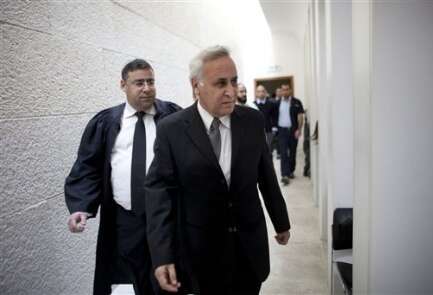
Rejecting appeal, court sends former President Katsav to jail
Historic day for the state of Israel as Supreme Court rejects former president's appeal over rape conviction • Katsav's lawyers: "He entered the courtroom with the mark of Cain" • Katsav to begin seven-year prison sentence on Dec. 7.