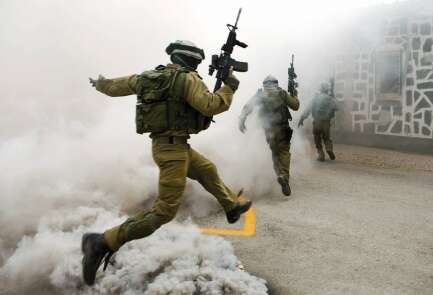
This spring marked twenty-five years since the establishment of the Israel Defense Force's elite Duvdevan Special Forces unit - famous for its daring, and deadly, undercover operations against terrorists in the West Bank. This special birthday was celebrated in style recently at the unit's base, whose exact location is kept secret, parts of which look more like a resort than a military camp. Over 3,000 of the unit's current and former fighters were invited to the celebration. The soldiers' ages spanned a full generation, with 19-year-old soldiers, still in the midst of their training, alongside no-longer-slender fighters in their mid-forties who could have passed for their fathers. As the evening began, the soldiers were served generous portions of the finest army cuisine, based on the ancient IDF culinary method: whatever it is, just fry it and serve. Later, they spread out across the base to gather in groups, organized by squad. Boisterous conversations ensued, punctuated occasionally by shouts welcoming newcomers into the circle. There were loud outbursts of laughter, and friendly slaps on shoulders, backs, rear ends and even on cheeks. The truth is that it's easy to understand their excitement. After all, they've experienced a lot together, as former unit commander Colonel G. explains. "I became Duvdevan's commander after a long stretch with the naval commandos, and I can tell you I've never seen such camaraderie or teamwork. These guys can recognize each other in the dark by touch, or even by smell. They're experts in tough fighting in close quarters, displaying amazing teamwork." The squads reflect their generations. Many of the squads are made up of the same diverse gallery of archetypes. There's the guy who, ten years later, is still on his post-army trip. He shows up wearing dreadlocks, giving a hug to his newly-religious comrade, decked out in ultra-Orthodox garb. There are the moshav and kibbutz members in cut-off shirts and shorts, careful not to stain the buttoned-down shirts of the lawyers or slightly embarrassed financiers in their dress pants and fancy shoes. The religious guy introduces them all to his shy, young, pregnant wife - the only one who escapes the bone-breaking welcome slap, which is how they greet each other here. The Mythological Rifle Company: Ehud Barak, Uri Bar-Lev and Shaul Mofaz After greetings from the Chief of Staff and a slew of commanders, the fighters conclude the night's festivities with a private performance by singer Dudu Tassa, before going their separate ways. But to really tell the story right, we must return to earlier in the evening, when retired Major General Uri Bar-Lev climbed up the road from the main gate, limping slightly, and joined the group, drawing over all the old-timers for a relatively modest wave of hugs and slaps. In the spring of 1986 they founded the unit together, he as their commander and they as his soldiers; and it's clear they respect and love him, and that's all that matters right now. Together they recalled the time when Central Command headquarters was still located in Jerusalem's Neveh Ya'akov quarter, under the command of Major General Ehud Barak. Barak realized at the time that the Palestinians throughout Judea and Samaria were becoming more restive. Within a year and a half, the first intifada would erupt overnight. Barak did the math. He understood that the operational reality was changing. Until then, his men had dealt mainly with stone-throwers and the occasional improvised Molotov cocktail, but the situation in the alleys of the refugee camps was at the boiling point. Barak knew that real armed terrorists could soon be waiting around the corner, planning serious attacks, and wondered how he would get his hands on them. A very special kind of person was required, and luckily there was Uri Bar-Lev, who was quickly summoned back from civilian life to a private meeting with the major general. The two had met years earlier at Northern Command, where Bar-Lev, a young company commander, was dispatched by Barak on special operations across the border. In one of them, Bar-Lev lost a leg from the knee down, but he had kept his spirits high, and Barak thought and in retrospect, his intuition was right - that maybe Bar-Lev was his man. "I was a computer guy at El Al at the time," Bar-Lev recalls. "But we knew each other from our early army service in Northern Command. He called me to Central Command headquarters and outlined a plan to put the terrorists on the run, making them fear for their lives instead allowing them to plan and carry out attacks. "He told me: 'I propose that you establish a force specializing in fighting terror, and operating effectively even within the refugee camps, a unit that would be assigned the tasks that are the 'cherry on top' in the battle against terror.' I came up with the name for the unit (Duvdevan means cherry in Hebrew) from his words and told him 'okay,' and started working." In its early days, Duvdevan was a small unit of fighters, who learned as they went along, gaining experience in carrying out special operations while training in a fenced-off part of a large special units base north of Jerusalem. There, Bar-Lev devised an exhausting training routine, which included some 80 kilometers of individual navigation exercises, long hours of target practice and urban warfare, and a 124 kilometer-long hike concluding the course. Someone would have to submit themselves to this craziness, and Barak gave Bar-Lev a free hand to recruit suitable soldiers in any way he saw fit. That's how Bar-Lev's staff, riding in fancy cars, began chasing after army trucks leaving the Paratroopers Brigade in Beit Lid for Army Training Base 1 in Mitzpe Ramon, filled with outstanding fighters and commanders meant to be Paratroopers Brigade officers. "We would stop them at the orchards outside of Beit Lid," he remembers, "climbing aboard after we had already gathered details about them and knew which soldiers we wanted. We didn't have to describe anything about what they would be doing [in the unit], because as soon as we said "Duvdevan" they immediately understood. The young soldiers immediately agreed to serve with us as fighters, grabbed their equipment bags and gladly jumped into our cars. Not one refused." At headquarters in Beit Lid, Paratroopers Brigade Commander Col. Shaul Mofaz was furious that his best men were being stolen from him right under his nose. But Barak had given Bar-Lev his total backing, and every combat soldier knows that riding in an army vehicle going on an operation, especially if you're disguised as an Arab, beats sitting in the back of an army truck. The unit's symbol was born when the first team neared the end of its training and needed to distribute fighters' pins. Bar-Lev: "I went to a Lebanese illustrator who converted and went to live in Ofra, and who placed the lily, the well-known symbol of the intelligence service, over paratrooper wings. I paid for the first printing and for the first hundred pins, which we distributed to the fighters at the ceremony at the end of the training course, also attended by the Chief of Staff and the heads of the Israel Security Agency [also known as the Shin Bet], the Mossad and other major generals. "We immediately began working on disguising ourselves as Arabs, because we knew that the first thing was to stake out our place in the field so we could raise the level of our operational responses," says Bar-Lev. Fig sellers, a trojan horse and the cherry-eater One by one, terrorists in Judea and Samaria began to experience bitter surprises. Imagine being a terrorist for a moment. You're walking down the alley near your house, comfortable in the heart of Hebron or Nablus, right after organizing the transfer of an explosives belt for a terrorist attack that evening. On the way to a local hole-in-the-wall to eat a plate of food, you kick an empty can out of boredom, and notice a fat old woman in traditional dress sitting on the ground, with a basket of figs for sale. Suddenly she jumps up athletically, pulls a loaded gun out from among the figs, puts it to your foreheads, pushes you into a passing car and is gone within ten seconds. Now you're crushed, blindfolded and in the car between the legs of Israeli soldiers taking you in for an interrogation by the Shin Bet, which you've heard is quite unfriendly. And who knows what will happen there, if the interrogation will ever end, and how you'll keep any secrets from them now. The nature of the intimate relationship between Duvdevan's fighters and the terrorists of Judea and Samaria is such that terrorists are quite interested in learning more about the unit. Thus, responsibility requires us to assume that the enemy is also reading this article, and to take care to refrain from revealing even a single piece of information that the enemy is not aware of. Describing Duvdevan's operational activities, therefore, is like serving a meal without spices. But we will try to work with what there is. Let's return to the fig seller, who could also be a stall owner, a street urchin, a prickly bush on the side of the road, a pile of vegetable containers or anything else you can imagine - or not imagine - out of which a ghostly Duvdevan figure emerges to capture or assassinate a terrorist. There is plenty of operational back-up for these disguised fighters, whose job is to carry out surveillance, arrests, assassinations, lookouts, intelligence-gathering using a variety of other techniques. Sharpshooters track the operation. Camouflaged rescue squads wait nearby. Meanwhile, inside the getaway car, referred to as the "horse," a trained driver waits for the order to pull into the alleyway. A permanent rapid response team from the unit is also ready to act around the clock, on two to three minutes' notice. In his room at unit headquarters, Lt.-Col. S., the current commander, gets ready for the party. It's cherry-picking season, and a basket of sweet, red cherries, a gift from a farmer from the Etzion Bloc to the unit in honor of the anniversary, sits on his table. S. is the first commander to rise through the ranks. He has served in Duvdevan for 18 years, rising from the rank of private to become commander of the unit. One look at his huge hands, which are shoveling cherries into his mouth at the moment, and it's impossible not to imagine the huge number of terrorists that they've dragged out of bed and pushed into a "horse," or pulled out of a car, suddenly tearing them from their lives shaking, shocked, and now stripped of any glory. He speaks as you'd expect: giving short answers, and stingy with the details. "The unit is involved in operations to prevent terrorist activity, in increasing its abilities, learning about the enemy and improving our inventiveness," he says. Nothing is unplanned: The Oslo Accords, Marwan Barghouti and the Church of the Nativity Col. G., who was commander 15 years ago, bet even then that S., a young lieutenant, would be the first commander of Duvdevan from within its ranks. It was a time when several officers from the naval commandos headed Duvdevan. After them, there were commanders from the air force commando unit Shaldag, from the infantry, and now, they hope, Lt.-Col. S. will ring in a new era of homegrown commanders. But it was under Col. G that the unit faced a stiff challenge. The Oslo agreements, signed during his tenure, constrained the unit's operations significantly. "Every operation that failed," he recalls, "was immediately discussed in the U.N., and you really felt the impact of the policy decisions. Suddenly we could not be caught in or openly enter entire areas where we used to roam freely. The price of making any mistake increased and we had to think differently, use more disguises and operate in unfamiliar places. We learned patience and how to restrain our aggressiveness. We had to make 'smart' arrests, so that those in the surrounding area wouldn't realize that a person had disappeared against their will, and there was an order from above to conduct 'clean' operations." At the same time, the unit matured, and an instructional company within it was formed which tried to develop some kind of professionalism based on written drills and an organized system of instruction. "It was a time of institutionalization, organization and establishing standards," he recalls. "Within three years the unit grew up and became an organized one, with regular and written exercises." In 2001, the unit dealt with two major tragedies. While attempting to capture Mahmoud Abu Hanoud, a major wanted terrorist at the time, one of the unit's forces fired at a camouflaged group of its own men, killing three Duvdevan fighters. The next year, while attempting to capture terrorists near Tulkarm, an IDF tractor knocked down a wall, which fell on unit commander Lt.-Col. Avi Weiss, killing him. But it's the small number of mistakes and missteps that prove Duvdevan's high level of professionalism, which at the time took a major role in Operation Defensive Shield. Its fighters encircled the Muqata, which then served as Yassir Arafat's headquarters in Ramallah, and arrested terrorists hiding in the Church of the Nativity. They also arrested terrorist leader Marwan Barghouti and took part in innumerable other operations, including operations whose complexity demanded weeks and even months of preparations and training, which Duvdevan carried out without a hitch in only two or three days. Col. A., who commanded the unit until recently, spoke of "superb professionalism, despite tremendous pressure. I remember whole weeks going by in which my first lieutenant and I never met, because we were busy running simultaneous operations." In recent years, things have quieted down significantly, and there have been far fewer terrorist attacks. Does that mean that Duvdevan's men can breathe any easier? Col. A. laughs. "The calm forced the unit to change, to develop additional techniques to reduce damage to infrastructure and avoid causing injury to innocent people. Once we would come to a fugitive's house, take all the people out and then send the house crashing down on the terrorist. We don't do that anymore, but we still need to capture the terrorist. It might seem like there are fewer top terrorist fugitives [these days], but on the other hand, our intelligence-gathering ability is also falling. So the unit still has plenty to do." We cannot describe the amazing exhibition of weapons and gear on display that evening, which are used at observation posts, and for sniping, communications and camouflage, and other equipment designed to achieve things we cant even mention here, but you can rest easy. That "fig-selling lady" is well equipped with weaponry, and it appears that anything the army has developed, as fantastic as it might seem, has been trained for endlessly, and perhaps already used in countless operations. The battle stories ahead: Weapons, fried kubbeh and the next generation The fighters amble through the stands at the exhibition, checking out their own weapons on display, and those that came into use after they had already left the unit. Observing their behavior and their faces as they make the rounds, the idea that these men are ruthless assassins seems ridiculous. The younger fighters' hands may be blistered from intensive training with the pistol tucked in their belts, but their eyes look the same as those of all their young comrades, the best of our youth who volunteer for elite units. I ask Col. A. if it's true that because of the nature of their activities, most Duvdevan fighters "lose it" at some point. "I am not aware of any psychological problems resulting from the difficult experiences or from the direct and aggressive contact with the Palestinians which characterize our actions," he says firmly. "I can certainly say that there are far fewer problems of this kind here than in your average infantry battalion, and that's because we're very highly skilled and trained." When the special evening ends, a few people stop, holding their chests, feeling the heartburn after the hamburgers, falafel and fried kubbeh from earlier in the evening. Will they return for the 50th anniversary celebrations, in the spring of 2036- Lt.-Col. S. smiles. "In 1994, when Gaza and Jericho were turned over to the Palestinians, they said they wouldn't need us anymore and we worried about what would become of us. In 1996, they eliminated the Shimshon special forces unit and we got worried again, but we're still here, with a growing volume of work, facing a much more complicated problem. The enemy isn't stupid, but tries to adapt to us by learning our methods and technology. That requires us to always be at least one step ahead, and for that we need many more years."