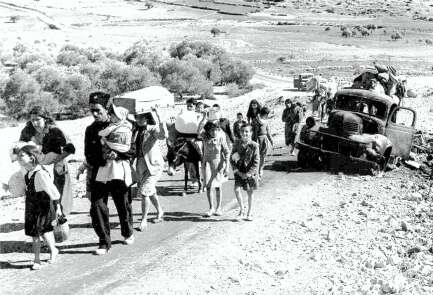
Security officials warn that in September, all hell is going to break loose. They have told the political echelon that the Palestinian leadership has raised the Palestinian populations expectations to intolerable heights. The Palestinian public is convinced that a Palestinian state with East Jerusalem as its capital will be established in several months. When their expectations are shattered and they realize that the Palestinian state exists on paper only, the third Intifada will break out. One of its components will be refugee displays and marches by refugees. According to the forecast, incidents similar to those that took place several weeks ago on the northern border will take place on the borders of Judea and Samaria and the State of Israel. This week in the Ben Shemen Forest, police officers attended the first training exercises intended to prepare them for the incidents expected in September. According to the scenario, thousands of Palestinians will march on the checkpoints along the separation fence in an attempt to infiltrate into Israel by force. Israeli Arabs will take part as well. All of them will unite under the banner of haq al-awda, the demand for the right of return. Security officials have told the political echelon many times that this demand is not merely tactical but fundamental. The Palestinians have no intention of taking it off the agenda. The security officials recommend that Israel prepare a public-relations response not only to the riots that will be taking place on the ground, but also to the Palestinians worldwide propaganda offensive, which will center around the right of return. Since 1949, Arab states say there are 900 thousand refugees. Official Israeli spokesmen have put it at 500 thousand. The United Nations Relief and Works Agency for Palestine Refugees in the Near East UNRWA, that came into being only after the refugees had left their homes, noted 726 thousand refugees. Today, most analysts put the number between six and seven hundred thousand. The Palestinians, according to four senior Middle East analysts we spoke with this week, are unlikely to drop their demand to return to Tiberias, to Jaffa, or to Haifa. The four well-known experts who have studied the development of the conflict, concur each in his own way about the circumstances that led to the creation of the Palestinian refugee problem. Prof. Benny Morris, once considered a post-Zionist radical leftist; has, for the last decade, been convinced that the Palestinians have pulled a fast one on the world; that they are uninterested in a two-state solution, that they want everything, including Jaffa, Lod, and Acco. In his books, Morris does not cut Israel any slack in describing the Palestinian tragedy and the circumstances of their uprooting and expulsion from their villages in 1948. But this week, Morris stated: Israel behaved properly when it decided in July, 1948, not to allow the refugee to return. Already then, its leaders understood well that returning refugees would serve as a fifth column, drown the nascent nation demographically and create an Arab majority in the Jewish state. The demographic contention is legitimate and, even today, would be accepted internationally as legitimate because the idea of a Jewish state is still considered by many communities as fair and just. Morris believes that former Prime Minister Ehud Olmert and Oslo Accord architect Yossi Beilin were mistaken in allowing each in their own era a more than symbolic loophole that would enable fulfilling the Palestinian right of return. If this symbolic loophole would have forced them to drop the demand to implement the 'right of return,' Morris writes, it would have made sense. However, The Palestinians did not, are not, and have no intention in the foreseeable future of giving up the 'right of return.' It's not a 'tactic,' it's a fundamental belief. Stopping the marches The roots of Yehoshua (Shuka) Porat, whose volumes on the flowering of the Palestinian nationalist movement are considered cornerstones of the field, are also planted deeply within the Left. In the past, Porat was one of the senior officials of the Meretz and Shinui parties, but he, like Morris, is resolute: The Palestinians will not waver on the right of return demand, because it is a useful weapon against us. They portray us as inhumane, and themselves as humane and pitiful, but beneath that image are intent on defaming Israel and eradicating out existence. Porat contends that, Israel cannot accept, under the rubric of 'right of return,' even one refugee or descendant of a refugee. On a practical level we must stop the refugee marches, and on the level of public diplomacy communicate that this is a foreign and hostile population, and that we as a society are not interested in changing the national character of our state. Prof. Rafi Yisraeli of The Hebrew University, an expert on the history of Islam and the Middle East, came to Israel from Morocco in the 1950s. He lived for years in a ma'abara (an immigration camp for refugees to Israel in its first years); today he resides in a beautiful home in southern Jerusalem's Ein Kerem neighborhood. Once an Arab village, Ein Kerem was abandoned by its occupants in 1948. The enormous difference, Yisraeli says, is that, within a decade and a half, we took in and rehabilitated the hundreds of thousands of Jewish refugees that left Arab lands, whereas [the Palestinians] have been hard at work for four generations perpetuating their status as pitiable refugees. There is no other such refugee situation that has continued on for four generations. Refugee or immigrant- Historian Prof. Yoav Gelber, of Haifa University, who heads up the Herzl Institute for Research and Studies of Zionism, penned Kommemiut v'Naqba. Gelber says the Palestinian refugee narrative suffers from serious factual distortions. Years ago, he pointed out the fabricated identity of Prof. Edward Said, the exemplary Palestinian refugee, a dispossessed resident of Jerusalem's Talbiyeh neighborhood, that he built for himself as a leading Palestinian ideologue in the 70s and 80s. Said, as it turns out, emigrated to Cairo when he was two years old. Gelber believes that the retroactive identity that Said adopted is representative of the feelings of guilt the Palestinian elite took upon themselves at the outset of the war. The Palestinian narrative talks about expulsion, Gelber says, but this story does not hold up under factual analysis. The wealthy among the Palestinians living here included quite a few businessmen and those of the free professions from Lebanon, Syria, and Egypt. They left as soon as they understood that there was going to be a war. Another group included villagers who moved to the cities primarily Haifa and Jaffa and simply didn't return to their villages, for example, of Taybeh and Tulkarm. Gelber says that yet another group was the Bedouins, who built their homes either in Jewish areas or bordering them one example is the Zinati tribe, who settled in Beit She'an, and crossed eastward across the Jordan River. They also just got up and left; no one was expelled. Gelber also points out that, when war broke out, the instances of expulsion were inconsequential: There were seventy thousand Arabs in Haifa when the war broke out, and in the forth week of April, 1948, before the Israeli forces conquered Haifa, thirty seven thousand remained. Meaning that half of the population left before the serious fighting. The Jewish leadership begged those who were left to stay, but they refused. Gelber says that even when the conflict moved from the phase of a conflict between peoples to one between nations, expulsions were localized. The vast majority left due to fear of war and bombings, and under the influence of radicalizing reports by the Arab propaganda outlets about slaughters perpetrated by the Etzel and Lehi. Leaving aside individual cases, there was no planned expulsion. There's the story of Lod, where the exodus may have been part foced, part self-expulsion, or villages close to Rehovot where there were Jewish settlements, as well as villages along the path of the Egyptian advance. Gelber attributes the testimonies that piled up over the years to an attempt by those fleeing to legitimatize their flight and pin the blame on outside forces. He also points out that Israel's first Prime Minister David Ben-Gurion refrained from conquering Judea and Samaria, after having received intelligence reports and assessments that the residents lving there wouldn't flee. Ben-Gurion didn't want to risk taking over such a large area, and one with an Arab majority, and didn't plan to expel its inhabitants, in the same way he didn't plan to expel the Arab inhabitants of areas that Israel counted on as its territory. Benny Morris also emphasizes that Palestinian propaganda adopted two lies and embedded them into the story of the refugees: The first that their narrative totally ignores the civil war that took place between the Palestinian community and the Jewish community between November, 1947 and May, 1948, one that the Palestinian community started. Their story begins with the invasion by Arab armies. The second lie is the claim was that the exodus was due to a planned expulsion. Morris also rejects the claim that the Arab Higher Committee (the central political body of the pre-state British Mandate era) and the national councils encouraged emigration. Morris dos however allow that the national councils and various militia officials on more than one occasion, ordered residents of towns and neighborhoods near population centers to evacuate the elderly, women and children to more secure areas. An example of this was in December, in Lifta (on Jerusalem's western edge), and in dozens of villages along the coast, and in the Jezreel and Jordan valleys. For years the Palestinians have been saying that the Hagana's famous Plan D, was the master plan for expelling the Arabs of the Land of Israel. Morris puts the issues into proportion in his book: 'Plan D' was intended to protect the areas where the state was to arise, its border, and the routes between Jewish population centers and the periphery. The plan estimated that the enemy's regular and partisan forces, and its militias would attack the newborn state in an effort to cut off the Negev and the eastern and western Galilee; to invade the coastal plain; and to isolate Tel Aviv, Haifa, and Jewish Jerusalem. The Hagana was instructed to prepare in the face of all that. The plan granted the brigades complete autonomy to conquer Arab villages, and, in practice, to decide each village's fate, whether to raze it and expel its residents, or to take it over. It clearly called for destroying villages that put up resistance, and to expel their inhabitants. In the main cities, the plan called for the battalions to expel the residents who resisted, and drive them into core Arab areas, but not to expel them from the country. In no circumstances are we talking about a policy or desire to expel the Arab inhabitants. Kenneth Bilby, one of the American correspondents working here in 1948, wrote that, the exit of the Arabs, at least at the beginning, got a lot of encouragement from Arab leaders like Haj Amin el-Husseini, and from the Arab Higher Committee... the Arab residents of the Land of Israel would flee to neighboring countries, something that aided in awakening the rest of the Arab peoples to greater efforts, and when the Arab invasion took place, the residents would be able to return to their homes, and be compensated with the furniture of the Jews that would have been thrown in the sea. Even Jordanian Defense Minister Edward Nusseibeh, wrote in his personal memoirs that Nobody believed that the war would continue so long, and end as it did. Everyone believed that within a short time the Arabs would return to their homes in the wake of the victory by the Arab armies, that would take over the country. His son, Prof. Sari Nusseibeh, several years ago allowed (Israeli historian and author) Dr. Tom Segev to peruse the documents, and Segev published them in his book, Days of Poppies. Shmuel Katz, in his book, Battleground: Fact and Fantasy in Palestine, brings many testimonies that apparently show how the great Arab exodus came as a result of encouragement by Arab governments. Prof. Yehoshua Porat notes that in 1973, Khaled al-Azam, who was Syrian Prime Minister in 1948, wrote that Adding to the defeat were the calls by the Arab governments to the residents of Palestine to leave. While Porat says the expulsion was a bluff, he adds that, Our own hypocritical version of events is not exact, either. However, he does not support the intensive activities of (a pro-Palestinian NGO) Zohrot, including their distribution of the Naqba educational package. They undermine the foundations of our existence here, and their material hold elements of half-truths. I once saw text that was appended to a map saying that Tel Aviv was built at the expense of Palestinian villages. What they don't say is that Tel Aviv began in 1909, and that in 1948, was a city of 200,000 residents. Porat, Yisraeli, Gelber and Morris all point out that in other places in the world, refugees are resettled in new areas and that millions were displaced in the last century, without blinking an eye, in Yisraeli's words. They suggest keeping this in mind when the descendants of refugees come storming the gates, and are convinced that fulfilling the right of return would be a suicide pact for Israel.
Yisraeli represents the comparison that the state of Israel is trying to make between the Palestinian refugees and the Jewish refugees of 1948. For years, he's been making the rounds with a presentation in which he stars as a Jewish refugee, and in which he makes the almost obvious comparison: Two historic events with an almost identical numbers of refugees: hundreds of thousands of Arabs that left Israel compared to hundreds of thousands of Jewish refugees from Arab countries.