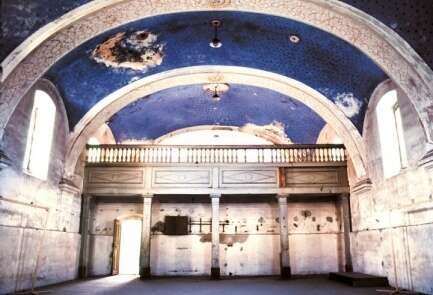
Bernadett Alpern did not grow up with a strong connection to her Jewish roots: Her mother is Christian and her paternal grandparents, Jewish Holocaust survivors, raised her father to be completely secular. "After they died, especially when my grandmother died in 2007, I suddenly had the urge to research the past," said Alpern, a photographer who was born and lives in Budapest. She went to visit Sarbogard, the Hungarian town where her grandfather was born. When she was looking for the synagogue where he used to pray during the holidays, she was surprised to discover that it had been converted to a large furniture shop. "That fact brought up a feeling that I can't really explain. On the one hand, the Jewish community in the town no longer exists and it is good that the space is being used in some way; but on the other hand, there is something strange about it, something a bit jarring, even sad." Alpern photographed the site in an effort to remember the moment and the feelings it stirred up, and after a while, she spoke about her experience to Ronen Dorfan, an Israel Hayom reporter who lives in Budapest. The conversation led the two on a journey through Hungary, Serbia and Bosnia, which was documented in the weekend supplement of this newspaper in 2012, with Dorfan writing the story and Alpern taking the photos. They located fancy buildings that were once the nuclei of thriving Jewish communities -- religious, social and cultural centers that are now being used as museums, libraries, concert halls, supermarkets, nightclubs, and in one case, a fencing club. However, what seemed like a complete experience became little more than a starting point. "I felt that this journey was as much external as it was internal and that there was more to do," Alpern said. A grant from France's European Association for Jewish Culture allowed her to go on another journey -- this time, it included 14 countries, 22 cities and more than 30 synagogues and it later became a publicized exhibition at the Ludwig Museum of Contemporary Art in Budapest. A grant from the Hungarian government allowed her to take yet another, more in-depth journey through her own country. Over time, the project, which she named "Used Stones," gained momentum and was shown at exhibitions throughout Europe and even in the United States. Now it is being shown in Israel as well. Used Stones will be displayed at Haogen pub in Haifa on Friday afternoon as part of a street exhibition near the city's port in honor of the Festival of Festivals event in downtown Haifa. Tearing off the yellow star Twenty-seven-year-old Alpern sounded excited in a Skype conversation, but also composed and already used to the events of the past two years of her life -- the journeys, the big exhibitions, the interviews with journalists and the constant need to keep moving toward the next destination. "This will be my third time in Israel," she said. "The first time was with the Taglit-Birthright project. In 2007, I came back for a semester as an exchange student for a degree in photojournalism and editing. I felt a connection [to Israel]; It was one of the most beautiful and exciting experiences. There is no doubt that I am also excited to come to Haifa with the project after it has come such a long way and taken on so much meaning." Before you started the project, did you go to synagogue with your family on the holidays- "Not at all. It is interesting that since I started taking the photographs, I also started going to synagogue on Rosh Hashana and Yom Kippur. I wanted to see these spaces full and operating for the purpose they were intended for. It is an experience that is powerful in its own way, after having visited so many of these buildings. I wonder what my grandmother would say about it." Alpern, the middle child in a family of five children, was the grandchild closest with her grandparents. She tells the story of how they met -- when he was 18 and she was 16, before the war -- and fell in love. When the war broke out, and the decrees were made against the Jews in Hungary, they swore they would wait for one another. "My grandmother gave my grandfather a photograph of herself and he wore it in a necklace for the entire war," she said. Her grandfather was sent to a labor camp and her grandmother was taken to a ghetto and then saved by the skin of her teeth from being put on a packed train to a concentration camp, thanks to a soldier's moment of kindness. "She had fair hair, so when she tore off the yellow star and walked away from the train station, no one stopped her," Alpern said. "She and her mother hid in Budapest with the help of good people, and at the end of the war, my grandfather, who survived, and my grandmother met again and built their lives together." Was the Holocaust discussed in your home- "No. Not even one word about it. Just like in many other families, it had a certain presence, but we did not ask about it. And suddenly after [my grandparents] died, I realized that there was no one to ask. I really want to know and to hear all the stories but I will never know exactly what happened. It makes me very sad; but it is not unusual, at least not in Hungary. In Hungary it is also not acceptable to ask someone if they are Jewish or to talk about one's Judaism; it's not that it's taboo -- you just don't ask those questions, and I was very close to my grandparents and spent a lot of time with them. I suspect that this plays a big part in my personal motivation in this project." A smile from a racist Alpern's project is on the seam line between work and leisure, and that is a big part of its magic. "In some ways, I am like every other backpacker in Europe, using this journey to meet new people and to learn about myself on the way," she said. "There is just the obvious exception that I am walking around with an analog camera, photography equipment and a computer -- it isn't always easy." Indeed, Alpern is a one-man show -- she researches, takes the pictures and writes the accompanying text. Her secret is to remain on that seam between work and play and to allow mystery and spontaneity to be a part of the experience. "I never plan the trip in advance," she said. "I just get to the city or town in which I know there is a synagogue and usually begin researching in a local coffee shop or library, I talk to people and learn about the area." This style of work produces two types of texts: A written history of the place that talks about the synagogue and its architectural style, and then alongside it a short story written in the first person of how she ended up there and what she felt and thought when she entered the synagogue. "Sometimes things get complicated," she said, "For example, more than once, there have been old, crumbling buildings that have been locked for years and no one knows where the key is. "But somehow, it all works out in the end, call it providence," she added with a laugh. You traveled extensively in Hungary -- did it change your views on the country- "Of course. It changed me as well -- a city girl who is suddenly visiting all these remote, rural areas. Hungary reveals itself in a completely different way when you explore it from top to bottom, and I am happy to say I was left with a positive impression: People were nice, welcoming, and eager to help and to tell me about the past. In one town, they told me how much they miss the Jewish community, that the Jews had built half the town and they reminded the residents of the town's period of growth and prosperity. It was very nice to hear things like that, especially when the second largest political party in Hungary [the Jobbik party] champions racism. In one town in southern Hungary, the manager of the library offered to help us, and when I went to his office to thank him, I saw that it was filled with Third Reich memorabilia. It was shocking, but in the end, even the racist man proved to be quite nice." Here, she laughed again. "Having never before visited small towns and villages, I was happy with the experience. I thought it would be depressing since many of the residents are poor and lead difficult lives." Over time, Alpern expanded the range of her search: Alongside synagogues in eastern Europe -- the Czech Republic, Slovakia, Serbia, Romania and Poland -- she also visited synagogues in England, Denmark, Italy, France, Germany, Holland and even New York. "It was important to me to show that the project does not focus exclusively on the Holocaust, rather that it speaks to a wider process that began before it and continued for a long time afterwards," she explained. "Sometimes these were modest, functional buildings; Sometimes they were big and fancy buildings that display the period's architecture. The Jews built many synagogues towards the end of the 18th century and the beginning of the 19th century -- the period during which they felt like welcome citizens in most of Europe -- they felt like illustrious members of the cities in which they lived. You can tell from these beautiful buildings, many of which are abandoned and crumbling today, that the community built them to last." Searching for a home for the story You don't need to feel close to religion for Used Stones to stir up conflicting emotions. On one hand, Alpern's photographs and texts that document the synagogues in their new incarnations -- as a stylish art gallery, a fire department or police station, a dry cleaning shop, a mosque, a church or a hip bar -- encapsulate the idea of renewal, dynamism, the fact that those same buildings have a new purpose that still brings people together inside them. On the other hand, it's hard not to feel the emptiness, the silent traces of the past. "It does indeed raise varied reactions, because on one hand, in many of these places, there is no longer a Jewish community," Alpern said. "In Hungary, for example, the only Jewish community today is in Budapest, though it is the third largest Jewish community in Europe. So it is good that these synagogues, which couldn't even get a minyan [quorum of 10 men needed for public prayer] today are not standing empty and falling apart. On the other hand, it's hard not to see these buildings that once held whole communities as sort of empty shells or ruins." Meanwhile, Alpern's project is in full swing, and her reputation as a photographer is earning her various exhibitions that relate to her project, though loosely at times: Over the summer, she had an exhibition in Germany, and she recently returned from New York, where she participated in a group exhibition that documented the Hungarian diaspora in the city; in January, she will present an exhibition at Budapest's Ethnographic Museum. "I don't plan it," she said. "The museums and galleries find me and I don't even have time to think about what I'm doing because the project keeps moving almost on its own." Every exhibition is adjusted to fit the presentation space, the atmosphere and the new photographs added to the collection, but the exhibition in Israel, Alpern said, will be a new experience for her. "I never showed my work outside, in the street. It will be an adventure, and I am looking forward to it. I am also very happy to go back to Haifa." Where do you want to take this project in the future- "I would like to turn it into a book; I still haven't started the process and I would need to raise funds, but this way I would be able to gather all the stories and pictures under one permanent roof, and to tell myself that I completed the project and could move on." Have the last two years working on the Used Stones also changed you- "That is a question I'll have to think about. And I think I will only be able to answer it once I stop [and complete the project]. I went on a long journey, opened my eyes to see everything, and accepted each challenge. These things make you become more mature. "But the most important part was meeting the people. And without all those people -- from the person who stops to chat along the way to the one who will do everything just to find the key to a synagogue that lay abandoned for years -- none of this would have happened."