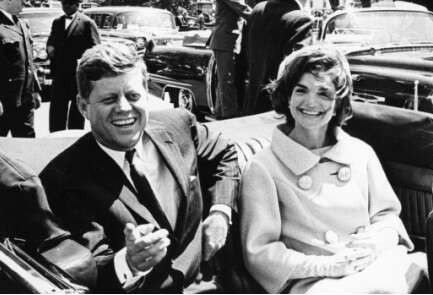
Exactly five decades have passed since Friday, Nov. 22, 1963. That day, which is etched in shame in the collective memory, Lee Harvey Oswald shot President John Fitzgerald Kennedy on the outskirts of Dallas, putting an end to a thousand days of high hopes and rising optimism about the United Statess ability to reshape the international environment according to the American vision.
The main thread running through the Kennedy era in the White House was the burning faith in the unlimited intellectual and scientific ability of human beings, which allowed them to overcome technological and mental limitations. In other words, the confidence of President Kennedy (who was anchored in the pragmatic tradition of the American nation) in the idea that there was a solution for every problem infused Washington of the early 1960s with a spirit of initiative and frenetic activity with the goal to change the global balance of power from the ground up.
Kennedy believed that in this way, the U.S. would be able to achieve superior status at the expense of the Soviet Union. His desire was to form a new and ambitious policy that would cause significant satellite countries, Egypt first among them, to be cut off from the circle of Soviet power and influence and bring them close to the West.
To accomplish this, Kennedy made a series of far-reaching economic gestures to Egypts president, Gamal Abdel Nasser. These included a significant increase in foreign aid, the provision of loans with easy repayment conditions with the cooperation of the World Monetary Fund and financing long-range development programs. Kennedy hoped that extending a helping hand and engaging in a series of confidence-building measures would slowly chip away at Nassers ideological commitment to financing and arming anti-Western underground movements in Aden, Libya and Oman.
The importance of the "Jewish vote"
It is absolutely clear that the ideological foundation that informed Kennedys policy on Israel and Egypt was not based on identification with the ethos, ideology or values of Israeli society. Since its establishment, the American public had seen Israel as a dynamic and pioneering country determined to promote the vision of intensive entrepreneurship, progress and democracy within the authoritarian Arab world.
Israel might have been expected to reflect the belief that prevailed among various groups and communities in American society that both nations resembled each other in a basic and profound way: the historical processes that had formed them, their cultural heritage and, above all, the dynamic spirit that surged within them. But the focus of Kennedys Middle East policy was Egypt, not Israel. For Kennedy, Israel was a constraint that had to be considered, but not a preferred destination in itself.
Kennedy and his administrations senior officials determined Israels place in a cold, calculating way, as a by-product of the process of bringing Egypt closer to the West. Since Kennedys victory over Richard Nixon, his Republican opponent in the 1960 presidential elections, was a narrow (and dubious) one, and since the "Jewish vote" was vital to his election in several of the key states that had high electoral value, the president wished to avoid friction with Israels prime minister, David Ben-Gurion, and the Jewish community as much as possible.
Missiles for refugees
As Ofer Mazar describes in his book In the Shadow of the Sphinx (published by the Ministry of Defense Publishing House), Kennedys decision to sell Hawk ground-to-air missiles to Israel was the price he had to pay to keep working toward improved relations with Egypt, which was the main goal that guided American diplomacy in the region.
Paradoxically, then, what the Oval Office had planned from the first as a tactical, isolated and pinpoint move to prevent the presidents status from slipping at home became the turning point that paved the way for the U.S.s transformation, during President Lyndon Johnsons era, into Israels strategic and political ally and also the main supplier of advanced weapons systems (such as the Douglas A-4 Skyhawk and F-4B Phantom fighter-bomber jets) to the government of Levi Eshkol, who succeeded Ben-Gurion in June 1963.
The Kennedy administration had another reason for supplying Israel with Hawk missiles. As the son of tough, seasoned businessman Joseph Kennedy, who was not always picky about the methods he used to increase his fortune, Kennedy tried to gain extra profit from the Hawk deal in the form of Israels consent to an international program, drawn up under his sponsorship, to solving the problem of the Arab refugees from the War of Independence. That was to be Israels payment for the Hawk missiles and soften the response of the Arabs (and Egypt in particular) to the sale of the missiles to Israel.
Indeed, in the summer of 1962, the White House proposed a package deal that would combine two policy initiatives that previously had been drawn up separately: that of the missiles and that of the refugees.
Kennedy tried to create a direct and binding link between both these frameworks, making the sale of the missiles conditional upon Israels explicit promise to accept the Johnson plan. But Israel remained firmly opposed. The prime minister felt the plan posed a clear and present danger to the countrys existence (in the form of the refugees, who would seek to invoke the right of return).
And so, at the end of a complex process within the administration, the White House softened its stance, approving the Hawk deal even without Israel making any immediate concessions regarding the Palestinians in return. The Johnson plan was never carried out because in addition to Ben-Gurions opposition, Egypt, Syria, Jordan and Lebanon also rejected it out of hand.
Tension over Dimona
The Kennedy administrations high hopes regarding Egypt were dashed fairly quickly, and the thaw in relations between Washington and Cairo came to an early end as the year went by. Nassers decision in 1962 to intervene in the civil war in far-off Yemen by sending tens of thousands of troops to Sana as aerial and naval support became a major breaking point in its relations with the Kennedy administration. The Egyptian armys use of chemical weapons in battle in 1963 drew a swelling wave of criticism at home and caused deep frustration among "all the Presidents men."
Lyndon Johnsons entry into the White House after Kennedys assassination would put an end to the strategy of economic incentive and launch a new and oppositional chapter in Americas involvement in that arena. In the nuclear sphere, Kennedy acted firmly and decisively, in the last year of his life, to compel Israels agreement to invasive supervision of the nuclear reactor in Dimona. Kennedy believed that by doing so, he would win an unequivocal commitment from Israel that it would refrain from any attempt to develop nuclear capability.
After the Cuban Missile Crisis in 1962, President Kennedy was very sensitive to the issue of nuclear weapons and the danger they posed. This caused a steadily-escalating conflict with Israel. The crisis took the form of a series of personal letters to Ben-Gurion that were sent from the White House in the spring and early summer of 1963, letters that grew sharper in terms of their content and the threats they contained.
Only 24 hours after Kennedy wrote the toughest letter of all, Ben-Gurion resigned, passing the burden of dealing with the American pressure to his successor, Levi Eshkol. After Eshkol began his term as prime minister, the tension between Washington and Jerusalem on this loaded subject eased slightly but the basic differences of opinion over the number and frequency of the visits to Dimona continued to cast a pall over American-Israeli relations during the last months of Kennedys life.
The shots that were fired from Lee Harvey Oswalds rifle took the nuclear issue off the agenda in one fell swoop. Although it would resurface during the Johnson era (particularly in relation to other arms deals), it would never again be the focus of presidential attention or the source of such sharp conflict. Indeed, in a complete departure from his predecessors policy, Lyndon Johnsons world view and priorities would quickly lead to the expansion and upgrading of the U.S.s strategic cooperation with Israel.
טעינו? נתקן! אם מצאתם טעות בכתבה, נשמח שתשתפו אותנו