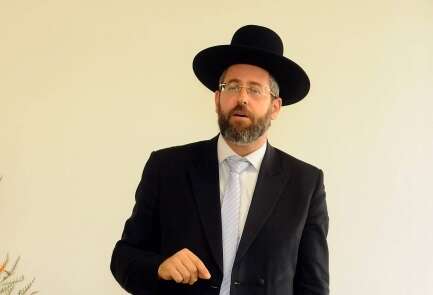
The long, tumultuous and sometimes acrimonious race for the powerful positions of Israel's chief Ashkenazi and Sephardi rabbis will conclude Wednesday evening, as the members of the body tasked with electing the heads of the country's religious establishment will cast their ballots at the Leonardo Hotel in Jerusalem.
The vote is set to begin at 3 p.m. and final results are expected to be announced around 8 p.m.
The 150 members of the electing body are appointed by the Religious Services Ministry and the Chief Rabbinate. The panel comprises the mayors and chief rabbis of Israel's 30 largest cities, the chief rabbis of the largest religious councils, dozens of prominent rabbis representing Israel's various communities, senior religious judges, the chief military rabbi, five ministers and two MKs.
The electors will be asked to use two ballots, one for the chief Ashkenazi rabbi and one for the chief Sephardi rabbi.
Sources familiar with the process told Israel Hayom that security has been significantly enhanced in and around the hotel, which expects the arrival of hundreds of political advisors, lobbyists, reporters and aides, alongside the candidates and the electors.
The atmosphere in the candidates' campaign headquarters has been described as "hectic," with the three rabbis vying for the position of chief Ashkenazi rabbi and the four vying for chief Sephardi rabbi sparing no effort to sway any possible swing votes in their direction.
The two rabbis who are elected will control the Chief Rabbinate for the next decade and the recent campaign, which has been described as a fight for the very character of the rabbinate, showcased the power struggle inside Israel's religious establishment. For the first time, the campaign also required intervention by the police, the High Court of Justice and the Attorney-General's Office.
The tense campaign has resurrected calls among the public and in certain political circles to have only one chief rabbi of Israel.
Religious Services Minister Naftali Bennett and Justice Minister Tzipi Livni announced Tuesday that they intended to pursue legislation to that effect, as well as devise legislation that would separate the position of the chief rabbi from that of president of the Supreme Rabbinical Court.
Should the ministers be successful in severing the link between the two positions, it would decrease the chief rabbis' power over the Supreme Rabbinical Court.
If passed, the amendment to the Chief Rabbinate Law establishing one chief rabbi and eliminating separate positions for Ashkenazi and Sephardi chief rabbis, would go into effect in 2023.
Know thy candidates
Three candidates are vying for the position of the chief Ashkenazi rabbi of Israel. The leading candidate is Rabbi David Lau, 47, the chief rabbi of Modiin and son of former Chief Ashkenazi Rabbi Yisrael Meir Lau, who pledges to reduce the rabbinate's infamous bureaucracy.
Lau enjoys immense popularity among the leaders of the Ashkenazi ultra-Orthodox community, which may result in a surprising surge in votes.
Lau's main rival is Rabbi David Stav, 53, who heads the Tzohar religious Zionist rabbinical organization and serves as the chief rabbi of Shoham. Stav, who was endorsed by the Yesh Atid, Habayit Hayehudi and Hatnuah parties, has vowed to revolutionize the Chief Rabbinate's services in a way that would make them "user friendly."
The third candidate vying for the position is Rabbi Yaakov Shapira, the son of former Chief Rabbi Avraham Shapira and the head of the Mercaz Harav Yeshiva in Jerusalem. Shapira has pledged to make the rabbinate more accessible to the public. Shapira's candidacy may prove to be crucial to the results, as the electors are said to be divided.
The four candidates vying for the position of chief Sephardi rabbi are considered to be on equal footing vis-à-vis the 150 electors.
Rabbi Tzion Boaron, 68, who serves on the Supreme Rabbinical Court, has been endorsed by outgoing Chief Sephardi Rabbi Shlomo Amar. He too has pledged to make the rabbinate more accessible to the public and Amar's endorsement may garner him a substantial number of the votes.
Boaron's main rival is Rabbi Yitzhak Yosef, 61, the son of Shas spiritual leader and former Chief Rabbi Ovadia Yosef. Shas' endorsement and his father's personal relationship with many of the electors are likely to play in his favor, but experts believe he still faces an uphill battle.
Safed Chief Rabbi Shmuel Eliyahu, 56, is the third and perhaps most controversial candidate in the running. Eliyahu's candidacy was challenged by several MKs and rights groups over several racist remarks he has made in the past. The rabbi was essentially disqualified last week by Attorney-General Yehuda Weinstein, but has decided to remain in the race.
Eliyahu is favored by both the national-religious and the haredi publics and experts believe his public skirmish with Weinstein did not harm his chances.
The fourth candidate in the running is Kiryat Ono Chief Rabbi Ratzon Arusi, 69, who has pledged to "address today's burning issues" including organ donation, women's exclusion and the issue of agunot (women stuck in unwanted marriages, whose husbands refuse, or are unable, to grant them divorces). Arusi has not been able to overcome his relative anonymity during the campaign and his chances of being elected as the next chief Sephardi rabbi are slim.
טעינו? נתקן! אם מצאתם טעות בכתבה, נשמח שתשתפו אותנו