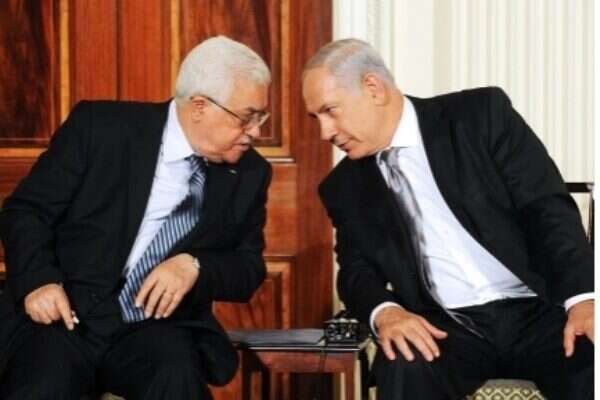
Will the Palestinians and Israelis resume negotiations? A senior Palestinian official confirmed on Monday that Palestinian Authority President Mahmoud Abbas was willing to drop some of his preconditions and instead might want Israel to take symbolic moves that would demonstrate its seriousness.
The official said Abbas would be willing to enter direct peace talks with Israel for a limited duration if Israel agreed to carry out several goodwill gestures. He is expected to communicate this to U.S. Secretary of State John Kerry when Kerry arrives in the region later this week. Abbas' flexibility is meant to gauge Prime Minister Benjamin Netanyahu's seriousness and determine the degree to which he would be willing to move forward in the peace process, the official said. Kerry will visit Israel, the Palestinian Authority and Jordan in what will be his fifth trip to the region since taking office.
The official told Israel Hayom that the Palestinians had recently been informed by Washington that in private talks with President Barack Obama, Kerry had been critical of the Palestinians, and to a lesser extent of the Israelis, for rebuffing his efforts to renew talks. According to the official, "Abbas knows that the shuttle diplomacy Kerry is going to undertake later this week will most likely be the last chance for resuming peace talks."
Abbas has reportedly been told by U.S. officials that continued intransigence would be unacceptable and that another aborted attempt to launch talks would leave the administration with no choice but to portray Abbas and the Palestinians as "peace rejectionists."
The Palestinian official said that Abbas' new position was designed to please U.S. and Israeli policy makers, although to some extent Abbas was hoping this would prepare Palestinian public opinion for the concessions he might ultimately make.
A senior Israeli official played down the significance of Abbas' new approach, saying, "He has made similar comments in the past, but what matters is whether he walks the walk."
"It is hard to know whether Abbas is serious this time, but if so, this is a welcome development that the prime minister considers long overdue," he said. "If Abbas renews talks only to call them off several weeks later, then blames Israel for torpedoing the talks and asks the U.N. to recognize the 1967 borders, this would surprise no one."
Speaking on Army Radio Tuesday, chief Palestinian negotiator Saeb Erekat said talks would not restart unless Israel embraced the 1967 borders as the basis for the talks.
"This is baseline for the two-state solution; if this goes down, the two-state solution goes down. We don't have preconditions," he said. "Is asking for an agenda of the negotiations a precondition-"
While stressing that the Palestinians would try to make Kerry's visit a success, he played down Abbas' reported concessions, saying talks would start "the minute the Israeli prime minister agrees on an agenda with the objective to establish two states [based] on [the]1967 [borders]." He said that the Oslo Accords, signed in 1993 and 1995, already mention the 1967 borders as the basis for negotiations.
Prime Minister Benjamin Netanyahu also expressed his desire to renew talks when he met a Georgian delegation on Tuesday.
"Our fervent hope is for peace, a genuine peace that can be achieved only through direct negotiations without preconditions. We're ready to enter such negotiations," Netanyahu said.
"I hope the Palestinians are too. And I have to say that our goal is not just to enter and put a mark to show that we've begun negotiations. Our goal is to persist in the negotiations, to engage in them consistently over a serious period of time, in order to try to grapple with all the issues and come to an agreement that resolves the fundamental issues in the conflict. This will require time and determination and a systematic approach, and I hope that this is what the Palestinians will have. That's our approach. I hope it's theirs too."
Although Kerry and Obama have said that they will not present an "American plan" for peace, Kerry has been at work on something very close to that, Arab and other officials familiar with his effort told The Washington Post on Tuesday. Influential Arab leaders have urged Kerry to "define the end game first," by establishing clear U.S. principles for the deal at the outset, and then settle borders quickly, a senior Arab diplomat said. That would require a strong U.S. hand in setting the terms for negotiations and keeping both sides at the table, the Post reported.
According to the Post, the American plan's "larger goal is a fast agreement -- ideally, within a year or so -- that draws permanent borders on the West Bank. The newly independent Palestinian state would have full international diplomatic recognition."
טעינו? נתקן! אם מצאתם טעות בכתבה, נשמח שתשתפו אותנו