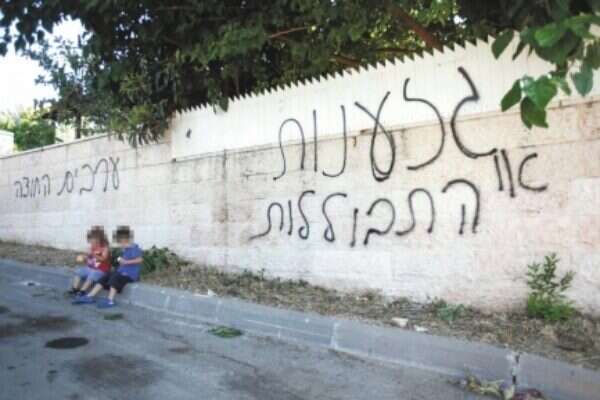
Prime Minister Benjamin Netanyahu strongly condemned Tuesday's extensive "price-tag" attack in the Israeli-Arab town of Abu Ghosh, just west of Jerusalem, saying the act "goes against Judaism, against the values of our people and against the values of our country." Netanyahu said the government would not abide such acts. "Just this week we passed [legislation] that allows us to take serious action against the people committing these crimes and we will do so," he said. The aim of price-tag attacks was initially to avenge Palestinian attacks against settlers and government policies viewed by extreme rightists as being harmful to settlers. But increasingly, the attacks are not connected to any perceived anti-settlement acts and are standalone acts of initiated violence and vandalism. The security cabinet on Sunday granted Defense Minister Moshe (Bogie) Ya'alon the authority to classify price-tag attackers as forming an "unlawful association," which would "significantly expand the investigative and prosecuting tools available to the security forces and law enforcement," the cabinet said in a statement. The attack in Abu Ghosh was the first price-tag incident reported in the town, which is also home to 50 Jewish families. It saw the tires of 28 cars slashed and derogatory graffiti spray-painted on the walls of several homes. The Hebrew graffiti said "Arabs out" and "Racism or assimilation." Earlier this week, the cabinet approved a series of legislative amendments that afford law enforcement agencies in Israel broader jurisdiction in price-tag investigations. But the Israel Security Agency (Shin Bet) and the Attorney-General's Office's recommendations to declare such incidents acts of terror were denied. The greater Jerusalem area has seen a rise in price-tag acts, with seven such incidents reported in the last three weeks, but police have yet to announce any arrests. Price-tag incidents are investigated by the Nationalistic Crimes Unit, a special taskforce formed by the Jerusalem Police in late 2012 with aim of investigating politically motivated crimes by both Jews and Arabs. So far its investigations have focused on incidents allegedly perpetrated by Jews. Police sources said no arrests had been made yet because the vandals did not belong to any official organization, and they operated in teams of two to three people and planned their attacks in utmost secrecy. Despite this, Police Commissioner Insp. Gen. Yohanan Danino said Tuesday that the unit was "very close" to making arrests. "Price-tag investigations are a very high priority for the Israel Police and arrests will be made very soon," he said. "What most people don't understand is that it's not the graffiti that is the problem, it's the act itself that could set Israel, and beyond, aflame." Internal Security Minister Yitzhak Aharonovitch called the attack "a heinous crime. This is not the first time this has happened. There are ongoing police investigations, there are suspects in custody and indictments underway, but this is a grave phenomenon." Aharonovitch noted that the special police taskforce includes 80 officers, adding that "The government's decision about [dubbing perpetrators] members of an unlawful association in very important and it sends an important message. I think they are terrorists, plain and simple. This is my opinion and I stand by it." "We have to find ways to eradicate this dangerous phenomenon because it could result in a religious war and bloodshed. This is the police's highest priority," he said. Abu Ghosh Council Head Salim Jabar said the town was "stronger than the vandals. We will not give the satisfaction of ruining our good relationships with the Jews and with the state. Abu Ghosh will continue to be a good neighbor [to the nearby Jewish communities] and we will remain loyal to the state, regardless of race, religion or gender." The residents of Abu Ghosh "understand that whoever did this doesn't represent the Israeli public. They are a fringe group and we are not worried about them," he said. 'Incident crossed red line' President Shimon Peres also condemned Monday's attack. In a phone call to Jabar, Peres said the attack was "racist behavior that crossed a red line. The residents of Abu Ghosh are a symbol of coexistence in Israel and they are very dear to my heart." Knesset House Committee Chairman MK Tzachi Hanegbi (Likud) echoed the sentiment, saying, "We all owe a debt of honor to the people of Abu Ghosh, who contributed to Israel's struggle for independence." Habayit Hayehudi Chairman MK Naftali Bennett leveled harsh criticism as the perpetrators, saying, "Price-tag acts are immoral and un-Jewish. There is a small group [of people] that wants to destroy any chance of coexistence and good neighborly relations between Jews and Arabs in Israel." The right-wing My Israel movement denounced the act as well: "This was an ugly, criminal and shameful act. 'Arabs out'? They are our brothers," it said in a statement. "This act was an attempt to destroy decades of good relation and a solid bond of friendship. We will not let the people who did this get their way," said Anat Knafo of the Har Adar Local Council, adjacent to Abu Ghosh.
A statement by the Mossawa Center, an advocacy center for Israeli Arabs, said, "Those who differentiate between acts of terror according to the identity of the victim are encouraging that next attack. Terror is terror regardless of its perpetrators and its victims."
Police chief: Attacks aim to set Israel, and beyond, aflame
Extensive "price-tag" attack in Israeli-Arab town Abu Ghosh, a symbol of coexistence • Police sources: No arrests yet because vandals do not belong to any official organization, act in utmost secrecy • Abu Ghosh council head: We will stay loyal to Israel.
Load more...