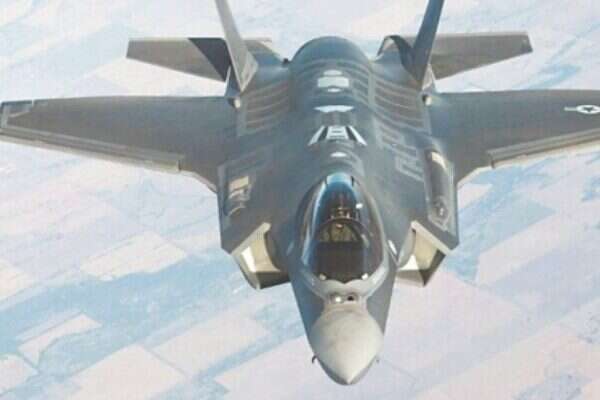
It is the most expensive defense project in history. Its estimated cost is $400 billion, though no one would be surprised to see this number go up. If everything goes according to plan, U.S. arms manufacturer Lockheed Martin will supply 3,100 stealth fighter planes to the U.S. military and 10 other foreign clients, among them Israel. The Israeli government has submitted an order for 19 of these F-35s at a cost of $2.75 billion. Israel also reserves the option to purchase 56 additional models. Each plane comes with a $150 million price tag. If Lockheed does indeed produce 3,100 models, the price would drop to $70 million per unit. As things stand now, this project is like the Israeli real estate market it just keeps getting more expensive. The first deliveries of the aircraft are due in Israel in 2016 and the planes will serve as the spearhead of Israels vaunted air force in the coming decades. A fighter jet of this caliber and level of sophistication simply does not yet exist. They are undetected by enemy radar, hence allowing it to undertake sensitive missions far from Israels borders without being noticed. The stealth fighters are able to elude detection by virtue of the material from which they are made and the shape of aircraft. The jets are painted with a special coating that contains radar-absorbent materials, and their design is configured to minimize radar detection. Stealth fighters are capable of reaching a maximum speed of Mach 1.6 and can travel a distance of 2,200 kilometers without aerial refueling, though the ability to refuel during mid-flight essentially enables stealth fighters to remain airborne indefinitely. The F-35 carries its payload in its belly, and is equipped with missiles that can be used in dogfights [as well as a cannon and bombs.] Its sophisticated systems enable the pilot to gauge the threat level. It also offers the benefit of certain advantages, like radar, high-resolution mapping, and software encoded in C++ that allows it access to periodic upgrades with enhancements off the shelf. It also gives the pilot an edge in spotting the enemy first. This fighter plane is without peer in the Western world. The only one that comes close is the dual-engine F-22, the F-35s older brother." Thus far, Lockheed Martin has supplied 187 of these models to the American military. The F-22 is no longer in production, and the Pentagon has not given permission for its sale abroad. It is worth noting that the F-35 is not just a fighter jet with advanced stealth capabilities, it is the most sophisticated, revolutionary weapon system that introduces a new dimension to the modern aerial battlefield. Its the plane for the iPad generation, said the pilots with whom we spoke at the Eglin Air Force base in Florida, the main training site for the F-35. In a rare display of openness, the U.S. Air Force permitted a group of Israeli journalists to gain access to the base. They were also granted permission to speak to some of the pilots and maintenance crews who train with the F-35 on a daily basis. The F-35 is a fighter jet that was designed differently, and as a consequence it behaves differently. The cockpit is activated through infrared technology and touch-screen mechanisms, giving it every bit the feel of operating an iPad. The information is transmitted onto a screen upon request or whenever there is system failure. The speedometers, fuel reserves, and other gauges are also available for digital display. This enables the pilot to concentrate solely on the task at hand without any interference. According to F-35 pilots, the planes operation is based on ones intuition (which is firmly in line with a principle sanctified by Apple), and it is very easy to learn how to operate it. It is so simple that the plane doesnt even have a two-seat model, not even for instruction. Model A is intended for use by the U.S. air force, while Model B, which is capable of taking off from short runways measuring 800 meters and landing vertically, is designed for the Marines. Model C is built for the Navy, which can use it for take-offs and landings on aircraft carriers. The fighter jet is operated by high-speed computers that calculate and assemble data at a rate that is simply beyond the capabilities of the human mind. The rate at which information is transmitted and shared between and amongst the pilots and grounds crew is nearly limitless in todays terms. Lockheed Martin officials say that these attributes render these fighter jets unstoppable war machines. The maneuvers made by a single jet are less important, said Col. Tomasty, who commands the 33rd squadron at Eglin. What is really important is the capabilities of a pair of jets or a formation of four F-35 jets who can complete the mission together. Were not talking about bringing more firepower to the battlefield. In this case, one plus one does equal three. The F-35 jets are like a pack of wolves. Without getting too explicit, one can understand that it is possible to activate the systems of a number of jets from a single cockpit. Sky-high price Lockheed Martin is an arms firm that has no competition in the West. Boeing, the sole remaining manufacturer of fighter planes remaining in the U.S., is completing its production of F-15 and F-18 planes, which appear to have undergone every possible upgrade imaginable to extend its lifespan. Currently, there are two projects featuring the production and manufacture of fifth-generation fighter planes to which the F-35 belongs. Theres the Chinese J-20 and the Russian T-50. These two models are potential adversaries to the F-35 both on a commercial and economic level as well as on the battlefield. Since, however, these are planes that are currently being manufactured on the other side of the world, there is much that is not known. Much of the information is based on speculation and assessments from afar. In the case of the J-20, there are even accusations that the fighter jet was made with technology and know-how that was stolen and copied. Nonetheless, even before the F-35 was thrust into its baptism by fire, it has been forced to fight for its life. Its war of survival stems mainly from the costs of its development, which has prompted a number of its customers and manufacturing partners to reconsider its necessity. One of those partners is Canada, a country that is a party to the planes development from its inception. Americas neighbor to the north is due to receive 65 planes. Canada had planned on investing $9 billion toward the purchase of the fighter jet of the future, but a recent report commissioned by the KPGM, a major international auditing firm which did a financial study of the project at the request of the Canadian government, estimated that the total costs of buying and maintaining the planes throughout their lifespan (assessments say the planes will last 42 years) exceed $40 billion. This outrageous sum touched off protests in Canada from citizens who accused their government of concealing information. As a result of the controversy, the Canadian government announced that it is considering alternatives to the F-35. Other countries involved in the development of the jet, like Australia and Denmark, are also showing signs of hesitation. The F-35 is a unique case, since it was built and developed with the expertise and know-how of an international team that included officials from the U.S., Canada, Australia, Denmark, Italy, Holland, Britain, Norway, and Turkey. Israel, Japan, and Singapore joined the project at its latter stage. The development of the jet cost $60 billion, said Steve OBrien, who serves as Lockheed Martins vice president of business development. This development plan was the key to the creation of the fifth-generation fighter jet. Israel was initially invited to join the project, which was known at the time as the Joint Strike Fighter project, but it refused due to the steep $100 million it wouldve required to pay to enter. The decision to balk at the asking price means that limitations have been placed on the addition of Israeli-manufactured systems (like the Elop night-vision technology made by Elbit or the Python missiles produced by Rafael, which are considered the best in the world) to the jet. When it comes to the F-35, the Americans are far less eager to agree to Israels request to install Israeli-made improvements simply because doing so would erode the planes stealth capabilities. It would also compromise advanced technological systems that are familiar to all of planes customers and enable a uniform system of maintenance and information delivery. The exception is the special Elbit-manufactured helmet and the wings, which were designed by Israel Aircraft Industries. It was also recently announced that Israeli enhancements would be made to the electronic warfare equipment as well as in the communications systems of models that were to be delivered to Israel. Relatively speaking, however, these are crumbs when compared to the price of the purchase, especially if it is consummated in full. Israel will make the F-35 better, OBrien said. The Israeli planes are from the No. 4 Production Block, which has been upgraded at a cost of $1.5 billion. Israel contributed half of one percent of this sum, and it will receive 100 percent of the enhancements. The very fact that this type of plane is in Israels hands gives it strategic deterrence beyond just tactical deterrence, said the Lockheed executive. King Kong in the sky The 58th Squadron at Eglin AFB is the one responsible for flying the new planes. It is currently training its pilots to become oriented with the new models after spending their careers operating F-15 and F-16 jets. Currently, the squadron has a fleet of 22 planes. Eventually, the number will reach 59, with 100 pilots who will be trained to operate the machinery. Lt. Col. Lee Close, the squadron commander, is filled with admiration for the F-35. As an F-16 pilot, I can tell you that I wouldnt be too happy to have to go up against something like the F-35 in the air, he said. Its so easy [to operate] that it almost feels like cheating on a computer game. It is flown intuitively, the helmet lightens the workload significantly, and youre King Kong when youre in the air. The fighter jet is smart and it monitors every event, said Maj. Falkington, a squadron pilot. You could almost say that the engine corrects itself. It even foresees problems, and this is something that no other plane does. The helmet does indeed look impressive. It resembles something worn in the Star Wars films. All of the systems that a pilot needs to effectively operate the plane are installed in the helmet. That is why there is no need to make any new additions or enhancements. There is just one cable that connects it to the plane and its systems. The helmet is custom-made and tailored to fit the individual pilot. That is why pilots report that its much more stable and reliable than the helmets of previous generations. Senior Airman Darren Kotran said that the planes maintenance requires no kind of paperwork. To maintain the plane, you need a laptop, and thats it, he said. Maintenance is easy and very efficient. One of the demands made to Lockheed Martin was to enable the crews to perform maintenance tasks on site, meaning without the need to bring in spare parts from a garage. Rather, all of the work was to be done on the runway. According to the technicians with whom we spoke, this is indeed the case. The planes production lines are currently in Lockheed Martins factories in Texas. Sophisticated robots perform the assembly of part, and the plane is moved from station to station where new parts and equipment are added. Once it has all the necessary parts, it undergoes a painting and final checks before it is finally delivered to the customer.
A fighter jet for the iPad generation
Although it costs $150 million per unit, the F-35 Stealth Fighter is a perfect fit for the generation of fighter pilots raised on smartphones and tablets. Israel has submitted an order for 19 of them. Back to the future.
Load more...