Nebraska is not a major tourist draw. The city of Omaha, in particular, doesn't attract too many visitors.
But that's not to say that there are no attractions there. The home of Warren Buffett, one of the five richest people in the world, is certainly a place frequented by those who happen to have the address.
About a week ago, a South Korean businessman arrived in Omaha. He hired a limousine and asked to see the house of the man known as the "Mozart of Capitalism," Warren Buffett. The driver took him to Farnam Street, in the Dundee neighborhood, a posh area in the center of town, but by no means the most grandiose.
"Here, this is the house," the driver told the Korean, who could not believe his eyes: a modest house (it is estimated to be worth $300,000 to $400,000), with no fence surrounding it, and not even a guard.
"This is how Warren Buffett lives-" the Korean businessman asked in disbelief.
"Yes. Just like this," the driver replied.
And that is exactly how one of the world's richest men, a man synonymous with success, who this week once again put Israel on the economic and business map, lives. This modest house, in many respects, represents the story behind this man, who manages to charm everyone he meets. Buffett feels good in his "God-forsaken" state, Nebraska, where the economy rests on agriculture, in particular pig-farming and corn. Nebraska is where he built the headquarters of Berkshire Hathaway, the wildly successful holdings company that he founded.
The billionaire's offices also suggest modesty. I visited the company headquarters this week, to see the offices of the man considered to be the greatest investor of all time. His offices are in Kiewit Plaza, one of the tallest buildings in Omaha but not the most extravagant of buildings. One would expect more. But it is even more impressive that Buffett doesn't even own his offices in the city of Omaha -- he rents two floors from a construction mogul.
So we can safely conclude from all this that Buffett doesn't like to throw money around. He doesn't like all the pomp and ceremony. He doesn't have much need for a driver, either. In Omaha, the locals tell me, it is not uncommon to see him stopped at a red light in his Lincoln in the next lane. Quite surprising for a man who once declared that if he wanted to, he could hire 10,000 people just to draw portraits of him for the rest of his life.
"I think that it is a great privilege to live in the same city as a man like Warren Buffett," says Dave, a photographer who is responsible for taking pictures when Buffett meets with his senior employees. Before my interview with Buffett this week, Dave warned me: "You will be surprised by how pleasant and simple this man is. No fanfare."
And indeed, that is exactly how it was. Buffett arrived, armed with a sense of humor, and whispered tips on how to get rich into my ear (but asked me not to tell). Mainly, and most importantly, he was very enthusiastic about Israel and about the Israeli company Iscar, whose acquisition he had completed this week, at the hefty price of $6 billion.
'A part of me has been sold'
Buffett is hilarious, and it appears that his sense of humor is infectious. In 2006, when he purchased the first 80 percent of Iscar, Buffett considered retiring. But then he changed his mind. He joked with his employees, saying, "I can't afford to retire."
This week, Iscar President Eitan Wertheimer, son of company founder Stef Wertheimer, was subjected to some humor himself. Uri, the boyfriend of Wertheimer's daughter Maya, sent him a congratulatory text message about Buffett's acquisition of Iscar. Uri offered to help Wertheimer find a new job as a babysitter or a cook.
Wertheimer, is seems, won't need Uri's help, but despite the jubilation that accompanied the deal, he admitted after his meeting with Buffett that he also felt a little sad.
"A part of me has been sold, but I know we did the right thing," he said.
He feels that Buffett's purchase of Iscar sends a message to investors the world over.
"It is a message of faith in Israeli companies and the Israeli economy. It goes far beyond buying Iscar. It is a type of Balfour Declaration," Wertheimer said.
The "Buffet Declaration," if you will.
Wertheimer takes immense pride in the fact that the company his family built was fancied by an investor who likes realistic assets. Buffett is also not one to gamble. He investigates an asset thoroughly before making a purchase, and when he does buy something, it is only the best of the best.
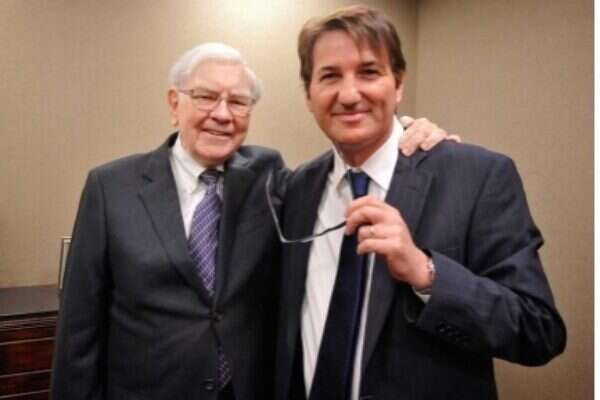
This week it was evident that Buffett and Wertheimer have a lot of respect for one another. Buffett has a habit of handing out his wallet when he has his picture taken with someone.
"Be careful," the photographer warned him about Wertheimer. "He won't give it back."
But Buffett was just waiting for an opportunity to play along with a joke. "My wallet is already empty," he said. "He already took $2 billion this time, and $4 billion last time, so all I have left in my wallet is the rabbi's dollar."
This was right after I had given him a dollar bill signed by the late Lubavitcher Rebbe, a gift from Chabad.
Back to Buffett's house, which he purchased in 1957 with his wife, Susan, when she was expecting their third child. It is a modest five-bedroom house. That same year, Buffett founded his fifth investment fund. Five years earlier, after he married Susan and became a father for the first time with daughter Alice, he had been renting an apartment for $65. Even back then, he could afford better. In 2008, when Forbes Magazine named him the richest person in the world with a net worth of $65 billion, he still didn't have any desire to move.
Buffett is not a fan of luxury. But throughout the years, he discovered that a private jet is a necessity for someone with the extensive business obligations that he has. In 1986, his company's shares broke the $3,000-per-share barrier. Since then, Buffett has become an attraction wherever he goes. He can no longer simply walk around an airport. During commercial flights, everyone constantly pesters him for advice on how to get rich. And so, despite his objections, he had no choice but to purchase a private jet, a Falcon. Two years later, he purchased 7% of Coca Cola stocks for $1.02 billion. Coca Cola turned out to be one of his best investments.
Buffett continues to amaze. When advanced technologies tempt investors from all around the world, he steers clear. He invests only in things he understands.
"You have to really be familiar with the industry," he says. "You're better off with one girl on your sofa than with 10 girls' numbers in your phone book." Buffett likes going for the sure thing.
'I still have plans'
There is no doubt that Buffett and Israel have turned into a love story. According to Algemeiner.com, Buffett is among the 100 people with the greatest influence on the Jewish people. Buffett himself is not Jewish, and is not devout in any religion, describing himself as an agnostic, the exact opposite of most of his conservative fellow residents in Omaha, where 35% of the population is Catholic and churches are well known for their vocal opposition to abortion.
As a whole, the state of Nebraska is extremely conservative. Only 3% of Omaha residents are African American. The state voted for Republican candidate Mitt Romney in the last U.S. presidential election, but Buffett is a supporter of President Barack Obama. The mayor of Omaha is also, surprisingly, a Democrat.
In an interview with Israel Hayom, the renowned investor couldn't speak highly enough of Israel.
"Israel is a great place to invest in because of the people in it," he said. "There is no other place in the world where you can find people with the kind of qualities and motivation and the ability to focus like the people at Iscar."
According to Buffett, Israel needs to just keep doing what it has been doing so far.
Buffett himself is 82, but still hungry. He asks me if I can recommend any companies for him to invest in. "I'm very serious," he whispers in my ear before we part ways.
"I am going to tell you something that I will say only to you," he says. "I still have plans, but don't tell anyone."
In the meantime, he is preparing for the biggest donation the world has ever seen. He plans to leave 99% of his fortune to charity, "so there is no point in standing outside my door," he concludes.
With that, he hands me his wallet. But then he takes it back. The wallet actually feels pretty full. Buffett is not a credit card type of man. He likes the real thing: cash.
טעינו? נתקן! אם מצאתם טעות בכתבה, נשמח שתשתפו אותנו