Iran announced on Tuesday that operations had begun at two uranium mines and a milling plant, and that Western opposition would not slow its nuclear work. The announcement came days after talks with world powers on Iran's nuclear program made no breakthrough. Iran inaugurated the Saghand 1 and 2 mines in the central province of Yazd and the Shahid Rezaeinejad yellowcake plant in the town of Ardakan in the same region, to mark the country's National Nuclear Technology Day, state news agency IRNA reported. Yellowcake can be further processed into enriched uranium to make fuel for nuclear power plants, Iran's stated aim, or if refined further to provide material for atomic bombs, which the West fears may be the Islamic Republic's ultimate goal. Neither site represents breakout technology for Iran, which already has smaller uranium mines and processing facilities. But it gives Iran greater self-sufficiency in making the raw materials for enrichment to nuclear fuel and, potentially, for warhead-grade material. Talks between Iran and six world powers held in Kazakhstan last week failed to achieve progress in resolving the decade-long dispute that threatens to trigger a new war in the Middle East. The powers the U.S., Russia, China, the U.K., France and Germany want Iran to curb its uranium enrichment activity. Iran denies Western accusations that it is seeking an atomic weapons capability. It often announces technical advances in its nuclear program, but these can be difficult to verify independently, Western experts say. For years, Iran has carried out construction work at Saghand and Ardakan, and Tuesday's announcement was apparently intended to show that it is becoming increasingly self-sufficient in the production of nuclear fuel, despite tightening sanctions. Some Western analysts, however, say Iran may be close to exhausting its supply of yellowcake or raw uranium and that such mining in the country is not economical. Iran has said its mines can supply the uranium ore needed for its nuclear program and that it has no shortage problems. The Ardakan plant will handle the ore from Saghand and can produce 60 tons of yellowcake annually, IRNA reported. Iran, a major oil producer, says it is enriching uranium for a planned network of nuclear power stations. Western nations have "tried their utmost to prevent Iran from going nuclear, but Iran has gone nuclear," Iranian President Mahmoud Ahmadinejad said in a speech at Iran's Atomic Energy Organization on Tuesday. "This nuclear technology and power and science have been institutionalized ... All the stages are in our control and every day that we go forward a new horizon opens up before the Iranian nation." The International Institute for Strategic Studies said the Saghand deposits were discovered in 1985. But because of the depth of the deposits and the ore's low uranium content, "the cost of yellowcake produced from the Saghand mine is likely to exceed current world market prices several times over," the think-tank said in a 2011 report. "Iran has invested in the Saghand mine to help it develop an independent source of uranium for its nuclear requirements but project development has proceeded very slowly," it said. As of mid-2010, construction at both Saghand and the Ardakan milling facility was continuing and there was no visible production taking place, ISIS said. It said it appeared that all Iran's uranium mining and milling had been carried out at another mine, Gchine, in the country's south. A report published last week by U.S. think-tanks Carnegie Endowment and the Federation of American Scientists said the scarcity and low quality of Tehran's uranium resources "inevitably compel Iran to rely on external sources of natural and processed uranium. Despite the Iranian leadership's assertions to the contrary, Iran's estimated uranium endowments are nowhere near sufficient to supply its planned nuclear program."
X
שיתוף כתבה
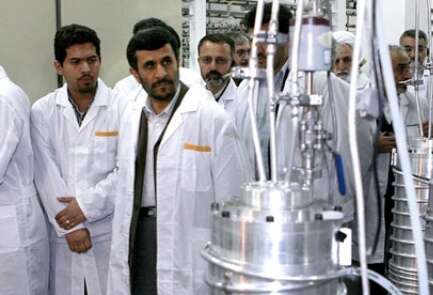
Defiant Iran inaugurates two new uranium production sites
Marking its "National Nuclear Technology Day," Iran announces opening of two uranium mines, which will extract uranium from a depth of 350 meters, and a yellowcake milling plant • President Mahmoud Ahmadinejad: "Iran has gone nuclear."