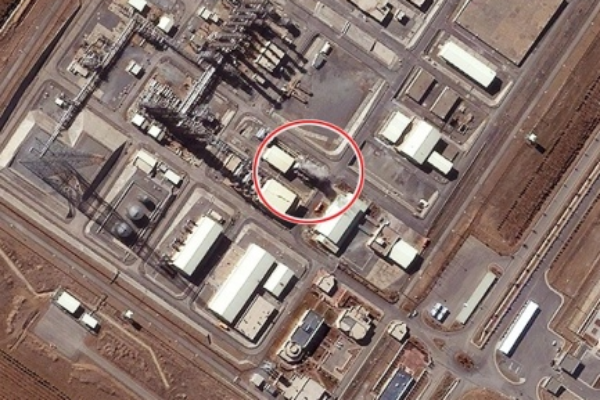
Iran has activated the Arak heavy-water production plant, 150 miles south-west of the capital, Tehran, according to a report in the British Daily Telegraph on Tuesday.
In response to the report, a senior Israeli official said Iran was pressing ahead with its nuclear program while "everyone is talking." She was referring to the nuclear talks currently taking place between world powers and Iran in Kazakhstan.
"As of now, the Iranians are thumbing their noses," Sima Shine, head of the Iran desk at the Strategic Affairs Ministry, told Israel's Army Radio. "They are coming to negotiations, speaking hyperbolically, trying to talk about their right to uranium enrichment ... but in parallel they are advancing [their nuclear program]."
According to the Telegraph, images from earlier this month commissioned by the paper from commercial satellite operators show "a cloud of steam" emanating from the "heavily guarded Iranian facility, from which international inspectors have been barred for 18 months," indicating heavy-water production.
Heavy water is required to operate a nuclear reactor that can produce plutonium for nuclear weapons.
Inspectors from the U.N. nuclear watchdog, the International Atomic Energy Agency, have been barred from entering the facility since August 2011 and Iran has repeatedly refused requests for information about it.
According to the Telegraph, Western governments and the IAEA have held information about activity at Arak for some time, and the images are the "first to put evidence of that activity into the public domain." The new images, the report said, also show details of the Fordo complex, which is built hundreds of feet beneath a mountain near the holy city of Qom.
At talks between Iran and the P5+1 powers in Kazakhstan on Tuesday and Wednesday, Western leaders offered to ease sanctions imposed on Iran in exchange for concessions on the Fordo facility, which is heavily protected from aerial attack. It was not immediately clear what, if anything, was resolved in during the two days of negotiations, which ended Wednesday. Iranian state TV reported that technical experts for each side will meet in Istanbul in coming weeks to discuss the latest proposals. But any hopes of a significant easing of the deadlock in the decade-old nuclear dispute were dented when Russian media cited a source close to the talks as saying there had been no clear progress in the discussions in Kazakhstan.
"So far there is no particular rapprochement. There is an impression that the atmosphere is not very good," Interfax news agency quoted the source as saying.
Israel Radio reported on Tuesday that officials in Jerusalem were not holding out much hope for results from the negotiations, but supported the talks because they increased the pressure on Iran and exhausted all diplomatic options so that other means can be advanced.
"The striking image of steam over the Arak heavy-water complex is a vivid demonstration that the regime has more than one pathway to a potential nuclear weapon," the Telegraph said. "New images of Arak highlight the progress Iran has made on facilities that could allow it to produce plutonium, potentially giving the country a second option in developing a nuclear weapon."
The report said other images of the area around Arak reveal numerous anti-aircraft missile and artillery batteries positioned there to protect the plant, "more than are deployed around any other known nuclear site in the country."
The missile defenses, based on the Telegraph's analysis of the images, "are most heavily concentrated to the west of the plant, which would be the most direct line of approach for any aircraft delivering a long-range strike from Israel."
The Arak complex reportedly comprises two parts: the heavy-water plant and a nuclear reactor. Unlike the heavy-water plant, however, the reactor has been opened to IAEA inspectors. During a visit earlier this month inspectors noted that cooling and "moderator circuit" pipes at the reactor were "almost complete," according to the Telegraph.
It said Iran had told the IAEA that it would "begin operating the reactor at Arak in the first three months of 2014."
Mark Fitzpatrick, a former U.S. State Department official at the International Institute for Strategic Studies, suggested to the Telegraph that Arak could be part of a process that "might trigger Western strikes on Iran."
The images commissioned by the Telegraph were analyzed by Stuart Ray of McKenzie Intelligence Services, a consultancy firm.
"The steam indicates that the heavy-water plant is operational and the extent of the air defense emplacements around the site makes it suspicious," Ray told the Telegraph.
טעינו? נתקן! אם מצאתם טעות בכתבה, נשמח שתשתפו אותנו