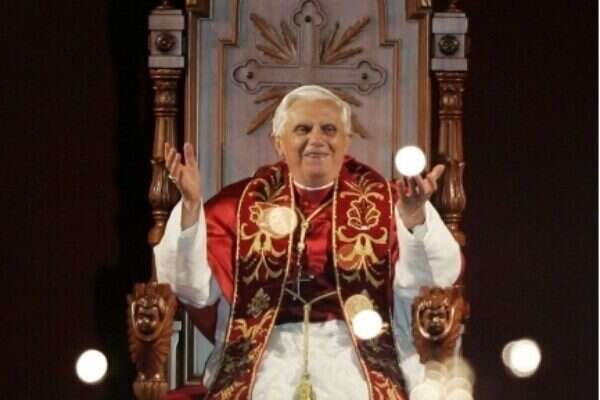
It was a long, hard summer for the octogenarian Pope Benedict XVI. His butler was arrested by Italian authorities after he was found to have leaked confidential documents allegedly revealing corruption and mismanagement at the Vatican. This was the scandal that became known as Vatileaks, and it provided inspiration for a book, "His Holiness: The Secret Papers of Benedict XVI," written by Italian journalist Gianluigi Nuzzi. The book offers a sordid account of a myriad of scandals that have rocked the church, including widespread pedophilia within the priesthood; financial irregularities; bitter power struggles; and intrigues surrounding the Holy See, all of which unfolded during Benedicts tenure. In France, Edouard Brasey, a science-fiction writer known for penning thrillers, published "The Last Pope," which is eerily similar to the real-life events unfolding in the Vatican. The books protagonist is a pope who finds himself in the middle of numerous scandals, yet even a sci-fi guru like Brasey couldnt stretch his imagination to the point where he envisioned the pontiff resigning from his post. The news of this past week was considered so inconceivable, so unlikely, so unreasonable and so antithetical to the doctrine championed by the Catholic Church. In short, it didnt seem possible. Brasey, a former journalist, was the most sought-after pundit in France this week. Everyone wondered how he managed to sniff out such a significant scoop and present his readers with the story of a troubled pope, so similar to real life. The pope in my book doesnt resign, but he suffers a great deal, he said. He gives a speech at St. Peters Square in the Vatican in which he vows to enact real reform throughout the church. I wrote this book in 2011 amidst all of the scandals that were being discussed at the time, and which were vividly manifest this past summer with the Vatileaks affair." The halls of the Vatican have become quite unfriendly for Pope Benedict. Despite the fact that there are no cellular telephones or televisions present, it is hard to avoid the litany of reports (some from first-hand sources) regarding scandals, many of which are described in Braseys book. "Money-laundering, rape and pedophilia conspired to sully the name of the Catholic Church," he said. "The pope understood that there was an urgent need for comprehensive reforms, but since he lacks the necessary physical and psychological stamina that is necessary to see the process through, he prefers to give up his post and allow his successor to do the dirty work that is so energy-consuming." Brasey is not the only one who predicted Benedicts downfall. It was just two years ago that French actor Michel Piccoli, who portrayed the pontiff in Nanni Morettis film "We Have a Pope," delivered a speech in a scene asking forgiveness from God after coming to the realization that "he no longer had the strength to carry out the task with which he was charged." Science fiction, you say- Nonetheless, a glimpse into the Vatican's fascinating archives (as the many films and books that have dealt with the subject matter can attest) shows the degree to which Benedict's decision is revolutionary and historic. It is a decision that will be dissected and analyzed 500 years from now, and not just because it was last five centuries ago that the a pope decided to step down. Many of his predecessors were in poor health while on the job, just as Benedict said he was during his speech on Monday (in which he announced his decision to quit as of Feb. 28). Customarily, however, death has been the only factor that ended a popes term. The world remembers how Benedicts immediate predecessor, John Paul II, who died in 2005, continued on his travels and kept giving speeches despite his advanced age and the onset of Parkinson's Disease. Isn't suffering an integral part of the Catholic Church's worldview? Is it not incumbent on the pope to endure suffering just as Jesus did, in the name of his followers? When one considers that Benedict XVI is one of the more conservative popes in modern history, his decision to resign is all the more surprising. How could a pope who opposed every possible reform within the Church, a pope who headed an institution that wholeheartedly embraced the Inquisition, be the one to resign, thus sending a shock throughout the Holy See? What hasn't been said about Benedict? He has constantly had to live in the shadow of John Paul II, who attained rock-star status which was plainly evident whenever he made trips to foreign countries. This writer remembers how he was warmly embraced by secular France, particularly by the hundreds of thousands of young citizens who took to the streets to salute him. In a highly uncharacteristic move, however, it seems Benedict has made more waves than the man he replaced. While he may be unable to introduce reforms, his stepping down certainly paves the way for their implementation. From the beginning of his term there have been whispers not only regarding Benedicts rigid ideologies but also his problematic past. Joseph Aloisius Ratzinger was the son of a police officer who opposed the Nazi regime in Germany. At age 14, Ratzinger joined the Hitler Youth, as was required of all German youngsters at the time. During the World War II Ratzinger served alongside his brother in a German anti-aircraft unit. Just before the war ended, he deserted. Benedict was hailed by former Prime Minister Ariel Sharon as "a friend of the Jews." He visited Israel and the Palestinian territories in 2009. Despite the warm sentiments, Benedict managed to infuriate the Jews when he decided to reinstate a papal sermon that called on the Jews to convert to Catholicism. The reaction to Benedict's resignation was one of worldwide shock. The French weekly LExpress sent its latest editions to the newsstands two days in advance bearing the front-page headline "Benedict XVI: The Secrets Behind His Resignation." This is a riveting international story, even to those who are not believers in the church. Guessing game The last time a sitting pope resigned was in 1415, when Pope Gregory XII, Venices native son, was forced to abdicate. That was a different era, an era in which the Catholic Church was bitterly divided. There was also the very problematic resignation of Pope Celestine V, who was elected to the post in July 1294 only to depart in December of that same year. He, too, fell victim to the rampant corruption and irregularities that dogged the Holy See. The fact that he could not speak Latin was also to his detriment. His successor, Boniface VIII, prodded him to leave his post. Later, he would engineer his arrest. What is past is past. It belongs to another time. Who would have believed that in this day and age we would see a pope voluntarily give up his position and relinquish the right to reside in Castel Gandolfo, that summer retreat that has hosted scores of world leaders? Due to the unique nature of Benedicts decision, many are left wondering what will happen after Feb. 28, the day on which Joseph Ratzinger returns to his former self, a (somewhat) regular theologist. The first matter on the agenda will most certainly be to find a replacement, and to do so quickly. The Catholic Church cannot remain orphaned and pope-less. The period of "vacantia," during which there is no sitting pontiff, cannot be permitted to endure long. "Benedict XVI will not take part in the process of selecting his replacement," said the Vatican spokesperson, Federico Lombardi. Now the eyes of the world will be fixed upon the Sistine Chapel, where the white smoke that emanates from the chimney will serve as the indicator that the process for choosing a successor has concluded. The world is moving ahead at lightning speed. It has already shown that it is ready to accept a black president of the United States. We were all stunned in 2008 when Americans put Barack Obama in the White House. Given the precedent, what is to prevent the Vatican from appointing a black man to the papacy- A number of foreign newspapers broached the names of two cardinals from Africa as possible successors: Peter Turkson, 64, who most notably expressed his support for use of condoms by married couples in order to prevent the spread of the AIDS virus; and Francis Arinze, the 80-year-old Nigerian. There are 177 million Catholics in Africa today, an astounding number when one considers that in 1900 there were just two million. Even in the Islamic republic of Mauritania, which is reputed to have a population comprised entirely of Muslims and where mosques are seen on every street corner, there is a Catholic church that draws African congregants on a regular basis. One should not discount the possibility that the next pope could emerge from Central or South America, where 483 million followers of the Church consider their faith to be an inseparable part of their daily lives. In Mexico this week, people poured out into the streets with tears in their eyes after hearing the sensational news of Benedicts resignation. The guessing game continues. There is speculation that the new pope could be Canadian. Marc Cardinal Ouellet, who in 2010 was picked by Benedict to head the Congregation for Bishops, was also mentioned as a possible choice. Ouellet is considered to be Benedict's preferred choice, but the outgoing pontiff has no say in the matter. There is also the possibility that the next in line will be an Italian. Before Benedict, the two popes who preceded him were from Poland and Italy, respectively. Angelo Scola, the powerful archbishop of Milan, might be a very worthy candidate, especially in a world in which Islam (with its more than 1 billion followers) is spreading at a faster rate. Scola is considered an expert on Christian-Muslim relations, and he has many contacts in the Islamic world. If he is indeed elected to the papacy, it is hard to envisage Scola, an expert in theology, repeating the remark made by the pope on Sept. 12, 2006, when he told a university audience during a discussion about religion-fueled violence that it would be best to consider the consequences that followed the forced conversion of nations that were conquered by Islam. Benedict noted that persuasive words, and not force and violence, are what would lead to the winning of hearts and minds. He went so far as to quote the 14th century Byzantine emperor, Manuel II Palaiologos, who once said: "Show me just what Muhammad brought that was new and there you will find things only evil and inhuman, such as his command to spread by the sword the faith he preached." The coming challenges Not only are we eager to learn who will succeed Benedict, but which reforms, if any, will be introduced in the Catholic Church. How ironic that the fascination with right-wing, conservative parties around the world like those in France, who received a great deal of attention during the previous elections has also had an impact on the Vatican. In a world with changing demographics, even a stiff institution like the Vatican needs to reinvent itself. As mentioned before, however, it is not easy to implement reforms in such a conservative institution. In 1978, Pope John Paul I tried to push through reforms. He failed because, among other reasons, his tenure lasted just 33 days. He died just weeks after taking office, and his death has been the subject of numerous conspiracy theories. His body was discovered just one day before the pontiff was scheduled to dismiss the commissioner of the Vaticans central bank. There was no investigation. When a pope dies, it is a cardinal, and not a doctor, who determines that his heart stopped beating. Joseph Ratzinger will look on from his new residence in the Vatican as his successor tackles the upcoming challenges facing the Catholic Church. Secularism continues to spread throughout Europe, the influence of Protestantism and Evangelism continues to grow in the U.S., changes in family values (including gay marriage, the use of condoms, abortion, all issues that the outgoing pope opposed, thus earning him the nickname, Gods Rottweiler), Islamic-Western ties, and, perhaps the most important and problematic issue of all, the sexual abuse of children committed by priests. Before Benedicts ascendancy, stories began to appear about cases of widespread pedophilia and efforts by the church to cover up these instances and protect their priests from the long arm of the law. Benedict did offer an official apology for the cases of pedophilia that were uncovered in Boston and Ireland three years ago, but it was also learned that in his previous posts in the church, Benedict offered his support to rogue priests. Benedicts successor will undoubtedly have to choose between a conservative approach which may cost the church followers in Europe, the U.S., and Africa and a more open, inclusive attitude, something that Benedict found morally unpalatable. Either way, the church needs to reinvent itself in accordance with the needs of the current century. The next pontiff will have to shepherd an institution that deftly combines conservatism with enlightened thinking.
The Vatican's game of thrones
The news of this past week was considered so inconceivable, so unlikely, so unreasonable, so antithetical to the doctrine championed by the Catholic Church.
Load more...