After all internal deals were sealed, political hit lists were distributed and Operation Pillar of Defense, which froze all political campaigning for one week, was out of the way, the Likud kicked off its primaries on Sunday with a call from Prime Minister Benjamin Netanyahu for independent voters to head to the polls. The list of Likud candidates for the next Knesset will be decided by 125,351 party members throughout the country who must choose between 97 candidates for a list of a probable 30 members of Knesset. Polling stations opened at 9 a.m. local time and were to close 13 hours later, at 10 p.m., with the results expected by midnight. To ease the voting process and to get more independents to vote, Netanyahu instructed party administrators to install 1,335 computers at 132 sites throughout the country so that each 200 voters on average would have access to a computerized voting system. In a taped message, Netanyahu urged all eligible voters to cast their ballots. He was said to be concerned about a possible low voter turnout due to a stormy weather forecast for Sunday. But as the sun came out on Sunday morning, it did not shine on the electronic voting machines at the polls, as report after report of malfunctions started coming in. A low turnout by independent voters will serve the more organized groups within the party, such as the workers unions and the party's extreme right-wing, who were expected to show up to vote in any weather. In the last Likud primaries in 2009, only 48,458 Likud members voted, a voter turnout of 49 percent. Sunday's computer malfunctions could affect voter turnout. On average, in previous campaigns, Likud primary voter turnout has been 50-60 percent overall and around 80 percent in Judea, Samaria and Jerusalem. The Likud's settler and right-wing bloc usually vote at around the 80% mark. On Sunday, these groups called on voters not to vote for the party's doves, such as Intelligence and Atomic Energy Minister Dan Meridor. Meridor's perceived liberalism, his strong stand on judicial independence and his moderate attitude toward settlements and outposts almost assure his departure from the party's new list. Analysts are keen to see if the party tilts further to the right in response to public disaffection over the truce deal which on Wednesday ended Israel's eight-day Operation Pillar of Defence against Gaza militants and averted a major ground operation. The main issue likely to be revealed by the ballot is the strength of the far-right Jewish settler lobby within the party. Last week, the settler lobby published a front-page advertisement in the English-language Jerusalem Post ranking Likud candidates on the basis of their opposition to a Palestinian state and how many settlements they had helped build in the occupied West Bank. According to Army Radio, Netanyahu has been putting pressure on his supporters to work to block any candidates seen as too extreme so that he will be able to present a "moderate" list which will not alienate centrist voters. Seven Likud MKs and ministers, including Meridor and ministers Benny Begin and Mickey Eitan, are concerned about being relegated to low spots on the list, forcing them out of their positions and offices in the next Knesset. The results of the primaries will no doubt hinge, among other things, on organized groups within the party who in recent days have cut deals and distributed lists of preferred candidates among party members. In most instances, "vote contractors" pass predetermined lists on to members, with 12 candidates, the number each voter is allowed to select, appearing on each list. One of the most prevalent lists is that of MK Haim Katz, chairman of the powerful Israel Aircraft Industries workers council, which is also supported by Transportation and Road Safety Minister Yisrael Katz, who is running for a top spot on the list. Haim Katz holds sway over 8,000-12,000 voters from the aircraft industry, and also received the support on Saturday of the Social Guard organization, which declared him the most socially oriented Knesset member in the Likud. It is widely acknowledged that both Katz's are the primary vote contractors in the Likud, and thus are sought after and courted. Haim Katz favors, among others, MK Zion Finian and Knesset Speaker Reuven Rivlin. He is also said to be seeking the ousting of MK Carmel Shama Hacohen. Yisrael Katz enjoys widespread support from the right wing of the party as well as other party activists, and even though he is among the leading contenders for a top spot on the Likud list he chose not to distribute a predetermined list of his own and instead to recommend only a small group of MKs, including Haim Katz and Zion Finian. The Likud's right-wing faction consists of three different groups: the Jewish Leadership group, headed by Moshe Feiglin; the nationalist group, headed by Shevah Stern and Natan Engelsman; and the Shomron Regional Council group headed by Gershon Mesika and Yossi Dagan. The groups failed to comprise a united list of preferred candidates despite representing the same ideological positions. Feiglin and Stern are at odds with each other and suggestions of candidates by one group have consistently been turned down by the other groups. Those in the forefront of the right-leaning factions include MKs Danny Danon and Yariv Levin, who have both appeared on a majority of the lists being distributed among party members. Other right-wing candidates said to have a good chance of reaching the top of the list are MKs Zeev Elkin and Tzipi Hotovely. The right-leaning Mattot Arim ("City Staff") organization, which works to advance the interests of the central region and large cities in Israel, has also endorsed Danon, Levin, Elkin and Hotovely. Four former Kadima MKs are also running for a place on the Likud ticket. Tzachi Hanegbi, Yulia Shamalov-Berkovich, Aryeh Bibi and Avi Dichter are all expected to receive a large number of votes among party members who do not subscribe to any predetermined list. Senior party members are concerned that the battle for the 24th spot on the list, which is reserved for a woman, will divide the party. If, they believe, Kathy Sheetrit or another candidate is assured a place on the national list, it will be at the expense of another current MK or minister. Netanyahu is supporting only one external candidate, economist Shlomo Maoz, who is running in the Dan region against several strong candidates, including Uri Faraj. On Sunday, Maoz went on Army Radio and said that he had been approached by Likud vote contractors with offers of providing voters if he paid tens of thousands of shekels. Maoz said he refused the offer, and Coalition Chairman Elkin said that there was no such practice in the Likud. Netanyahu sent a taped message on Saturday night to all party members via their mobile phones saying, "I call on you to come vote for your Likud candidates for the next Knesset. In this election, the primaries, you will determine who will lead the country in coming years. I urge you to come and influence, determine and vote." Meanwhile, in tandem with the Likud primaries, members of Yisrael Beytenu will gather at the Maccabiah Village in Ramat Gan on Sunday and Monday for a marathon of interviews with the party's candidates for the next Knesset. The candidates are those who made it to the final stage of the selection process, which was initiated because the party will be running jointly with the Likud. The official list will only be announced after the results of the Likud primaries are in. Yisrael Beytenu chairman Avigdor Leiberman will have the final say on the composition of his party's list, and the candidates will most likely include those who are acceptable to both Leiberman and Netanyahu. According to the agreement between the parties, both leaders will try to formulate a united list acceptable to both, but Leiberman will determine the number of spots his party will have on the united list. Some analysts believe Leiberman may try to insert Defense Minister and Independence party chairman Ehud Barak in the united Likud-Beytenu list to prevent the post of defense minister which is seen as a springboard to the post of prime minister from falling into the hands of Vice Prime Minister and Strategic Affairs Minister Moshe (Bogie) Ya'alon.
But by mid-morning on Sunday, there were widespread reports of serious technical malfunctions at many voting booths. Computer malfunctions were reported at Jerusalem's main voting station at the International Convention Center, as well as in Tel Aviv, Judea and Samaria and Ramat Gan, where some voting booths were completely shut down. Israel Radio reported that many voters were turned away from voting booths because of the technical malfunctions.
As the extent of the morning's technical malfunctions became apparent, Education Minister Gideon Sa'ar said that the primaries "were a farce" and called for them to be scrapped and held again.
X
שיתוף כתבה
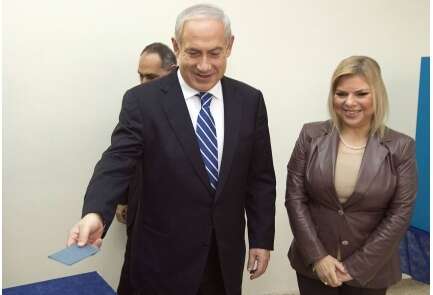
Low turnout could bolster rightists in Likud primaries
Widespread computer malfunctions reported as 120,000 Likud members vote for ruling party's list of candidates • Low independent voter turnout will favor the settler lobby • Numerous polling booths shut • Sa'ar: Primaries are a farce, must be postponed.