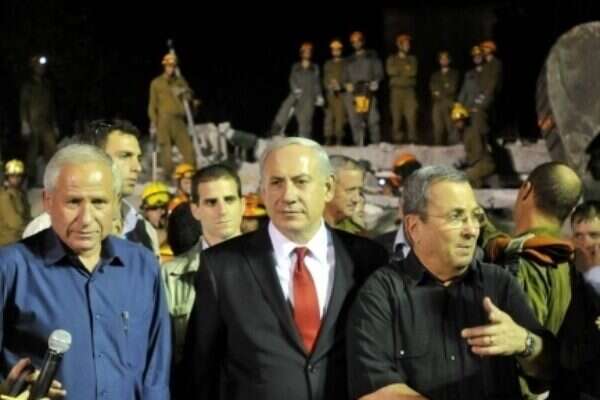
Israel will continue to strike back decisively against terrorist groups in the Gaza Strip, Prime Minister Benjamin Netanyahu said on Sunday. Netanyahu spoke at the weekly cabinet meeting as ongoing violence around Gaza left eight Israelis wounded four soldiers and four civilians. Five Palestinians have been killed and 25 wounded in the latest round of escalation. "The IDF is operating, and will operate, aggressively against the terrorist organizations in the Gaza Strip, which are taking heavy blows from the IDF," Netanyahu said. "The world needs to understand that Israel will not sit idly by in the face of attempts to attack us. We are prepared to intensify the response." Defense Minister Ehud Barak warned on Sunday that Israel would not allow terrorists in the Gaza Strip to "change the rules." "This isn't North America or western Europe; it is a place where weakness is not looked at with mercy," Barak told Israel Radio. "Keeping our eyes peeled, we need to dish out hits when necessary, and sometimes take a few. That's how it is in the ring. We do not expect our neighbors to disappear and they are not going to become Dutch or Belgian any time soon." "The main fight is on the [Gaza Strip] border fence..Israel will not allow them [terrorists] to try to change the rules," Barak said. He noted that the situation today was not the same as it was 10 years ago, when communities near the Gaza border would suffer from daily rocket and mortar fire. But Shaar Hanegev Council head Alon Shuster had a different take on the situation for residents of southern Israel. "For residents in the Gaza Strip periphery, this [wave of attacks] is nothing new and has been going on for 13 years," Shuster said. "The rocket fire does not represent something new or escalation, it is the everyday reality here, and all the activity the IDF has done in the area, including ground operations, has not changed this painful reality for the residents of the Gaza Strip area." The IDF says it holds Gaza's Hamas rulers responsible for the violence and that it will "not tolerate" terrorist activity emanating from Gaza. In a text message to reporters, Hamas spokesman Fawzi Barhoum threatened to respond to Israeli military operations. "Targeting civilians is a dangerous escalation that cannot be tolerated," he said. "The resistance has the full right to respond to the Israeli crimes." Homefront Defense Minister Avi Dichter said that it appeared the current round of escalation would end in with a cease-fire, but questioned what would happen in the future. "Hamas will try to stop this round as quickly as possible," Dichter said. "That is not the problem. The question is whether we will be forced to have discussions about endless rounds of attrition such as this. You have to understand, the Israeli government does not have a policy of toppling the Hamas regime in Gaza, and we also can't create another reality without air strikes, or say, 'Bang, bang,' that's it. Efforts to stop Hamas are part of a long process it's not a matter of days but of years." Dichter also said the coming Knesset elections in January would not preclude the possibility of an extensive IDF operation in Gaza. "There was already action (Operation Cast Lead) taken once before, a month ahead of the elections," Dichter said. "Anyone who thinks that this is a protective barrier will be surprised." Transportation Minister Yisrael Katz also commented on the violence in the south, saying at Sunday's cabinet meeting that Israel must act with "a very clear policy." "Sever the head of the snake and disconnect from Gaza, and move toward deterrence," Katz said. "We have to remove the Hamas leadership in Gaza." Katz said Israel should completely cut itself off from Gaza, including ending the supply of electricity, water, food and gas to Gaza residents, and then "move toward a policy of deterrence, exactly like in south Lebanon." "I am one of the millions of Israelis sitting in bomb shelters whenever the siren goes off," Katz said. "Residents of the south cannot live in this situation any more and we have to change it."
Netanyahu: IDF striking heavy blows against Gaza terrorists
Defense Minister Ehud Barak: There is no mercy for the weak in the Middle East • Homefront Defense Minister Avi Dichter: Hamas will try to end this round quickly • Transportation Minister Yisrael Katz: Israel must topple Hamas in Gaza.
Load more...