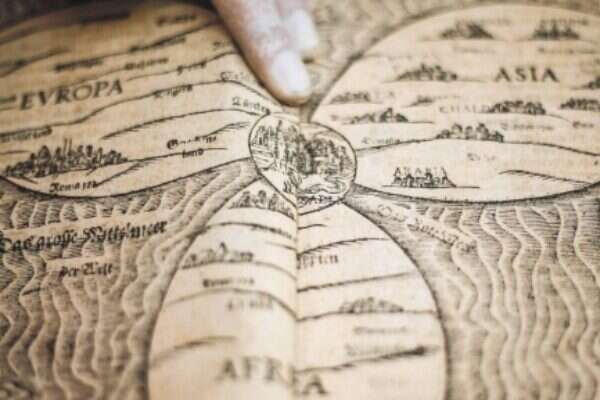
After a long waiting period, the Jersualem-based Ben Zvi Institute for the study of Jewish communities in the East will open an exhibit on Friday to the public containing Heinrich Bünting's clover leaf map of the world, depicting Jerusalem as the center of the world. The clover leaf map of the world was originally published in 1581 by the German theologian Heinrich Bünting in his "Travel book through Holy Scripture." The clover leaf map is comprised of three continents: Asia, Europe and Africa, with the fortified city of Jerusalem highlighted in the center. The map illustrates the culture of the 16th century: America is positioned in a small bottom corner of the map while Jerusalem is the navel of the world. The map combines reality with imagination, past and present. Mythological monsters swim in the oceans, while cities destroyed in biblical times are resurrected on the map. The Ben Zvi Institute's library, located in the historical "Beit Hahalutzot" ("Pioneers' Home") building in Jerusalem's Rehavia neighborhood, has recently undergone a unique renovation and remodeling, led by Israel Prize-winning architect Ada Karmi-Melamede. The building is currently in the process of reopening as the first international school for Jerusalem studies. Ben Zvi Institute Director Yaakov Yaniv said, "To commemorate the launching of the international school for the study of Jerusalem, and as part of our policy as an institute of research, culture and education, we intend to reveal to the wider public rare historical artifacts, relevant to the study of Jerusalem and Israel, to the greatest extent we can." According to Yaniv, "These artifacts have profound meaning, and through them we can learn about Jewish life in the city." Dr. Lavi Shai, the illustration archive director for the Ben Zvi Institute said, "The map reflects the yearning for a city which was out of reach."
Jerusalem, front and center
The Jersualem-based Ben Zvi Institute will open an exhibit on Friday containing German theologian Heinrich Bünting's clover leaf map of the world from 1581, depicting Jerusalem as the center of the world, as well as other artifacts.
Load more...