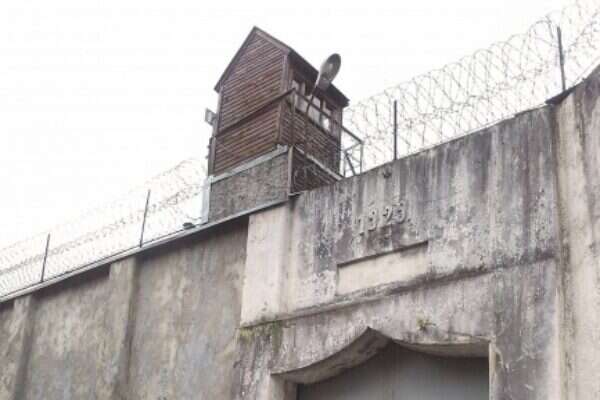
The day the Vilna ghetto was destroyed on Sept. 23, 1943, was declared Holocaust Day in Lithuania. On a visit to Vilna, we passed by the Presidential Palace and the national flags there were lowered to half-mast. Due to Sunday being part of the weekend, ceremonies marking the day were moved to Monday the following day, Sept. 24, including the main ceremony at the Ponary forest where an estimated 70,000 Jews were massacred by German SD, SS and Lithuanian Nazi collaborators and buried in mass graves during World War II. This year, a new aspect was added to the ceremony. Seventy-two years after his arrest in Sept. 1940 by the Soviet Union's secret police, who were then known as the NKVD, a plaque was installed on the wall of the Lukiskes Prison commemorating Begin, who was sent to the prison for the "crimes" of leading the Zionist movement Betar in Poland and being a member of a "national bourgeois anti-revolutionary Zionist revisionist" party. A dedication appears on the plaque in Hebrew, English and Lithuanian, saying: "Menahem Begin, the sixth Prime Minister of Israel (1977-1983), Nobel Peace Prize Laureate, Litvak, in 1940-1941 imprisoned by the NKVD in the Lukiskes Prison, where he was deported to the Pechora Forced Labour camp in north Russia." Begin's interrogation at the prison, which included conceptual arguments between Begin and his Jewish interrogator, and his ordeal at the Pechora work camp afterwards, to which he was sent for "re-education," were recounted in a book he wrote and titled "White Nights," which he published in 1953. After the Soviet Union collapsed in 1991, Begin's investigation file was disclosed and was found to corroborate the account he gave in his book. The book was published again in 1995 with the original investigation documents. At a ceremony held at the outer wall of the prison in Vilna, Lithuanian Justice Minister Remigijus Simasius said Begin was sent to the prison at a time when the justice system fought against people who tried to uphold justice. It was mostly Jews who suffered at the hands of that regime, he said. Emanuelis Zingeris, head of the Foreign Affairs Committee in the Lithuanian parliament and chairman of the Jewish-Lithuanian Committee, said the memory of Begin relates to the past Soviet rule in Lithuania and that it is important to deal with the country's Nazi past as well. Representing Israel at the ceremony was Agriculture and Rural Development Minister Orit Noked and Ambassador Hagit Ben Yaakov. Noked said that Begin inspired political prisoners throughout the world and that his legacy is a monument to liberalism, social justice and the struggle against tyranny and oppression. The minister thanked the Lithuanian government and pointed out the "excellent and courageous" relations between the two countries. Herzl Makov, director of the Menachem Begin Heritage Center in Jerusalem, said Begin's story is part of the splendid and tragic past of Vilna's Jews and that the historical truth of that period must be the foundation of the countries' continuing good relations. After the ceremony, the group made their way to the Ponary forest, where in the midst of the place where the massacre of Vilna's Jews occurred, another emotional ceremony was held in the presence of Lithuanian government leaders, Israeli diplomats and ambassadors from various countries. Addressing the audience at the site, Zingeris referred to a statement made by a senior Iranian Revolutionary Guard official this week about Iran's right to conduct a pre-emptive strike on Israel if it believes Israel is about to attack his country. The statement was one of many made by Iranian officials in recent weeks that included threats of an existential nature. Zingeris said that next year Lithuania will assume the chairmanship of the EU and must stand by Israel in its struggle against Iran. Lithuania should work towards uniting the European community on this matter, "so that there will be no more memorial monuments like this one ... here at Ponary." The ceremony ended with a song that became a partisan hymn during the war, which was sung in Yiddish, the language in which it was written. Pania Branchevsky, a Jewish partisan at the time, stood near us and joined the singing. We sang the song in Hebrew. "The day which we yearn for will arrive, and our marches will thunder 'We are here.'" After the ceremony, we visited the site of a huge pit where Jews from Vilna were murdered en masse and recited the "vision of the dry bones" prophecy from chapter 37 of the Biblical book of Ezekiel, in which the dry bones of Jews were resurrected in the land of Israel.
Lithuanians honor late former Prime Minister Menachem Begin
Ceremony in Vilna marks 72 years since the incarceration of late Prime Minister Menachem Begin in a Lithuanian prison, for the "crimes" of leading the Zionist movement Betar in Poland • Begin wrote of his ordeal in his book "White Nights."
Load more...