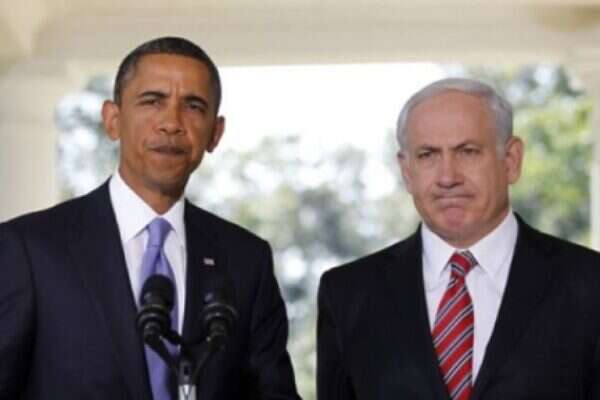
Relations between Prime Minister Benjamin Netanyahu and U.S. President Barack Obama seem to be on a collision course yet again. Amid disagreements over how to prevent Iran from building a nuclear weapon and it appears that the lack of trust between the leaders is at an all time low. The Prime Minister's Office confirmed on Tuesday that Obama has no intention of meeting Netanyahu during the prime minister's upcoming visit, on Yom Kippur eve, to the United Nations General Assembly in New York. A senior Israeli source said that "no meeting will take place despite our making clear to the White House that we are interested in one, and that Netanyahu, despite his tight schedule, is willing to fly from New York to Washington to meet the president. We received a message that the president's schedule will not allow for a meeting with the prime minister." The White House denied published reports that Obama had rejected Netanyahu's request to meet with him in Washington next week. No such request was made or rejected, White House spokesman Tommy Vietor said. "The president is arriving in New York only on the 24th and is leaving the next day; Prime Minister Netanyahu isn't arriving in New York until a later stage of the week," said Vietor. "If we need to we'll get to Washington, but it's not an issue of timing or scheduling," said an Israeli official from the Prime Minister's Office in response. It should be noted that Obama has found the time to meet with Egyptian President Mohammed Morsi. Meanwhile, the White House said in a statement that Obama and Netanyahu spoke for an hour Tuesday night, agreed to continue "close consultations going forward" regarding Iran's nuclear ambitions, and reaffirmed that the two countries were "united" in efforts to prevent Iran from obtaining a nuclear weapon. The unusual, late-night announcement from the White House comes after Netanyahu criticized what he called the world's failure to spell out what would provoke a U.S.-led military strike against Iranian nuclear facilities. Netanyahu has urged the U.S. to set "red lines" for Tehran. The Obama administration has refused. "The world tells Israel, 'Wait. There's still time,'" Netanyahu said Tuesday. "And I say: 'Wait for what? Wait until when-' Those in the international community who refuse to put red lines before Iran don't have a moral right to place a red light before Israel." Netanyahu says peaceful methods against Iran are not working, and he has warned repeatedly that Iran is getting perilously close to acquiring a nuclear bomb. His remarks have generated speculation that Israel is readying to strike on its own to prevent that from happening. U.S. Secretary of Defense Leon Panetta said that if Iran decides to develop a nuclear weapon, the United States would have a little more than a year to act to stop it. "It's roughly about a year right now; a little more than a year. And so
we think we will have the opportunity once we know that they've made that decision, [to] take the action necessary to stop [Iran]," Panetta told CBS. Panetta also said he believes that "As of this moment, Israel still hasn't made the decision to attack. Obviously [Israel] is a sovereign country, and ultimately they will make their decisions based on what they think is in their national security interest." On Monday State Department spokeswoman Victoria Nuland said "it is not useful" to set deadlines or declare "red lines." She and White House press secretary Jay Carney also noted that Obama has stated unequivocally that the United States will not allow Iran to obtain a nuclear weapon. On Tuesday, Nuland said the Iranian situation is a matter of "intense discussion" with Israel. She declined to elaborate, saying she did not want to conduct diplomacy in public. Also on Tuesday, diplomats told The Associated Press that the U.N. atomic agency has received new and significant intelligence over the past month that Iran has advanced its work on calculating the destructive power of an atomic warhead through a series of computer models within the past three years. The diplomats who spoke to The AP said the information came from Israel, the United States and at least two other Western countries. They demanded anonymity because they were not authorized to discuss classified information member countries make available to the IAEA. In Tehran, Foreign Ministry spokesman Rahmin Mehmanparast told reporters that Iran will start answering the agency's "questions and concerns" only when "our rights and security issues" are recognized. Israel says such evidence is concrete proof that Iran is well on its way to reaching weapons capability, perhaps in the coming months. Some U.S. officials have bristled at what they see as Netanyahu's attempts to exploit the U.S. campaign season to push Obama into a difficult position. The officials spoke on condition of anonymity because they were discussing a sensitive diplomatic matter. The U.S. officials stopped short of accusing Netanyahu of taking sides in the election, but the Israeli prime minister has a longtime relationship with Republican candidate Mitt Romney. Romney, who visited Israel in July, has repeatedly criticized Obama's handling of the nuclear issue. Israeli officials say American politics do not factor into their thinking, but that the sense of urgency is so grave that the world cannot hold its breath until after the November election. Obama and Netanyahu have long had a rocky relationship because of policy differences and a lack of personal chemistry. In one notable incident, a frustrated Obama left a White House meeting with Netanyahu to go eat dinner with his family. In a veiled criticism of Netanyahu, his own defense minister, Ehud Barak said preserving good relations with the U.S. was essential and that all disagreements should be handled quietly. "These differences should be smoothed over, between us, behind closed doors. We should not forget that the U.S. is the main ally of Israel," Barak said. Vice Prime Minister Moshe Ya'alon blasted Barak's comments, saying "I support the prime minister's demands from the American administration to give the Iranian regime clear red lines to stop their nuclear program. It's a shame that the defense minister prefers narrow political and party interests instead of providing support for this important demand, and instead has decided to begin his election campaign at the expense of national interests while riding the prime minister's back." Independence party (of which Barak is the chairman) Director-General Oshi Elmaliah responded to Ya'alon saying, "Based on their records, Ya'alon cannot teach the defense minister what national responsibility is, about ethics or about being a good colleague." While there are signs that the sanctions are harming Iran's economy, Israeli officials believe it has not altered their pursuit of a nuclear bomb. Israelis are astounded that Iran continues to be one of the leading oil producers, because exports have continued almost unabated to China, India and other points in Asia. The Israeli efforts may be bearing some fruit: Last week several European Union foreign ministers said they would support tougher sanctions on Iran. And Canada on Friday severed diplomatic relations with Iran, accusing the Islamic Republic of being the most significant threat to world peace. An Iranian semi-official news agency says Iran expects more countries to follow Canada's example and close their embassies in Tehran. Israel itself has not publicly defined its own red lines. Officials say that by doing so, they would essentially be telling the world when it is going to attack.
The Knesset plenum convened an emergency session on Wedensday morning to discuss the strained relations between Israel and the U.S.
Obama, Netanyahu 'united' on Iran despite mounting tensions
According to reports, U.S. President Barack Obama declined to meet the Israeli prime minister during an upcoming trip to U.S. • Meanwhile, White House says leaders spoke for an hour Tuesday night, agreed to continue "close consultations going forward."
Load more...