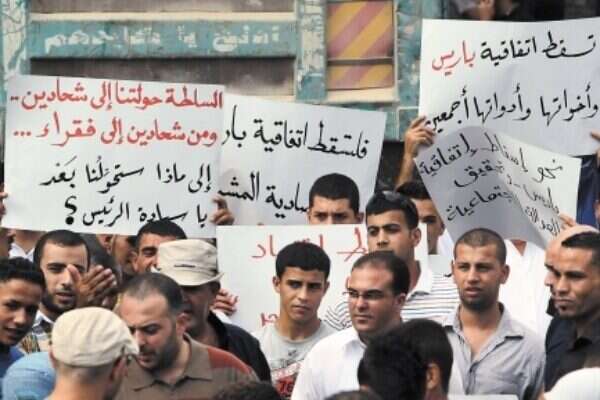
Thousands of Palestinians in the West Bank on Sunday continued to protest, for the fifth day in a row, the high cost of living in the Palestinian Authority-controlled areas. Protesters, carrying signs calling for PA Prime Minister Salam Fayyad to resign, blocked main roads in the West Bank and burned tires, causing heavy traffic jams and leading to altercations between protesters and drivers. Several enraged protesters caused heavy damage to public property in the town of Tubas, and even physically accosted the regional governor, Marwan Tubasi, who was wounded after being hit in the head by a rock. "This is unacceptable and violent behavior. The just protest has turned violent, and that hurts all of us," Tubasi told Israel Hayom. The PA is aware of the public's growing support for the social protests. Instead of attempting to find solutions for its collapsing economy, Ramallah on Sunday blamed Israel for the dire economic situation. PA officials argued that most of the economic clauses signed between Israel and the PA as part of the Oslo Accords in 1994, which regularize both sides' economic and commercial relations, need to be revisited and amended. PA President Mahmoud Abbas issued a directive on Sunday to Civil Affairs Minister Hussein al-Sheikh to "re-examine the agreement" and ask Israel to consider overhauling the economic agreement that has determined its customs and tax rates for the past 18 years. Asked about the PA directive, Amos Gilboa, a senior Israeli Defense Ministry official, told Israel Radio, "We have to examine exactly what they are proposing to see if it's practical." U.N. agencies and Palestinian economists say the economic sections of the Oslo interim peace deals, outlined in the Paris Protocol of 1994, have been implemented by Israel selectively and mostly to its own benefit. "Eighteen years of the Paris economic agreement have become a heavy burden on the Palestinian people and have led to very difficult financial and economic conditions," al-Sheikh told Reuters. According to Abbas, a request to re-open the economic understandings was sent to Israel and Ramallah was awaiting a response. Diverting the blame toward Israel, however, has not led to the desired effect on the Palestinian public, which is demanding immediate solutions. "It's true that the Zionist occupation is largely to blame for everything that is happening, but the leadership must find solutions and not who to blame," said Muhammad Sarhan, chairman of the public transportation union, who announced that as of Monday morning all public transportation in the West Bank would be shut down to protest the cost of gasoline. The aid-dependent PA has also been plunged into its deepening financial crisis by a drop in assistance from Western and wealthy Gulf backers. The Paris Protocol maps out an economic blueprint for a customs union between Israel and the Palestinian territories and pegs value added tax to Israeli rates, now at 17 percent, effectively blocking any steep price cuts in the West Bank. In another blow to the Palestinian economy, provisions allowing the Palestinians to make free trade agreements with other states and having access to Israeli markets have not transpired. Fayyad said on Thursday he would be willing to resign if there was "a real public demand" that he step down. The Palestinian government is grappling with a recurring budget deficit and external debt, both hovering above a billion dollars or nearly a fifth of gross domestic product. Foreign aid is now lagging, as a hoped-for $1.1 billion in 2011 reached only $750 million, as pledges from Gulf states in particular fell short. Some economists say economic growth could be as low as 3-4% this year, and with a fifth of the population unemployed, prospects for many of the West Bank's 2.5 million Palestinians are declining. The Palestinian Authority's cash crisis has delayed salary payments for some 153,000 civil servants several times this year. Worried the stalling economy will unleash unrest in the territories, Israel is showing flexibility. After a year of negotiations, Israel agreed this summer to streamline the handling of import duties it collects on goods bound for the Palestinian market duties worth some $100 million a month, around two-thirds of PA income. But Samir Abdullah, director-general of the Palestine Economic Policy Research Institute, said the Paris accords need to be renegotiated to free Palestinians from their dependence on Israeli oversight and allow them more leeway to trade abroad. "Israel has not committed to open its market to the Palestinians while the Palestinian market has remained open to it," he told Reuters.
Palestinians blame Israel for dire economic situation in West Bank
PA President Abbas asks Israel to "re-examine agreement" that has determined PA customs and tax rates for the past 18 years • Senior Israeli official: "We have to examine exactly what they are proposing to see if it's practical."
Load more...