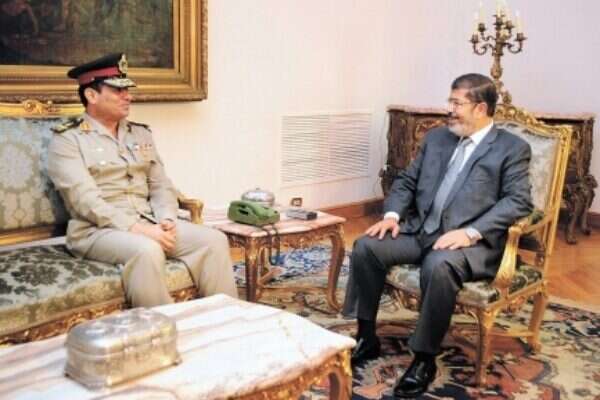
The U.S. is providing additional military assistance to peacekeeping forces in Egypt's Sinai Peninsula to strengthen security in the region, U.S. Defense Secretary Leon Panetta said on Monday. He said that so far the Pentagon had not moved to send additional U.S. troops to Sinai, but a truck-mounted tracking system sent to the Sinai would allow Egyptian troops to follow friendly forces. Just over a week ago, masked terrorists killed 16 Egyptian soldiers at a checkpoint along the border with Gaza and Israel, then burst through a security fence into Israel. Israel detected the infiltration and launched an airstrike to stop the assault. The attack sparked a major Egyptian military operation in the peninsula aimed at stamping out Islamic militant groups that have grown in numbers and in boldness since the ousting last year of President Hosni Mubarak. "We just want to make sure that we know how those forces are deployed in order to ensure that we can more effectively go after those terrorists that would try to create an incident or terrorist act," Panetta said. The U.S. has about 800 troops in the Sinai as part of an international peacekeeping force. Panetta did not rule out sending more U.S. forces to Sinai, but said the U.S. was working closely with Egyptian leaders "to determine what additional help they may need in order to ensure that the area is secured." Panetta's comments came after Washington on Monday encouraged Egyptian President Mohammed Morsi's government and Egypt's military to work together, a day after Morsi dismissed Field Marshal Mohamed Hussein Tantawi, the country's long-standing defense minister and army chief and replaced him with Lt. Gen. Abdel-Fattah el-Sissi. "It is important for the Egyptian military and civilian leadership to work closely together to address the economic and security challenges facing Egypt," White House spokesman Jay Carney told reporters on Monday. "We hope that President Morsi's announcement will serve the interests of the Egyptian people." Carney said Sissi was familiar to the U.S. from his former position as director of military intelligence. He added that Washington welcomed the appointment. "We know new Defense Minister Sissi from his previous post, and we look forward to continuing to work with him now. Ambassador [Anne] Patterson has been in touch with him, and the Department of Defense will also reach out soon. Further, we commend Gen. Tantawi for his service, especially during the extremely difficult transition from President Mubaraks leadership through the elections," he said. Carney also noted that the U.S. was prepared to help Egypt in its efforts to uproot terrorists from Sinai. "We had expected President Morsi to coordinate with the military to name a new defense team. And we will continue to work with Egypts civilian and military leaders to advance our many shared interests. In particular, we are ready to help President Morsi and the military as they continue to work to prevent extremists from operating in the Sinai," he added. The U.S., Egypt's main foreign backer for 30 years, said it had expected the changes, and expressed a desire to see the military and the government working well together. "We had expected President Morsi at some point to coordinate changes in the military leadership, to name a new team," U.S. Defense Department press secretary George Little said in Washington. U.S. State Department spokeswoman Victoria Nuland added: "What's important to us is that the civilian leadership and the military keep working well together to advance the goals of the democratic transition in Egypt." According to The Washington Post, U.S. officials have dismissed rumors that Sissi, the new Egyptian army chief and defense minister, is an Islamist with secret ties to the Muslim Brotherhood. Officials say that Sissi is well known to Washington after having spent a year of professional training in the U.S., and was considered a generally effective military intelligence chief. He once met with John Brennan, the White House's counterterrorism chief. Hes a solid guy, who has shown a solid level of cooperation, The Washington Post quoted one U.S. official as saying. Washington Post columnist David Ignatius said the U.S. was not worried about the reshuffling of Egypt's military brass, but that it would be concerned if Morsi was to try to make changes in Egypts judiciary, which has remained an independent center of power since Mubarak was deposed. Worries about changes to the judiciary were sparked by Morsi's move on Sunday to appoint senior judge Mahmoud Mekki as vice president. "The fear is that Mekki, as a former jurist, might reject rulings by the courts," Ignatius wrote. Egypt's military itself sent a message of reassurance Monday on Morsi's replacement of Tantawi and his decision to retake powers the generals grabbed from his office days before his June 30 inauguration. A posting on a Facebook page known to be close to the generals said the changes amounted to the "natural" handing over of leadership to a younger generation. "The armed forces is a prestigious institution with a doctrine of full discipline and commitment to legitimacy," it said. "With the military stripped of legislative authority, and in the absence of parliament, the president holds imperial powers," Egypt's top reform leader, Nobel Peace Prize laureate Mohamed ElBaradei, wrote on his Twitter account Monday. Egypt's official news agency quoted an unnamed military official late Sunday as saying there had been no "negative reaction" from within the military. And a day after the orders, no unusual military movements were detected anywhere across the nation. Analysts have floated the possibility that the shake-up of the military brass was part of a "safe exit" deal struck between Morsi and the generals to shield them against prosecution for alleged crimes during the time they ruled the country. They cite the appointment of Tantawi and Gen. Sami Annan, the chief of staff, as presidential advisers as evidence to support their theory. Meanwhile, as part of the Egyptian military's ongoing "Eagle 3" operation in Sinai aimed at eradicating terrorism, Egyptian media reported that security forces plan to hold extensive raids throughout the peninsula in coming days. Dozens of additional troops and tanks have been deployed in the area, especially in northern Sinai, just south of El-Arish, which is believed to be a hub of terrorist activity. Despite Hamas' praise of Morsi's decision to replace Egypt's military brass, the Islamist group, stunned by Egypt's closure of its border with Gaza, said on Monday that Morsi was imposing the same pain on the Palestinian enclave as ousted President Hosni Mubarak. Egypt pulled the shutters down on the Rafah passenger terminal a week ago, after the attack on Sinai on Aug. 5. Hamas has persistently denied speculation that some of the assailants had crossed into Egypt from Gaza. "We suffered from the unjust regime of Mubarak that participated in the [Israeli] blockade of Gaza. Why should we suffer now in the era of Egypt's revolution and democracy-" Hamas Interior Minister Fathi Hammad said in a statement. The Egyptian leadership is requested to order the reopening of the Rafah crossing to alleviate the suffering of Palestinians wanting to travel, students, patients, residents in third countries and pilgrims." Egypt said on Monday it would open the crossing temporarily yet again, but just for three days, mainly to permit travel for humanitarian cases such as Palestinians seeking medical care abroad, and students, a Hamas official said. Meanwhile, Foreign Minister Avigdor Lieberman said this week that Israel had offered Egypt assistance in the investigation of the Sinai attack. The foreign minister said the attack was, first and foremost, a blow to Egypt's national security, and also to its economy and tourism. "Egypt is our largest neighbor and the first country in the region with which we signed a peace agreement," Lieberman said. "We told the Egyptians, 'We're at your service,' and for now we're waiting." According to the foreign minister, Egyptian security forces know that "behind this attack stand jihadist operatives with links to al-Qaida operating in Sinai." Lieberman called on Egypt to operate its security forces that were already stationed in Sinai. "Right now it is just a matter of deciding to act and determination to confront the situation," he said.
US: We are ready to help Morsi prevent terror in Sinai
Defense Secretary Leon Panetta says U.S. sending additional troops to Sinai and working closely with Egypt to secure Sinai • Washington welcomes new Egyptian army chief, who spent time in U.S. • Hamas says Morsi hurting Gaza the same way Mubarak did.
Load more...