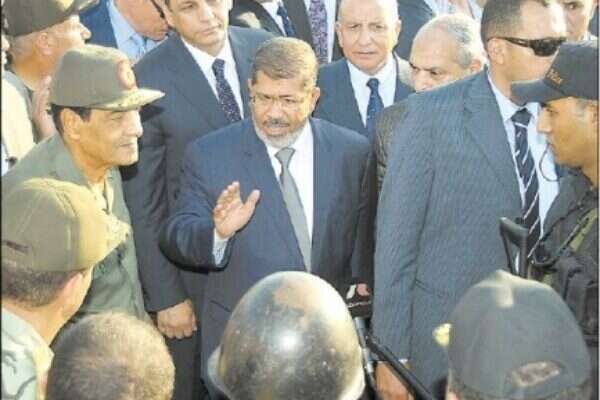
Since last Sunday evening, there has been just one question on the minds of the Israeli defense establishment: Have the folks in Cairo seen the light? The answer to this question has preoccupied experts and analysts from Military Intelligence, the Mossad, and the Foreign Ministry. Aside from recent declarations and initial actions, the answer has yet to be determined definitively. Not only will it prove critical to how the southwestern border with Sinai will look in the future, but it will also play a crucial role in shaping the texture of relations between Israel and the Muslim Brotherhood-led Egypt. If the butchering of 16 Egyptian police officers during an iftar feast to break the fast of Ramadan doesnt alter Egypts attitude toward Sinai and terrorism, then nothing ever will, said a senior Israeli official. At first glance, there is no doubt that Egypt is deeply shocked by the attack. In the past, security forces who died as a result of terrorism in Sinai (and the numbers have piled up over the years) were buried without honor or fanfare. Most of the police officers stationed in Sinai are from the lower socio-economic class poor, ignorant natives of peripheral villages. Nobody paid them much mind when they were alive, just as nobody thought much of them in their deaths. This was not the case this week. The mass, quasi-official funerals that took place this week are a common scene in Israel, but they are rare in the Arab world, particularly in the ever-restrained Cairo. The presence of the prime minister and the defense minister speaks to the extraordinary nature of the event as well as the depth of the shock. Their public vow to avenge the deaths of the policemen was clear, unequivocal, and pointed. This time, nobody can accuse them of doing the Wests bidding or being Mossad agents. For the new president, Mohammed Morsi, this is his first test of leadership. Since he ascended to high office, he has periodically clashed with the military council, particularly over the issue of good guys versus bad guys. There is a dispute over who is on Egypts side, who is against it, with whom should Egypt cooperate, and with whom should it not. The natural inclination of Morsi and his people was to embrace Islam and turn their backs on the West (and Israel). The natural inclination of their adversaries, the generals who have amassed considerable experience in dealing with Middle Eastern issues, was to do the opposite. Sundays attack ended albeit temporarily this debate. The jihadists who acted in Sinai and who distinguished little between Egyptian blood and Israeli blood gave Morsi his first lesson. Since the attack, the new president has performed admirably. In internal security discussions, veteran officials say that they have never seen a sense of urgency as acute as that displayed by Morsi, not even during the Mubarak era. They note that Morsi visited the scene of the attack. He also made statements and issued instructions. Finally, he authorized a series of operations, including the closure of the Rafah crossing, the search and closure of underground tunnels used for smuggling weapons, the arrest and hot pursuit of suspects, and the firing of both the governor of northern Sinai, Abdel Wahab Mabrouk, and the head of Egyptian intelligence, Murad Muwafi. Muwafis dismissal, which was reported two days ago, is disconcerting to Israel. As the successor to Omar Suleiman, Muwafi acted as Israels main go-between who transmitted messages from the Mossad and Israel Security Agency (Shin Bet) to the government in Cairo. Muwafi and his staff were involved in mediating between Israel and Hamas during the Gilad Schalit negotiations. They were also tipped off by Israel whenever security threats materialized along the border, even during the tumultuous days of the Tahrir Square upheaval. It is worthwhile to especially emphasize the dramatic night when Egyptian commando officers rescued Israeli security personnel from a raging mob that eventually destroyed the Israeli Embassy in Cairo. It is difficult to ascertain whether Muwafi was axed because of his failure to anticipate the terror attack, or if Morsi used the attack as a pretext to push aside one of the stalwarts of the previous regime. The answer to this question will become apparent soon, and it will also provide a glimpse into the thinking of the newly installed Egyptian government. Building trust Many in the Israeli defense establishment believe that a rare, golden opportunity has been created. Israel has a chance to sway the new government in Cairo toward our direction. While this is not what Morsi may have intended when he was elected, the exigencies of the situation have clarified to him this week that if he opts for the wrong path, he is liable to fall victim to terrorism and its repercussions. Defense officials say that what is needed is action, not declarations. Morsi must take quiet, diplomatic steps whose main purpose is to exploit this window of opportunity and take confidence-building measures so as to build closer ties with Israel. Whether this is possible is unclear, but there must be an honest attempt. It seems that Egypt is so shocked and rattled by what happened that it is even amenable to reassess its fundamental outlook. That may entail taking another look at its relationship with Hamas, the Muslim Brotherhoods sister movement. Rumblings that some of the terrorists and perhaps some of the orders to go ahead with the attack came from the Gaza Strip caught Hamas off balance this week. The organizations leadership went into a two-pronged panic, fearing that not only could Israel exploit the attack to deliver a military blow to the Strip, but that Egypt would also go crazy. The first scenario did not happen. The second did, if only partially. It was Egypt, of all countries, that sealed the Rafah crossing and ordered a crackdown against weapons-smuggling tunnels. Hamas, which has seen its rule challenged by even more extremist elements in the Gaza Strip (like Islamic Jihad, the Popular Resistance Committees, and Salafi groups who openly sympathize with global jihadist aims), now faces an immediate dilemma. Should it act forcefully against these organizations and risk the wrath of the Gaza street? Or should it refrain from doing so and risk disapproval from Egypt? Things cannot be any worse for Hamas. Israel should be on its guard for signs that Hamas doesnt try to wiggle out of its predicament by provoking conflict with the Israel Defense Forces. Hamas should also be perturbed by the increased vigilance being displayed by the Egyptian security forces in Sinai. In the last two years, the peninsula has become a no-mans land, particularly in light of the government vacuum created as a result of the uprising. In the absence of law and order, anyone who had money and connections could do as they pleased. Terrorist organizations exploited this state of affairs to smuggle large quantities of arms into the Gaza Strip. When they realized that Gaza is much more vulnerable to attack from Israel, which would not dare violate Egyptian sovereignty over the peninsula so as to preserve the peace treaty it signed with Cairo, they began to stockpile significant amounts of arms in caches that were ensconced in safeguarded areas of Sinai that the security forces have, in the past, been hesitant to approach. Predictably, Sinai turned into a testing ground for the various arms that were hidden there. Naturally, Sinai evolved into the main staging ground for attacks on Israel. No longer did terrorists need to be based in Gaza to fire directly at the western Negev. Instead, they took up positions in the so-called chet axis (in the shape of the Hebrew letter "chet") that stretches from Gaza, through the underground tunnels, toward Israel. All of the rejectionist groups were involved in this activity including Hamas, which was responsible for launching most of the Katyusha rockets fired at Eilat. They were helped by Bedouin in Sinai, who receive financial benefits for their cooperation. Regardless of whether it is smuggling labor migrants from Africa, sneaking drugs across the border, or helping terrorists carry out attacks, the Bedouin have gained from these lucrative endeavors. Information on these terrorist activities that are taking place in the heart of Egyptian territory frequently has been passed on to the authorities in Cairo. Initially, Israel demanded that the Egyptian government take action, particularly after the sabotage attacks against the natural gas pipelines. Then came the attack that claimed the lives of eight Israelis driving along Route 12 last August. Eventually, the Israeli government made do with transmitting frequent reports in the hopes that somebody there would come to their senses. Last weekend, the Egyptians were informed that a terrorist cell was planning to carry out an imminent attack. Yes, Israel did not see the entire picture. Otherwise, the attack would have been thwarted, and we would not have been as surprised as we were by the brazenness of its planners. Logic, however, states that the information that was provided should have been enough. On the contrary. Egyptian officials claimed that the urgent notice issued a day earlier by the anti-terror unit, which called on Israeli tourists to quickly leave Sinai and return home for fear of possible kidnappings, was an Israeli plot to ruin Egyptian tourism. While there was no linkage between the travel warning and the intelligence tip that ended with the attempted attack at Kerem Shalom, it is reasonable to assume that the Egyptian interior minister, who made the statement about the tourism industry, will henceforth consider information coming from Israel with greater weight and seriousness. Reassessing and redeploying Following the attack, the IDF high command ordered a number of tactical changes in its alignment of forces along the southwestern border. A number of these changes entail the quantity of forces and their deployment. Others involve intelligence-gathering methods, the use of which will be expedited, as will the construction of the fence that will run along the frontier. Despite the failed attack (or, perhaps, because of the failed attack), it is believed that there will be more attempts, and they will be no less bold in nature. Whoever is capable of massacring 16 Egyptian policemen without batting an eye in order to commandeer an armored vehicle and trespass into Israel will certainly not hesitate to execute spectacular attacks by other means. In this respect, the sky is the limit, as is the sea. Terrorists could deploy a booby-trapped unmanned aerial vehicle against a military base or a town on the Israeli side of the border, or they could guide a ship loaded with explosives in the direction of an Israel Navy vessel or at Israeli vacationers in Eilat. Behind 200 kilometers of fences and walls sit Israeli towns, civilians, and forces that at any given moment could become targets, as evidenced by the more than two dozen warnings of possible attacks from the other side of the border. It seems there are those who do see the Israelis as worthy targets. A large chunk of the responsibility for terrorism in Sinai can be attributed to the Bedouin there Sinouin, as they are known in Israel. These are individuals who have taken the lead in fomenting terrorism in the peninsula. Most of them are young, fearless, and unheeding of any authority. They have also been indoctrinated with an extremist brand of Islam, in the name of which they are willing to carry out the most insane deeds. Their involvement in weapons and drug smuggling creates a clear and present danger which has caused the IDF high command to lose sleep. Just as Hezbollah exploits any opening to sow terrorism against Israel (as evidenced by the revelations of explosives which were smuggled into Israel from Lebanon and which were discovered in Nazareth earlier this week), the terrorist groups in Sinai also use the smuggling routes from where migrants, prostitutes, and drugs are transported for violent purposes. They also enlist the aid of Israeli Bedouin, who provide information on IDF activity along the border. The aid that they receive from within is just one problem that Israel must cope with as it relates to terrorism from Sinai. The other stems from the inadequate intelligence infrastructure that could shed light on what is taking place in the peninsula. It will take years for the Israeli authorities to close the information gap. Israels anti-terror efforts are compounded by the compartmentalized nature in which extremist Islamists, namely Salafi organizations that derive inspiration from al-Qaida, operate. There is also the matter of the peace treaty with Egypt, which has an influence over Israels modes of operation along the border. Jerusalem is hesitant to violate the terms of the peace treaty, particularly with the recent installment of the new (and, from Israels standpoint, less-than-friendly) government that is in charge in Cairo today. These difficulties had a negligent impact on the events of this week, particularly on the Egyptian side. On the Israeli side, the terrorist warnings were taken with the utmost seriousness. Forces were deployed at the scene, intelligence means were employed, resources were diverted from other fronts, and the air force was on constant alert. The Israeli defense systems were on the highest level of alert. There were some tactical mishaps, particularly the length of time during which the Egyptian armored vehicle was permitted to move freely inside Israel proper until it was intercepted as well as the unsatisfactory coordination between the security forces and the nearby border towns. But the impact of those lapses on the final outcome was marginal. The bottom line is that the commanders made the right decisions, and the incident was brought to its conclusion just 15 minutes after it started. It did take the IDF way too long to debunk the rumors that civilians were kidnapped (another lapse that needs to be probed and corrected), but overall Israel can certainly look upon this event as a success. The IDF thwarted a large-scale, challenging attack, all of the terrorists were killed, and there were no casualties on our side. Nobody in Israel can promise that these will be the results from now on. The IDF and other security agencies operating alongside it must meet a high threshold due to the threat level, the daring of the enemy, the means at their disposal, and the multi-front challenge that requires a stationing of forces in other areas and prevents the military from devoting its attention exclusively to Sinai. Without quality intelligence that enabled the IDF to go on high alert in time, it is doubtful whether the army would have registered similar results this week. It is also doubtful whether the IDF will succeed in duplicating the result in the future. The threat level will drop significantly if Egypt begins to take concrete action both independently and in concert with the IDF against terrorism. This brings us back to the question marks that are a source of concern for Israel. We have already learned to live with the fact that the quietest borders we have had over the past few decades Sinai and the Golan Heights have become the most menacing frontiers. While the situation in Syria is a clearly discernible war, the situation in Egypt is quite different. The events of this week spark some hope that terrorism will succeed in doing what the formal peace treaty wasnt able to thus far. Who knows? Perhaps, in the insane irony of the Middle East, those who were acting in the name of Islam will succeed in bringing the Islamist regime in Cairo closer to the Zionist regime in Jerusalem.
Whos the real enemy?
The jihadists, who have turned the Sinai Peninsula into a hotbed of terrorism and who distinguish little between Egyptian blood and Israeli blood, have taught Egypts new president, Mohammed Morsi, an important lesson.
Load more...