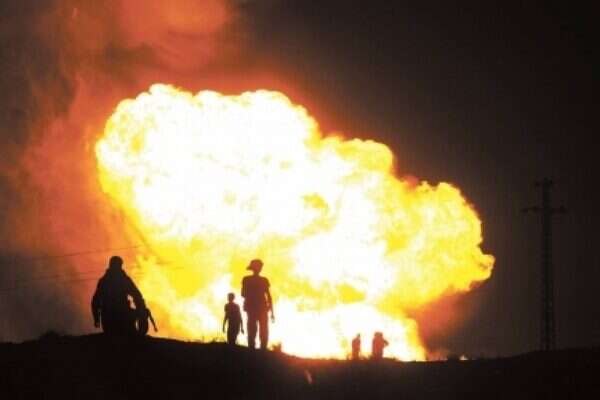
Israel, aiming to avoid further damage to its troubled ties with Cairo, said on Monday it saw the Egyptian termination of a deal to supply Israel with natural gas as part of a business rather than a diplomatic dispute. Foreign Minister Avigdor Lieberman told Israeli radio stations the cancellation of the deal was "not a good sign," but added "We want to understand this as a trade dispute. I think that to turn a business dispute into a diplomatic dispute would be a mistake." "Israel is interested in maintaining the peace treaty and we think this is also a supreme interest of Egypt," he said. The head of the Egyptian Natural Gas Holding Company announced Sunday the termination of its contract to ship gas to Israel because of violations of contractual obligations, a decision Israel said overshadows the increasingly fragile peace agreement between the two countries. The gas deal was signed in 2005 under the leadership of then-Prime Minister Ariel Sharon, and has been overseen by a joint Israeli-Egyptian company. The deal leans heavily on economic clauses of the 1979 peace treaty between Israel and Egypt. The termination of the gas deal thus appears to be a violation of the peace treaty. Speaking to Al-Balad Al-Youm, a program on Egypt's Sada Al-Balad television channel, Major General Tariq El-Mahdy, former head of Egypt's Air Defense Forces and current governor of Egypt's New Valley region, said the decision would not lead to war between Israel and Egypt. "We should understand that there is no relation between the Camp David Accords and the gas deal with Israel," El-Mahdy said. "Decisions over war and peace can't be taken simply -- the slogan of Egypt's army is to be ready for war as if it will happen tomorrow." Egypt's Minister of Petroleum Abdullah Ghorab told Bloomberg on Sunday night that the decision to cancel the gas agreement was not political but commercial, and that Egypt was exercising its rights under the agreement. The correlation between the gas deal and the peace treaty rests on the agreement within the treaty that Egypt would supply Israel with oil. This commitment was converted to apply to natural gas. By unilaterally terminating the deal, Egypt has essentially reneged on its commitment. In addition, the manner in which the gas deal was terminated runs contrary to the treaty clause stipulating cooperation and dialogue in resolving all conflicts. It appears that the decision also came as a surprise to many Egyptians, as the gas deal was one of the country's most lucrative sources of revenue. Egyptian media reported that many Egyptians were upset that they learned of the cancellation from Israeli media reports, and that the move was not announced by the Egyptian authorities. Meanwhile, Israel Radio reported Monday that a senior Egyptian military official had denied the termination, saying that the deal was re-evaluated in efforts to adjust its terms to current market prices. According to the Arabic-language daily Asharq Al-Awsat, the official said that the deal was still very much in place, and had not been terminated as reported. He added that several clauses within it had merely been modified. Israel Radio suggested that perhaps the official's remarks were meant to create an opening for Egypt to recant, or that it was perhaps indicative that the ruling military council was not included in the decision to terminate the deal. Analysts in the Arabic press, however, have suggested that the national gas company could not have taken such a fateful decision without the go-ahead from the Supreme Council of the Armed Forces, which effectively rules Egypt. The natural gas deal has become a symbol of tensions between Israel and Egypt since the Egyptian uprising that saw the end of Hosni Mubarak's 30-year rule. For many Egyptians, it typifies the close relations Mubarak's regime had forged with Israel and how his associates benefited greatly from such business deals. Critics charge that Israel got the gas at below-market prices and that Mubarak's cronies skimmed off the proceeds, costing Egypt millions of dollars in lost revenue. Sinai militants have blown up the gas pipeline to Israel 14 times since the uprising more than a year ago. Mohamed Shoeb, the head of the Egyptian Natural Gas Holding Company, said the decision to cancel the deal was not political. "This has nothing to do with anything outside of the commercial relations," Shoeb said. He added that Israel was four months overdue in paying for gas supplied by Egypt. Israeli Foreign Ministry spokesman Yigal Palmor denied this claim. Shoeb told Egyptian television that the decision to cancel the contract was made Thursday because "each side has rights and we are representing our rights." Israeli officials responded to the announcement with grave concern. Finance Minister Yuval Steinitz (Likud) voiced concern over economic as well as diplomatic implications of the unilateral Egyptian decision. "This is a dangerous precedent that overshadows the peace agreements and the peaceful atmosphere between Israel and Egypt," he said in a statement. "We must now double and triple our efforts to expedite the supply of domestic natural gas to begin in 2012, rather than April 2013, and overcome all the bureaucratic obstacles. We must protect our energy independence and lower the price of electricity for businesses and private citizens alike." Infrastructure Minister Uzi Landau (Israel Beitenu) echoed Steinitz's remarks, saying Sunday that "Israel is working to establish its energy independence in any case and the rapid development of alternative Israeli supply sources." Opposition Leader and chairman of the Knesset Foreign Affairs and Defense Committee, Shaul Mofaz (Kadima), also issued a response Sunday, saying that the termination of the gas deal was a "blatant violation of the peace agreement and a new low in the relations between the two countries." "This move requires an immediate response on behalf of the U.S., as an overseer of the implementation of the Camp David Accords," Mofaz added. MK Benjamin Ben-Eliezer (Labor), who was involved in the formulation of the Israeli-Egyptian gas deal as infrastructure minister, said that the termination of the deal was yet another indication of a possible future confrontation between the two countries. He argued that there was no possibility that the Egyptian company reneged on the deal without the express approval of the Egyptian government. "The decision was political," he insisted. Senior officials at the Prime Minister's Office, however, spoke with top Egyptian officials on Sunday and explained that the Egyptian government had not been involved in the decision in any way, and that it was a purely commercial move. One official said that "this dispute is currently under legal arbitration abroad, and has not yet been decided. This has nothing to do with diplomatic relations between Israel and Egypt." Israel's electricity company has been warning of possible power shortages this summer, partly because of the unreliability of the natural gas supply from Egypt. Hussein Salem was among the shareholders of East Mediterranean Gas Co. a joint Egyptian-Israeli company that carries the gas to Israel. Once a close friend of Mubarak, Salem fled Egypt for Spain and was sentenced in absentia to seven years in jail over corruption in the gas deal with Israel. On the Israeli side, EMG sought international arbitration in October because of the Egyptian side's failure to supply the quantity of gas stipulated in the contract because of the frequent bombings. Under the 2005 deal, the Cairo-based East Mediterranean Gas Co. sells 1.7 billion cubic meters of natural gas to the Israeli company at a price critics say is set at $1.50 per million British thermal units a measure of energy. The gas deal has been the subject of litigation in Egypt. An appellate court last year overturned a lower court ruling that would have halted gas exports to Israel. Opposition groups that filed the suit before the uprising claimed that Israel got the gas too cheaply under the 15-year fixed-price deal between a private Egyptian company, partly owned by the government, and the state-run Israel Electric Corporation. Ibrahim Yousri, a former Egyptian diplomat who had brought the issue to court, welcomed the decision to terminate the gas deal altogether. "It has become a scandal bigger than the (ruling) military council can withstand," Yousri said. He said there were gas shortages in Egypt, and growing economic woes, further inflaming popular unrest. He called the business deal "treason" to national interests, adding, "This is a great political step."
It's not personal, it's business, Israel says of Egypt gas snub
Egypt gas company unilaterally terminates gas deal with Israeli contractor, essentially violating peace treaty • Steinitz concerned over "economic and diplomatic" implications • Infrastructure Minister: Israel working to establish energy independence.
Load more...