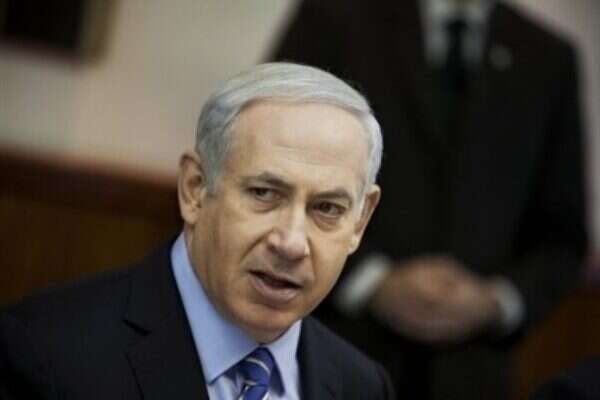
Prime Minister Benjamin Netanyahu and his Palestinian counterpart Salam Fayyad were set to meet in Jerusalem on Tuesday in what was slated to be the highest-level meeting between Israelis and Palestinians in over a year and a half. The two leaders were set to exchange letters on their respective positions in an attempt to renew the stalled negotiations. An Israeli official said this week that Netanyahu would reiterate his call for talks to resume without preconditions and for a meeting with Palestinian Authority President Mahmoud Abbas. In a meeting with Arab ambassadors in Sri Lanka on Tuesday, Abbas said he believed that Netanyahu would reply to the PA's letter within two weeks of receiving it, Israel Radio reported. Abbas expressed hope that Netanyahu would accept Palestinian demands so that negotiations could resume. He said that Washington intended to present its own proposals to advance the peace process, in part because the U.S. opposes any renewed Palestinian appeal for recognition of statehood at the U.N. According to the PA president, in the coming months the Palestinians will be engaged in a back-and-forth with Israel and the U.S., as Washington wants to prevent the PA from taking any major steps before the U.S. presidential elections. Sources at the Prime Minister's Office remained relatively silent on the meeting, but according to Israel Radio their expectations were not high. They said the meeting with the Palestinians was important and that the goal was to find a way to bring the Palestinians back to the negotiating table. Netanyahu's letter is believed to include Israel's security principles, which the Palestinians refused to hear during Quartet-sponsored discussions in Amman in January. The discussions ended in a stalemate. Netanyahu was also expected during Tuesday's meeting to call on Abbas to make tough decisions, including recognition of Israel as a Jewish state and abandonment of the Palestinian right of return upon the signing of a peace agreement. The letter Fayyad is due to deliver from Abbas to Netanyahu is expected to seek that Israel agree that any future deal on a Palestinian state would be based on 1967 borders with land swaps, a settlement construction freeze in Jerusalem and in Judea and Samaria and a release of all Palestinian prisoners held in Israel. Abbas' letter could serve as a prelude to a renewed unilateral Palestinian move for statehood recognition in the U.N., an effort suspended last fall amid stiff opposition from Washington and Israel. "It's a last-ditch effort indicating that we're doing everything possible in order to realize a two-state solution," Palestinian legislator Hanan Ashrawi said about the missive. "We hope that there's a positive response, but we're sending a message that, without one, we have a strategy for what follows," she said. Palestinians said the letter would accuse Israel of reneging on its obligations under the 2003 "road map"- agreed upon by both sides - which includes a halt to settlement activity. Foreign governments have viewed the letter with apprehension, welcoming a rare high-level Israeli-Palestinian meeting, but warning against any threatening language. In a phone call last month, U.S. President Barack Obama cautioned Abbas against provocative actions. Abbas has insisted that his letter, which he has taken weeks to prepare, would simply remind Israel of its commitments under interim peace deals. "All options are all on the table for Palestinians, with the exception of dissolving the national authority or withdrawing recognition of Israel. We are not seeking the isolation of Israel, but rather to isolate its settlement policy," Abbas told the official Palestinian WAFA news agency last week. Netanyahu says the future of settlements, which the Palestinians and many countries regard as illegal, should be decided in peace negotiations. U.S.-sponsored peace talks froze in late 2010 after Netanyahu rejected Palestinian demands that he extend a partial construction freeze in Judea and Samaria, which he had imposed at Washington's behest to coax the Palestinians back into talks. Palestinian officials said the letter Fayyad will hand over is a watered-down version of previous drafts which suggested the Palestinian Authority, run by Abbas, would dissolve itself or sever ties with Israel if there was no progress. The French news agency AFP reported on Sunday that Abbas's letter would state that Israel's actions have stripped the PA of its "raison d'etre" and that this status-quo cannot continue. As a result of actions taken by successive Israeli governments, the Palestinian National Authority no longer has any authority, and no meaningful jurisdiction in the political, economic, territorial and security spheres, Abbas writes in the letter, a copy of which was obtained by AFP on Sunday. "In other words, the PA lost its raison detre which, if it continues, will make it unable to honor its commitments, the PA president said, referring to previous agreements signed with Israel since the 1993 Oslo Accords. We want to avoid sliding toward the one-state option, especially as the current status quo cannot continue, Abbas was quoted by AFP as writing in the letter. However, in an interview with the Palestinian daily Al-Ayyam on Monday, Abbas denied that he intends to dismantle the PA if the deadlock in peace talks continues. There are many reasons which have contributed to the weakening of the Palestinian Authority, but its dissolution is out of the question, AFP quoted him as telling Al-Ayyam. A growing number of voices in the Palestinian establishment, including Marwan Bargouthi, a popular leader serving five life terms in Israel after being convicted of committing murders during the second Intifada, have argued for economic and political divorce from Israel. "Our security personnel are maintaining law and order in the Palestinian territories, and consequently Israelis are benefiting from the effort," said Mohammad Shtayyeh, a member of the central committee of Fatah, the ruling party in the West Bank. "We are paying in security terms and are not being paid in political terms," he told Reuters. In spite of internal disagreements and a geopolitical climate that has seen the world preoccupied with other issues, the Palestinians hope the document will articulate their position ahead of any renewed push for U.N. recognition. "We know that 2012 is a year of political vacuum. The U.S. is busy with elections, the EU with the euro, the Arab world with the (Arab) spring," Shtayyeh said. Nonetheless, the Palestinians were considering taking their case to the U.N. General Assembly after failing to secure backing at the Security Council in 2011. "Going to the General Assembly this year will be an important step. We have a majority there, and no one has a veto," he said. However, only the Security Council, where the United States has veto power, has the authority to grant full U.N. membership. Meanwhile, during the inauguration of a water dam in the West Bank, Fayyad warned that the Palestinians would continue to develop the Jordan Valley without Israeli consent, Palestinian news Agency Wafa reported. During the event, Fayyad reportedly inaugurated the Ouja Dam, which he said was part of project to develop Area C that falls under Israeli control. Our non-stop efforts to develop the area known as Area C and every inch of our country aim mainly to benefit from our resources, mainly our water resources, he said. He was quoted by WAFA as saying that the construction of the Ouja Dam was proof that we will not be deterred by unfair classifications and names. Fayyad added that he would not wait for Israel's permission to allow him to develop that area of the West Bank, declaring that this is our land and it is our natural right to develop this area and to serve our people living here.
Netanyahu, Fayyad set to meet
In highest-level meeting to be held between Israelis, Palestinians in over year and a half, two leaders to exchange letters • Palestinian letter is "last-ditch effort" to realize two-state solution, PA legislator says.
Load more...