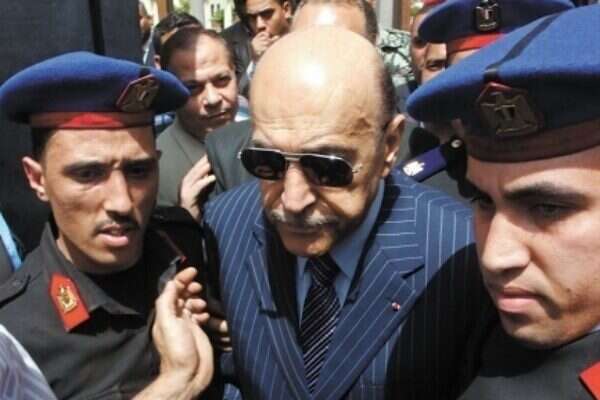
Omar Suleiman, deposed Egyptian President Hosni Mubarak's longtime deputy and intelligence chief, has changed his mind: he announced Friday that he would be vying for the presidency of Egypt, despite declining to run early on. Suleiman's candidacy is contingent on his ability to collect 30,000 signatures - every candidate for the Egyptian presidency must have the backing of 30 lawmakers or 30,000 signatures by Sunday evening in order to run. Egyptian analysts surmised Saturday that Suleiman's surprising announcement came as a result of an agreement with Mubarak's last prime minister Ahmed Shafiq to drop out, so as to not hurt Suleiman's chances, in a combined effort to block the Muslim Brotherhood from gaining control over the presidency after dominating the parliament. Shafiq welcomed Suleiman's candidacy in a statement, saying it "represents an expression of the richness of the current civilian trend that desires to protect the state's Egyptian identity." Suleiman's announcement shook up Egyptian politics and elevated passions one day before the deadline on Sunday for candidates to nominate themselves in the country's first free presidential vote, scheduled to take place in two rounds in May and June. To many of those who led the uprising last year, which resulted in Mubarak's ouster after a 30-year reign, Suleiman's reappearance is proof that a powerful security establishment is determined to reverse a transition to democratic rule before the army hands power to a civilian president. In a statement circulated by his campaign aides, Suleiman said public demand had persuaded him to run if he could obtain the necessary registration of 30,000 supporters. In the statement, addressed to "citizens of Egypt," he said that "I have been shaken by your strong position. The call you have directed is an order and I am a soldier who has never disobeyed an order." In other election news, Egypt's electoral commission said Saturday it had received verification that the mother of leading Salafi presidential candidate Hazem Abu Ismail had U.S. citizenship, a status that would likely disqualify him from the race. Abu Ismail had emerged as one of the frontrunners. The commission said it had received a letter from the Foreign Ministry informing it that Nawal Abdel-Aziz, mother of Hazem Abu Ismail, obtained American nationality on Oct. 25, 2006, the commission's Hatem Begato said. The commission would give a verdict on Abu Ismail's eligibility after the Sunday deadline for all presidential candidates to submit their applications to run, he said. In an official statement, Abu Ismail's campaign denied that the candidate's mother had any citizenship other than Egyptian, accusing the United States of having presented forged documents to the Egyptian government. He would appeal any decision to bar him from running, it said. Meanwhile Saturday, Egypt's most powerful political group, the Muslim Brotherhood, announced it was nominating the head of its party as a back-up candidate for president in the face of attempts to disqualify their primary nominee. The decision to put forth a second candidate was spurred by fears that the ruling military council may use Egypt's election committee to disqualify Islamist presidential hopefuls in order to make room for former regime officials to win. The upcoming election is crucial for both the military and the Brotherhood, which are already sparring for power. The military wants to keep control of key security and economic portfolios until at least June, when a new president is announced, while the Brotherhood is pushing to name a new government first. In a statement released late Saturday, the Brotherhood said they were putting forth party leader Mohammed Morsi as an alternate to Khairat el-Shater, the group's chief strategist and financier. The Brotherhood, which emerged from last year's uprising as the most powerful party in Egypt when it won nearly half the seats in parliament, said in its statement that there appear to be efforts by Egypt's election committee to disqualify certain candidates from the race. "There are attempts to create barriers for some candidates," the Brotherhood said, adding that there are those who want the former regime to return to power. "Because we are protecting the success of the revolution and all of its goals ... we have decided as the Brotherhood and its party to nominate Mohammed Morsi as our backup candidate for president," the statement said. El-Shater was released from prison last month after serving five years on charges relating to his membership in the then-outlawed Brotherhood under Mubarak. Egypt's last four presidents have hailed from within the top ranks of the military. An Islamist candidate would erode decades of military control and place its ruling generals under civilian oversight. The Brotherhood said el-Shater faces no legal obstacles to running for president and that this issue was vetted clearly before announcing his candidacy.
Egypt's ex-spy chief surprisingly announces presidency bid
Omar Suleiman must get signatures from 30,000 supporters by Sunday evening in order to qualify for presidency race • Move seen as effort to block Muslim Brotherhood from gaining control over executive branch, after dominating the parliament.
Load more...