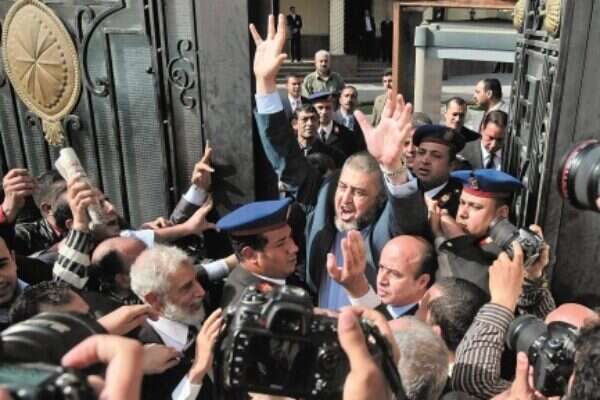
The recently announced Muslim Brotherhood candidate for Egypt's presidency, Khairat el-Shater, reiterated on Thursday his view that Islamic religious law should be the basis of Egypt's new constitution. At a Cairo gathering of senior religious leaders this week, Shater said that "the plan to implement Shariah in Egypt is a goal of the utmost importance." The freshly minted candidate also said that if he is elected president, he will work to carry out a comprehensive reform of the Interior Ministry, which is responsible for the police and internal intelligence service. During ousted president Hosni Mubarak's rule, the Interior Ministry was the country's most despised government body. Shater denied that the Muslim Brotherhood's decision to put forward a candidate for president came in the wake of a deal hatched between the movement's leadership and the Supreme Military Council that currently rules Egypt. In the meantime, the Muslim Brotherhood is already preparing for the day after, working to strengthen ties with the United States. White House officials met in Washington on Tuesday with representatives from the movement, another sign of thawing relations between the U.S. administration and the brotherhood, following years of chilled relations and tensions. White House spokesman Jay Carney said on Thursday night that representatives of the movement met with "mid-level" officials of the U.S. National Security Agency. "We have broadened our engagement to include new and emerging political parties and actors," said Carney, "It is a fact that Egypt's political landscape has changed and the actors have become more diverse, and our engagement reflects that. The point is that we will judge Egypts political actors by how they act, not by their religious affiliation." Fending off criticism, Carney explained that Republican politicians too, including Senators John McCain and Lindsey Graham had also met with representatives of the Muslim Brotherhood when they visited Egypt. Administration officials were surprisingly optimistic in their response to the brotherhood's decision to run a candidate for Egypt's leadership. In a conversation with The New York Times, senior administration officials explained that this is in fact a positive step because it will present a challenge to the other radical Islamist candidate who is running for president. Last week Shater even met with a delegation of U.S. members of Congress visiting Cairo. He described to them the Muslim Brotherhood's commitment to preserving rule of law, democracy and human rights. Meanwhile, Omar Suleiman, former deputy to Mubarak, officially announced that he will not run for president due to "bureaucratic difficulties."
White House downplays Muslim Brotherhood meeting with officials
Muslim Brotherhood representatives meet "mid-level" officials in Washington, signaling further thaw in relations • Movement's presidential candidate Khairat el-Shater views instituting Islamic law as a top priority.
Load more...