A fragile truce appeared to be slowly taking hold as fighting between the Israel Defense Forces and terrorists in the Gaza Strip entered its fifth day early Tuesday morning. An agreement ending the current operations between the two sides, including a halt to assassinations, entered into force at 1 a.m., an Egyptian intelligence official told the French news agency AFP on condition of anonymity. The official said the deal was reached after intensive contacts with both sides in a bid to stop the military operations against the Gaza Strip and to end Palestinian bloodletting. Israel has not announced a formal recognition of a truce or cease-fire, with officials saying only that "quiet will be answered with quiet." While the number of rockets fired at Israel's south had dropped dramatically Tuesday morning when compared with the previous four days of fighting, at least 11 rockets were fired from Gaza overnight Monday. A Kassam rocket and six mortars were fired at the Eshkol region on Tuesday morning, causing no injuries or damage. Homefront Defense Minister Matan Vilnai told Israel Radio early Tuesday morning that the latest round of fighting "seemed to be behind us." Despite Vilnai's statement, schools across the southern region up to 40 kilometers (24.8 miles) from the Gaza Strip remained closed on Tuesday pending a new situation assessment. Israel Air Force warplanes struck at least three terrorist targets in Gaza overnight Monday, including at least one rocket-launching crew, weapons smuggling tunnels and weapons factories. IDF Chief of General Staff Lt. Gen. Benny Gantz on Tuesday told reporters that the IDF had assassinated Popular Resistance Committees leader Zuhair al-Kaisi last Friday to thwart a terrorist attack in the southern region that could have had strategic implications, and that the alert over the attack still existed. Al-Kaisi masterminded a terror attack last August which originated in the Sinai with attackers crossing into Israel near Eilat, killing eight Israelis and fleeing back into Egyptian territory, with IDF forces in hot pursuit. The ensuing clash led to the deaths of several Egyptian security officers, an event that sent Israel-Egypt relations to their lowest point in decades. It is possible that Gantz was referring to a similar scenario further harming ties between Jerusalem and Cairo. During a visit to the IDFs Gaza Division in the south, Defense Minister Ehud Barak said that the decision to eliminate Kaisi was correct. Right now the results are good, and we are preparing for the next time well need to take action, he said. Speaking at the IDF's induction base at Tel Hashomer in the central region, Gantz said that during the latest confrontation with Gaza terror groups, Israel used not even a thousandth of its power, but also warned that Israel's enemies were becoming stronger and increasing their rocket power. The Israeli home front would be at the center of any renewed conflict, Gantz said, and praised the resilience of the residents of southern Israel. He added that Israel was monitoring events in Gaza, that "it's not over until it's over," and that quiet from Gaza would be met with quiet on Israels part. Fire, however, will be met with fire, he said. Gantz also expressed satisfaction with the "very good" results of the fighting in recent days. The IDF struck several terrorists but very few civilians, he noted. Since the fighting started on Friday night, an unprecedented 200 rockets have been fired at Israel from the Gaza Strip. The IAF struck 37 targets in Gaza, including 19 rocket-launching crews, the IDF Spokespersons Unit said Tuesday. Palestinian medics in Gaza put the total death toll there late on Monday at 25, with more than 80 injured, AFP reported. Of those killed, 19 were members of armed terrorist groups -- 14 from Islamic Jihad, and five from the Popular Resistance Committees. According to AFP, six of those killed were civilians, among them two minors. According to the IDF, the Iron Dome anti-rocket interceptor system shot down 52 rockets that were poised to hit populated urban centers in Israel's south. According to a senior Egyptian official, a taskforce headed by the Director of the Egyptian General Intelligence Directorate, Maj. Gen. Murad Muwafi, has been actively engaging both sides in an effort to bring an end to the most recent round of hostilities that has claimed casualties on both sides since Friday. The Egyptians were hammering out the deal with Hamas, which had not taken part in the latest fighting, but had not stopped the Popular Resistance Committees and Islamic Jihad from firing at Israel. Hamas controls the Gaza Strip, and Israel holds the terrorist group responsible for all activities emanating from the territory under its control. As of late Monday night, the tentative contours of the emerging cease-fire appeared to emerge. They include an Israeli cessation of targeted assassinations in return for Palestinians ending rocket fire from the Gaza Strip. Israeli officials refused to comment on reports that a deal had been struck, but communicated: Quiet will be reciprocated with quiet. If rocket fire does not stop, things will escalation. Reuters reported on Tuesday morning that as part of the cease-fire deal, Israel had agreed to stop assassinations, an unusual undertaking for Israel. There has been no confirmation of that report from Israeli sources. Homefront Defense minister Matan Vilnai, speaking on Army Radio on Tuesday morning, denied that Israel had agreed to stop targeting terrorists for assassinations. It was unclear on Tuesday if a formal announcement of a cease-fire would be made, or if the IDF, Palestinian Islamic Jihad and the Popular Resistance Committees would gradually taper off their fire. According to Reuters, Strategic Affairs Minister Moshe Ya'alon said that Hamas had approached Egyptian intelligence and asked to pass a message to Israel regarding the renewal of calm. "We do not carry out negotiations with Hamas," Ya'alon said. "Our response through the Egyptians was very simple. This is basically our policy since the beginning of the current administration: If you are quiet, we will be quiet, if you shoot, or plot attacks, we will hit you, and so the ball is certainly in their court." These comments echoed Prime Minister Benjamin Netanyahus comments from Monday. The IDF is ready to expand activity and will continue to pursue it as needed, he said. The winning formula combines overwhelming offensive measures -- the ability of the IDF to attack the terrorists wherever they are -- and the defensive measures and the citizens stamina in the southern communities. Netanyahu also issued a stern warning: We will hit anyone who seeks to harm our citizens. A senior military official said Monday that Islamic Jihad sustained the most casualties over the nearly five days of fighting -- both as a result of the assassination of many of its top mid-level operatives and because of the damage inflicted on its rocket-launching apparatus -- but there might not be an organization that could wield enough pressure on it with enough intensity to halt its rocket fire in practice. A diplomatic official in Jerusalem blamed Iran for the recent developments, claiming that it has been pressuring the Islamic Jihad to continue fighting and increase the range and intensity of its rocket fire. The terrorist offensive has been carried out by Iranian-backed and Iranian-funded elements; the attacks underscore the severity of the threat that might materialize if these were to be backed by a nuclear Iran. The world must close ranks on the Iranian threat," the official told Israel Hayom. Foreign Minister Avigdor Lieberman echoed these comments Monday, saying, Iran serves as the oxygen supply of these terrorist groups and without its military and financial backing their continued existence would be jeopardized. Hamas has so far stayed out of active combat in this latest round of hostilities, but on Monday a senior IDF officer in the Southern Command did not rule out the possibility that pressure from lower level operatives might eventually drag them into the fighting as well. Hamas has been embarrassed, the official said. The Islamic Jihad has assumed the role of the protector of the Palestinian people; for now it is unclear how far this narrative will continue. Israeli officials expressed concern that the fighting might continue, but said they were encouraged by overall gains of the fighting so far -- no Israeli fatalities compared with 28 Palestinians killed, most of them terrorist operatives. Israeli officials lauded the performance of the Iron Dome anti-rocket system, which intercepted 85 per cent of rockets it engaged near residential areas, despite the growing intensity of the medium-range rocket fire that has come to dominate the latest round of hostilities. Senior IDF officials said Monday that while it was unclear if the Gaza-based terrorist groups planned to use the longer-range rockets they possessed, rockets had already hit the Gedera region, encroaching on Israels central region. Israeli police officials said Monday that the rocket that hit Gedera reached a longer-than-usual range as part of a test to add more residents to the targets of bloody attacks. Residents of Ashdod had to endure another violent day Monday, after the Iron Dome failed to intercept a Grad rocket which hit a main public center in the city. Twelve people were wounded by glass shrapnel from car windshields and windows, another man suffered a heart attack as he was trying to run for cover, and other people were shock victims. This is clearly a miracle, United Hatzalah medic Moshe Weizman said Monday. Several vehicles and windows from nearby buildings were shattered; luckily, there were no lives lost. Ofira, a resident of the Ashdod neighborhood where the rocket struck, voiced her disappointment with the response of the local authorities. What we have is a state of complete helplessness, she said. People ran all over looking for somewhere to hide. Some people screamed and lay on the ground. We saw the missile fall in front of us between the buildings, like in a bad war movie; people were in hysterics.
X
שיתוף כתבה
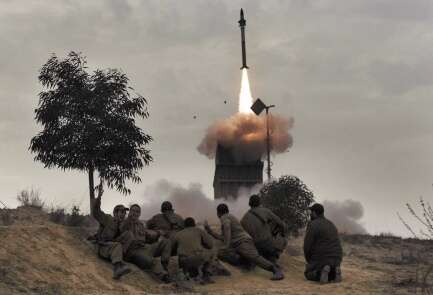
As fragile truce takes hold, Gantz warns of bigger enemies
Egypt confirms ceasefire from 1 a.m. Tuesday, saying Israel vows to end targeted assassinations • Jerusalem says quiet will be met with quiet, fire with fire • Despite truce, 11 rockets fired at south on Tuesday • Some 200 rockets fired since Friday.