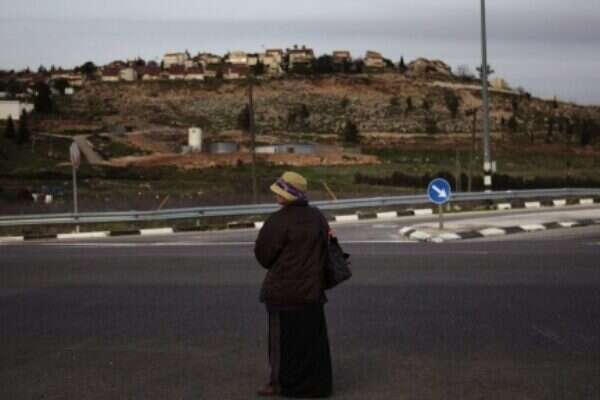
The government gave preliminary approval on Wednesday to a plan to build 600 new homes in the Judea and Samaria settlement of Shiloh, a move that drew rebukes from the U.N. and Palestinians and threatened to raise tensions with the U.S. as Prime Minister Benjamin Netanyahu prepares to head to the White House. Israeli officials tried to play down Wednesdays decision, saying construction was years away at best. But the timing of the move may further hinder already troubled Middle East peace efforts. It casts a shadow over a trip by Netanyahu to Washington in March, in which he is expected to discuss Irans nuclear program and other regional issues. The U.N.s Middle East envoy, Robert Serry, called the Israeli announcement deplorable and said it moves us further away from the goal of a two-state solution. Speaking to reporters, State Department spokesman Mark Toner declined to comment about the announcement, but said the U.S. policy on settlement activity is clear. We dont believe its in any way constructive to getting both sides back to the negotiating table. And we want to see clearly a comprehensive settlement that delineates borders and resolves many of these issues. Israeli-Palestinian peace talks have been stalled for the past three years over the issue of Jewish settlements. The Palestinians, who claim the West Bank and east Jerusalem for a future state, say there is no point negotiating while Israel continues to expand its settlements. Israel, which captured the areas in the 1967 Six-Day war, says negotiations should begin without preconditions. The international community opposes all settlements. A low-level dialogue launched last month in Jordan failed to make any breakthroughs. On Tuesday, Jordan blamed Israel for the impasse, citing Israels unilateral policies. Defense officials played down Wednesdays decision, saying it was made by a low-level planning committee under the control of the Defense Ministry. One official said the project was in the embryonic phase and would require multiple stages of authorizations, including approval by top leaders, that would take years to complete. The officials spoke on condition of anonymity under ministry guidelines. But Yariv Oppenheimer, director of Peace Now, a dovish group that opposes settlement construction, called it the biggest settlement construction plan in the West Bank since Netanyahu took office three years ago. Construction is to take place in Shiloh, a settlement nestled in the heart of Judea and Samaria. Peace Now claimed that Wednesdays approval also included retroactive legalization of about 100 homes built without permits. Defense officials could not confirm the claim. The government is giving a prize to building offenders and continuing the system by which every time the settlers build without permits, the government approves the construction and allows them even more construction, Peace Now said. Palestinian spokesman Ghassan Khatib said Wednesdays approval shows how Israel has no respect for the international community or international laws, while at the same time sheds a light on the ... lack of effective actions by international community toward Israeli settlement policy. Netanyahus office did not return requests for comment. Also Wednesday, Israeli officials said they would invest $130 million over five years to improve roads in Jerusalems Arab neighborhoods. Since Israel captured east Jerusalem in 1967, its Arab neighborhoods have not enjoyed the same level of funding the western Jewish sector has received. Jerusalem Mayor Nir Barkat said the five-year project will improve main thoroughfares, pave new roads and add safety features like traffic dividers. Daniel Seidemann, an activist who has criticized Israeli policies in east Jerusalem, said the road works could help end decades of inequality. But he said past funding pledges havent materialized, and said the plan could also be aimed at cementing Israels control of east Jerusalem. Israel claims all Jerusalem as its eternal capital, but the Palestinians hope to make east Jerusalem the capital of a future state. We are treating Arab neighborhoods as inextricable parts of this city because they are administratively and geographically inseparable, the mayors spokesman, Barak Cohen, wrote in an email. About one-third of Jerusalems 800,000 people are Palestinians. Although they hold residency cards, most do not vote in municipal elections in order to protest Israels control. This gives them little representation in the halls of power despite their frustrations with urban policy. In a new reflection of their disgruntlement, a top Muslim official condemned the citys plans to hold a marathon next month. Now in its second year, the marathon will draw hundreds of Israeli and foreign athletes who will follow a path through Jerusalems Old City in east Jerusalem. Palestinian mufti Sheik Mohammed Hussein accused Jerusalem of using sports to change the demographic reality on the ground. They are using pictures of the al-Aqsa mosque, and pictures of the Old City, including pictures of shrines of Muslims and Christians, as propaganda for this marathon, Hussein said. This gives an indication to the world outside this territory that these areas are part of Israel, while international law says all these areas and places are under occupation. Spokesman Cohen said this route is an attempt to showcase the diversity of Jerusalem and its centrality for people of all faiths. In another development Wednesday, Israels Supreme Court temporarily lifted a travel ban on a Palestinian human rights activist so he could travel to Geneva to meet with a U.N. official. Israel has prevented Shawan Jabarin, director of the Al-Haq human rights organization, from leaving the West Bank for the past six years and has kept the reason for the travel ban classified, the activist said in a statement on his organizations website. The travel ban would still remain in effect upon his return, according to a statement from the court.
US reiterates settlement building 'not conducive to peace'
After Israel gives initial approval for nearly 600 housing units in Shiloh, Washington repeats policy on settlement activity • U.N. Middle East envoy Robert Serry calls new housing plan deplorable."
Load more...