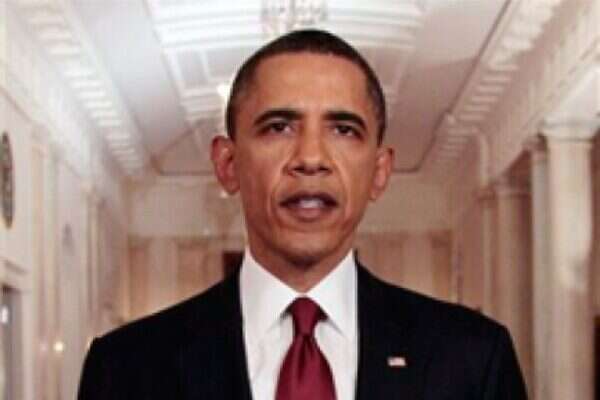
After months of postponing measures against Irans central bank, U.S. President Barack Obama signed an executive order on Monday freezing all Iranian assets in the U.S., including those of the central bank. In a letter to Congress, Obama wrote, I have come to the conclusion that the additional sanctions are warranted, particularly in light of the deceptive practices of the central bank of Iran and other Iranian banks, citing hidden transactions and other loopholes that are exploited. Commenting on the new sanctions, a U.S. Treasury official said, Iran will face increasing economic and diplomatic pressure until it addresses the well-grounded concerns of the international community relating to its nuclear program. The new, stricter sanctions, authorized in legislation that Obama signed in December, will be enforced under an order he signed only now. They give U.S. banks new powers to freeze assets linked to the Iranian government and close loopholes that officials say Iran has used to move money despite earlier restrictions imposed by the U.S. and Europe. The new U.S. penalties were unexpected now. The sanctions were included as an amendment in the wide-ranging defense bill the president signed in late December, though when and how they were to be levied on Iran was unclear. The White House had previously said it would take months to evaluate the likely effect on the fragile global economy before taking the next large steps, including new penalties on the central bank. Now, U.S. institutions are required to seize Iranian state assets they come across, rather than rejecting the transaction involved. The value of Iranian assets affected by the new order was not clear. Iran does almost no direct business with the U.S. after three decades of enmity, but its money moves through the world financial system and its oil is sold in dollars. The action against the central bank of Iran is more significant for its timing than its immediate effect. It comes as the U.S. and its allies are arguing that tough sanctions can still persuade Iran to back off what the West contends is a drive to build a nuclear bomb. The U.S. and Europe want to deprive Iran of the oil income it needs to run its government and pay for the nuclear program. But many experts believe Iran will be able to find other buyers outside Europe. The EU announced last month it would ban the import of Iranian crude oil starting in July. The U.S. does not buy Iranian oil, but last month it placed sanctions on Irans banks to make it harder for the nation to sell crude. The U.S., however, has delayed implementing those sanctions for at least six months because it is worried about driving oil prices higher at a time when the world economy is struggling. Iran produces about 5 percent of the worlds crude oil. In an interview Sunday with NBC, Obama said the U.S. has a very good estimate of when Iran could produce a nuclear weapon, and he spoke favorably of the effect sanctions and diplomacy could have to resolve the impasse between Tehran and the West. He said that although the U.S. is not aware of everything taking place in Iran, the Iranians themselves are a divided people and it is difficult to determine which of its leaders is making the decisions. Obama reiterated his belief that diplomatic pressure could help avert a confrontation with Iran, but said the U.S. has prepared itself for different scenarios and has the capability to carry them out if and when it becomes necessary. Israel, meanwhile, has been increasingly open about its concern that Iran could be on the brink of a bomb by this summer and that this spring offers the last window to destroy the countrys nuclear facilities, some of which are underground. Many Israeli officials believe that sanctions only give time for Iran to move more of its nuclear program underground, out of reach of military strikes. Israeli officials reacted to the new U.S. measure coldly with one senior government official saying, Obama is not using a doomsday weapon against Iran and is not imposing crippling sanctions. He is not adopting the Senates decisions - which were approved by a vote of 100 to 0 - against Irans central bank and against Irans import and export of oil. The official added that although the move was a step in the right direction, only the results will determine the moves effectiveness. We have to remember that sanctions have been imposed on Iran for years, but they are not enough and are not preventing Supreme Leader Ayatollah Ali Khameneis regime from moving forward with its nuclear program, the official said. According to IAEA officials, Iran has increased its uranium enrichment activity at the underground Fordo facility, which is shielded from aerial surveillance and protected against airstrikes. An additional 350 centrifuges were reportedly added to those already installed at the site. Meanwhile, an Iranian newspaper claimed on Monday that the Jan. 11 assassination of Mostafa Ahmadi-Roshan - a senior official at the Natanz uranium enrichment facility - was the work of a bomb manufactured in the U.S. According to the report, the bomb, which was attached to Roshans vehicle by an assailant on a motorcycle, was given to an Iranian-based Kurdish organization fighting for independence. The report claims that another similar bomb was found by security forces close to the spot where the assassination took place.
Noose tightens on Iran as Obama freezes Iranian assets in US
U.S. president signs executive order freezing Iranian assets in U.S., including those of Irans central bank • Israeli officials say move is positive, but will not paralyze Iran • Reports in Iran accuse U.S. of assassinating Iranian scientist.
Load more...