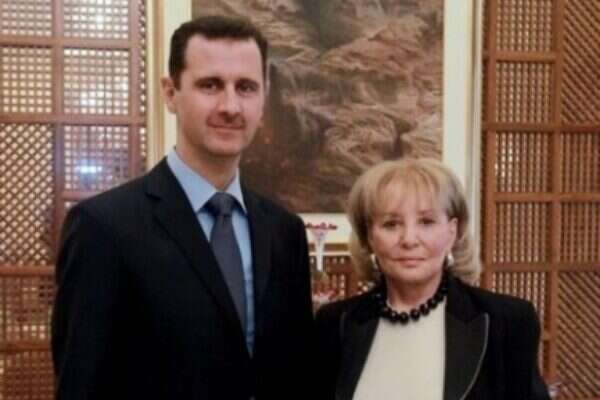
In what has proved a revealing glimpse into the inner workings of Syrian President Bashar Al-Assads regime, hackers leaked Syrian government emails and passwords over the Internet on Monday. One of the more interesting documents available online details a list of talking points intended for Assads use during his interview held with Barbara Walters in Damascus, which first aired on the ABC network on December 7th. The interview was the first to be conducted by Assad with an American journalist since the uprising began in Syria in March 2011. One of the documents leaked allegedly came from an email account belonging to one of Assads political advisers, and included talking points intended for the Syrian president to employ during his interview with Walters. In the email the adviser claims to have conducted major research on the American medias coverage on the Syrian issue and the American societys perspective of what is happening on the Syrian ground, providing detailed talking points he said would prove helpful for the preparation of the upcoming interview with Barbara Walters. The adviser writes that he based his research on personal talks with American journalists, Syrian expatriates living in the U.S. and online news articles written about Syria. The adviser outlined some of the major points and dimensions mentioned in the American media, which depict the violence and bloodshed underway in Syria, as well as mistakes and alleged torture practices by Assads regime. The adviser writes that the American media understands the bloodshed as done by the government to attack innocent civilians and peaceful demonstrators, and suggests Assad instead use the phrase armed gangs to explain the violence. Mentioning armed groups in the interview is extremely important and we can use American and British articles to prove that there are armed gangs, writes the adviser. The email further stresses the importance of Assads discussing mistakes in the interview as it is hugely important and worth mentioning that mistakes were made at the beginning of the crisis and because we did not have a well-organized police force. The American psyche can easily be manipulated when they hear that mistakes were made and now we are fixing it. The adviser also writes that it is worth mentioning what is happening now on Wall street and the way the demonstrations are been suppressed by police men, police dogs, and beatings. Turning to the issue of torture, the adviser suggests that Assad claim that Syria doesnt have a policy of torturing people, as opposed to the U.S., which has schools specializing in the teaching of torture techniques to police forces for use against criminals and outlaws. For instance the electric chair and killing through injection ... We can use Abu Ghraib as an example, writes the adviser. The email also suggests Assad refrain from discussing Syrian governmental reforms in depth as the American audience doesnt really care about reforms. They wont understand them and they are not interested in doing so. Thus, a brief mention of the reforms undertaken in the past couple of months is more than enough. Assad is also urged to mention President Barack Obamas declining popularity. When Obama asked H.E. [Assad] to step down he himself has had a 70 percent drop in his popularity in the U.S. The adviser added that Assad should mention how his own popularity has both risen and declined in the media over the last decade, claiming that Americans love these kind of things and get persuaded by them. Regarding the media, the adviser says that Assad should cite the significance of social networking sites like Facebook and YouTube remaining open during these turbulent times. Assad is also urged to state that there is no Syrian opposition leader who is ready with a new agenda for the country as all such leaders are from the previous generation and that opposition leaders have refused to meet with officials from the current regime in Syria. In the interview, which aired in December, the Syrian president asserted that he did not give any commands to kill or be brutal and denied he ordered deadly crackdowns on those who oppose him. Theyre not my forces, Assad responded when asked if Syrian troops had cracked down too hard on protesters. They are military forces (who) belong to the government. I dont own them. Im president. I dont own the country. He said some Syrian troops may have behaved badly, but that they faced punishment. The U.N. estimates that more than 5,000 people have been killed in Syria since the uprising began, many of them civilians and unarmed protesters demanding Assads ouster. Who said the United Nations is a credible institution- Assad said, when Walters asked him about allegations of widespread violence and torture. We dont kill our people, said Assad, no government in the world (kills) its people unless it is led by a crazy person. Since the uprising began nearly nine months ago, Assad and his closest advisers have sealed off the country to outsiders while clinging to the allegation that foreign extremists are behind the uprising, not true reform-seekers aiming to open the authoritarian political system. The relentless bloodshed has pushed many once-peaceful protesters to take up arms. Army dissidents who sided with the protests have also grown bolder, fighting back against regime forces and even attacking military bases and raising fears of a civil war. Still, Assad insisted he still had the support of the Syrians, and said he was not afraid of meeting the fate of other leaders deposed during the Arab Spring. If you dont have the support of the people you cannot be in this position, said Assad, Syria is not easy ... it is a very difficult country to govern if you dont have the public support. Assad laughed slightly when asked if he felt guilty about the bloodshed. I did my best to protect the people, he said. You cannot feel guilty when you do your best ... you do not feel guilty when you dont kill people. You feel sorry for the lives that have been lost but you dont feel guilty.
Syrian government memos leaked online
Hackers leak Syrian government emails and passwords over the internet • Documents include list of talking points intended for use by Syrian President Bashar al-Assad during his recent interview with Barbara Walters on ABC.
Load more...